
1″ 3-Way Brass Ball Valve – L-Port Diverter, Low Pressure Drop
1 inch 3-way brass ball valve with L-port for diverter & mixing applications. Full port design minimizes pressure drop. Ideal for water/oil/gas flow switching.
Description
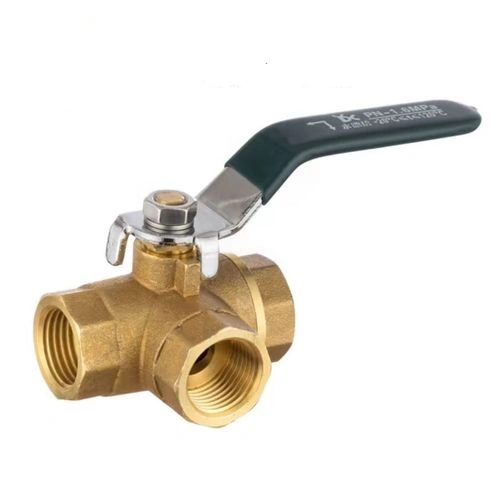
A multi‑functional ball valve equipped with three port connections. It shifts media flow direction, enables diversion or convergence by rotating its internal ball at 90°. Two mainstream bore configurations are available: L‑port and T‑port. The L‑port variant switches one incoming stream to one of two outlet paths, or selects one of two inlets toward a shared outlet for directional change. The T‑port design delivers split flow by feeding one inlet into two outlets simultaneously, or merges two incoming streams into a single discharge port.
This valve fits multiple multi‑directional fluid‑control scenarios: HVAC chilled‑hot water switching, oil‑field water‑injection wellhead diversion, forward‑wash / backwash cycle switching for water‑treatment membrane skids, chemical batching processes and solar thermal collector loops. It serves as an integrated high‑efficiency alternative to conventional assemblies made up of two separate ball valves plus a tee fitting.
Material & Specification
| Item | Parameter |
|---|---|
| Body Material | Forged brass (CW617N / ASTM B124) |
| Ball Material | Chrome‑plated brass / 304 stainless steel |
| Seat Material | PTFE |
| Seal Material | PTFE + NBR / Optional FKM |
| Nominal Size | DN25 (1″) |
| End Connection | NPT / BSP female thread on all three ports |
| Bore Pattern | L‑port (directional / selection) or T‑port (diversion / convergence) |
| Pressure Rating | 600 WOG (Water, Oil, Gas) |
| Temperature Range | -20°C ~ +120°C (PTFE seat) |
| Operation | Lever‑operated 1/4‑turn (90°) flow switching |
| Operating Angle | 0°, 90°, 180° (subject to bore geometry) |
| Port Type | Full Port |
| Stem Design | Blow‑out Proof |
| Design & Test Standards | MSS SP‑110 / ASME B16.34 / API 598 |
Application Scenarios
- HVAC seasonal switchover for chilled and hot water: one single valve completes cold‑heat source diversion for supply‑return branches.
- Oil‑field water‑injection wellhead diversion: rapid transition between regular water injection and well‑bore washing workflows.
- Forward‑wash / backwash switching for ultrafiltration and reverse‑osmosis membrane modules: toggle between normal running and membrane regeneration cycles.
- Filter bypass loop: isolate or engage filter circuits to allow cartridge replacement without system shutdown.
- Solar collector array control: reconfigure collector strings between series and parallel modes or toggle different thermal loops.
- Chemical batching and process control: route different feed streams and select sampling paths.
- Heat‑recovery systems: redirect fluid flow across diverse cold and heat sources.
Core Benefits: 3‑Way Function & Low Pressure Drop
For multi‑port fluid handling systems, both convenient flow transition and stable pressure performance are equally critical. This valve is engineered around two core merits: integrated 3‑Way Function and Low Pressure Drop.
- Integrated 3‑way construction: single‑unit multi‑path switching Traditional diversion setups assemble two discrete ball valves together with a tee fitting. Operators open and close individual valves to reroute flow. Such composite layouts bring notable drawbacks. They occupy substantial installation footprint; combined length often exceeds 300 mm, creating layout challenges inside compact pipe shafts or equipment panels. Multiple threaded joints generate up to six potential leak points. Operators also have to memorize complex open‑close sequences, raising human error risk amid dense valve clusters.
The 1 inch 3 way brass ball valve consolidates all required functionality within one compact body. Its overall length stays below 150 mm. Potential leak joints drop from six down to three, cutting leakage risk by over 50 %. Site personnel only turn the lever to target positions for flow reconfiguration; no complicated valve‑operation logic needs memorizing, substantially mitigating mis‑operation hazards.
- Full‑port bore: minimal pressure fluctuation during transition Low‑pressure‑drop performance distinguishes this 3‑way ball valve from 3‑way plug valves or globe valves. Adopting a Full Port internal flow channel, the ball bore matches the inner diameter of connected piping. No flow‑area reduction or turbulent zones arise whenever the valve locks into a working position.
Field‑oriented gains from this design include:
- Stabilized pressure during mode transition: pressure spikes or sharp drops are avoided upon switching, preventing equipment vibration, seal damage or insufficient flow rates.
- Improved system energy efficiency: its near‑zero flow‑resistance K‑factor imposes barely any extra load on pumps or compressors, yielding long‑term power savings.
- Broader media compatibility: the unobstructed full‑size bore resists clogging, making it suitable for high‑viscosity fluids and streams carrying minor suspended solids.
Application Case: Ovintiv Inc. — Wellhead Diverter Retrofit for Permian Basin Water‑Injection Manifold
Project Name: Permian Basin Water Injection Manifold – Wellhead Diverter Valve Retrofit Location: Permian Basin, Texas, USA
Ovintiv Inc. is a major North‑American oil‑gas producer running large‑scale shale‑oil extraction and water‑flood development across the Permian Basin. Its water‑injection stations deliver pressurized water (20 MPa operating pressure, 100‑200 m³/d flow rate) to a network of 12 surrounding injection wells.
Project Challenge
Each wellhead manifold must toggle between two operational modes:
- Normal injection: feed water from central stations down into subsurface formations.
- Well‑bore wash: shut off injection supply and redirect flow toward well‑cleaning pipelines.
The original configuration relied on two standalone ball valves plus a tee fitting. Constrained wellhead real estate offered less than 2 m² usable working area around each Christmas tree. The bulky composite manifold caused lever interference. Operators needed to manipulate two separate valves under 20 MPa high‑pressure service, which introduced considerable safety risks from human error.
Solution
Starting in 2023, over 60 production wells within this field received standardized upgrades with 1‑inch L‑port 3‑way brass ball valves. Each single valve replaced the prior two‑valve‑plus‑tee assembly. Manifold footprint shrank by roughly 40 %, eliminating lever‑to‑lever interference.
Project Outcomes
- Simplified wellhead piping layout, freeing up adequate room for instrument mounting and field maintenance access around Christmas‑tree assemblies.
- Full‑port low‑pressure‑drop characteristics kept pressure variation below 0.5 MPa during switching events, preventing formation sand production and reservoir damage triggered by abrupt pressure swings.
- Streamlined operation: a simple 1/4‑turn lever action completes transition between injection and washing cycles. Switching time dropped from more than 30 seconds down to under 3 seconds, eliminating mis‑operation risks.
- After 12 months of service, the fleet of more than 60 three‑way ball valves accumulated over 5,000 operational cycles, with zero leakage, zero maintenance interventions and zero safety incidents caused by mis‑operation.
Internal engineering notes from Ovintiv project team commented: “Thanks to its integrated architecture and full‑port bore, the 1‑inch 3‑way brass ball valve solved both our wellhead spatial constraints and pressure‑instability concerns. It represents one of our most successful component selections for this field‑wide retrofit.”