
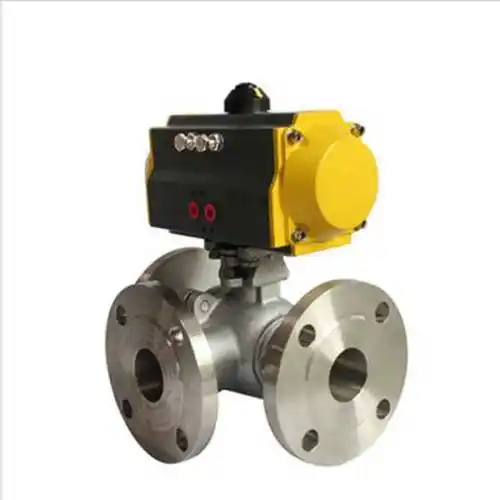
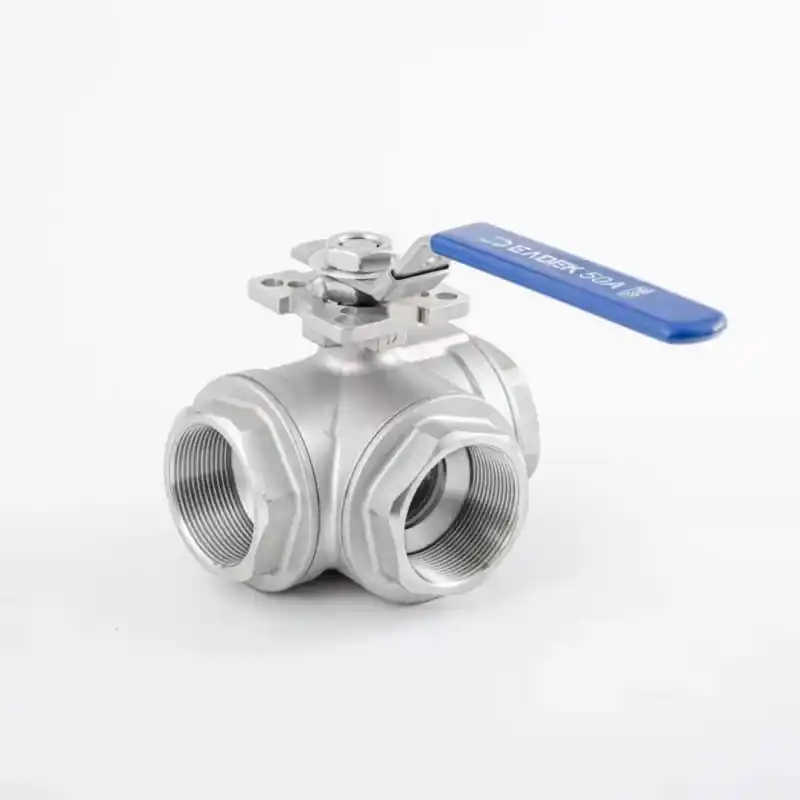
1 Inch Three Way Ball Valve – Full Port for CIP & Flow Switching
1 inch three way ball valve in SS316, L-port and T-port designs for flow diversion and mixing. Full port reduces pressure drop, one-valve design minimizes leak points. Ideal for food processing and HVAC.
Description
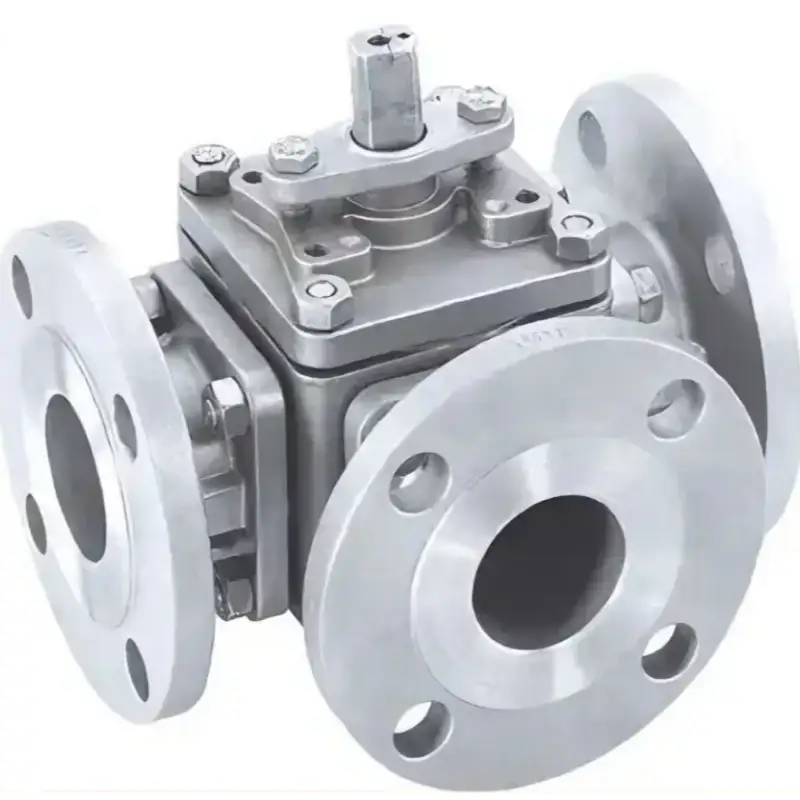
A three way ball valve 1 inch corresponds to a nominal size of 1‑inch (DN25). Ball rotation enables flow diversion, splitting and merging for three‑leg piping circuits. Balancing substantial flow capacity with broad end‑interface compatibility, this 1‑inch size ranks among the most frequently‑specified options for industrial process lines.
Its key advantage over conventional assemblies built from multiple two‑way ball valves plus pipe fittings is that one single valve fulfils flow‑reassignment functions that otherwise demand two two‑way ball valves and three T‑fittings. Potential leak points drop from more than six down to merely 2‑3. Meanwhile, overall piping layouts become far more compact, cutting installation footprint by approximately 50 %.
Material and Construction
The valve body is cast from ASTM A351 CF8M (316L) stainless steel with sound corrosion‑resistance, suited for food‑grade, pharmaceutical, water‑treatment and diverse chemical‑media service. Balls and stems undergo precision machining and mirror polishing. Electropolished internal surfaces with Ra ≤ 0.4 μm are available for food‑grade variants. Reinforced‑PTFE seats deliver bi‑directional bubble‑tight sealing within the full rated‑pressure envelope.
Available in either 2‑piece or 3‑piece body configurations, the product facilitates convenient in‑line servicing. An Anti‑static Device comes as standard to support safe operation with flammable process fluids.
Structural Benefits from Reduced Leak Points
Every additional fitting joint within traditional switching assemblies introduces an extra potential fugitive‑emission source. Set‑ups assembled with multiple two‑way ball valves and T‑connectors commonly contain six or more joints. By integrating three independent flow passages inside one single housing, 1″ three way valve completes flow‑switching tasks with only two pipe connections (inlet plus outlet), cutting leak‑risk locations by over 60 %. For leak‑zero‑tolerance sectors including food‑processing, biopharmaceuticals and data‑centre cooling, this translates into lower maintenance overhead and enhanced system reliability.
Full‑Port Design
The ball bore inner diameter matches pipe inner dimensions (Full Port, Bore Diameter ≥ Pipe ID). Abrupt cross‑section transitions are eliminated, resulting in negligible pressure drop. Within CIP cleaning loops, full‑port geometry preserves cleaning‑fluid velocity and turbulence intensity without valve‑induced attenuation, securing sufficient cleaning coverage. Where required, this unobstructed bore also permits smooth pig transit.
Specifications & End Connections
| Parameter Item | Specification Details |
|---|---|
| Nominal Size | 1 inch (DN25) |
| End Connection | NPT thread / BSP thread / Tri‑Clamp clamp‑end / ANSI 150/300 flange (optional) |
| Pressure Rating | 1000 PSI WOG / 600 PSI Steam |
| Temperature Range | ‑20°C ~ 180°C (PTFE seat) |
| Flow‑Port Variant | L‑Port (flow switching) / T‑Port (mixing or diverting) |
| Body Material | CF8M (316L) stainless steel / Nickel‑plated brass |
| Ball Material | 316L stainless steel / Chrome‑plated brass |
| Seat Material | Reinforced PTFE |
| Operation Type | Manual lever (lock‑hole equipped) / Pneumatic actuator / Electric actuator |
Flow‑Port Selection Guidance
‑ L‑Port: Designed for diverting one incoming fluid stream between two separate outlet branches. Typical applications cover cooling‑water bypass re‑routing and heat‑exchanger supply‑return switching.
‑ T‑Port: Suited for combining two feed streams into one discharge outlet or splitting a single inflow into two separate outputs. Representative use‑cases include sequenced CIP cleaning‑fluid delivery across multiple tanks and blended injection of dual‑component chemical reagents.
Typical Application Sectors
This valve delivers proven field performance across multiple industries:
‑ Food & Beverage: Sequential conveyance of CIP cleaning media and batch‑oriented flow‑path change‑over for product transfer pipelines.
‑ HVAC & Commercial Buildings: Cold‑hot water supply‑return switching for data‑centre cooling units and commercial‑building air‑handling systems.
‑ Pharmaceutical & Bio‑engineering: Material diversion for reactor charging lines, sampling ports and solvent‑recovery piping.
‑ Water Treatment & Irrigation: Permeate or concentrate stream splitting for ultrafiltration / reverse‑osmosis skids, plus zoning control for large‑scale commercial irrigation networks.
Reference Application Case
At the Nestlé S.A. manufacturing facility in Chonburi, Thailand (Case 1), 1″ 3 way ball valve units (T‑Port, 316L stainless steel, Tri‑Clamp connection, full‑port bore, electropolished inner surface Ra ≤ 0.4 μm) were mounted on each branch take‑off along the main CIP supply header.
Previously, each branch adopted a combination of two 1‑inch two‑way ball valves together with T‑fittings to realise cleaning‑fluid diversion. Every switching point contained as many as six fitting joints; within hygienic food‑grade piping, each joint represented a potential microbial‑growth site as well as a leak hazard.
After retrofitting with these 1″ 3 way valves, each single valve replaces the former assembly of “two two‑way ball valves + three T‑fittings plus assorted joints”. Potential leak points per switching node fall from six down to only two (the two Tri‑Clamp connections at valve ends), delivering roughly 65 % reduction in leakage probability.
Meanwhile, the full‑port profile maintains CIP fluid velocity and turbulence without valve‑related impairment, meeting strict hygiene benchmarks for infant‑formula production. Following commissioning, microbial‑test pass rates rose from 97.2 % to 99.8 %, and valve‑servicing frequency dropped from monthly to quarterly. This solution has been adopted as standard hardware for multiple additional milk‑powder production lines across Nestlé Asia sites.
Quality Assurance
The product complies with FDA 21 CFR 177.1550 for food‑grade PTFE seats, with optional API 607 fire‑safe compliance, and is pre‑fitted with an Anti‑static Device. Every valve undergoes 100 % pressure and tightness inspection prior to shipment to guarantee stable long‑term performance under demanding process conditions.