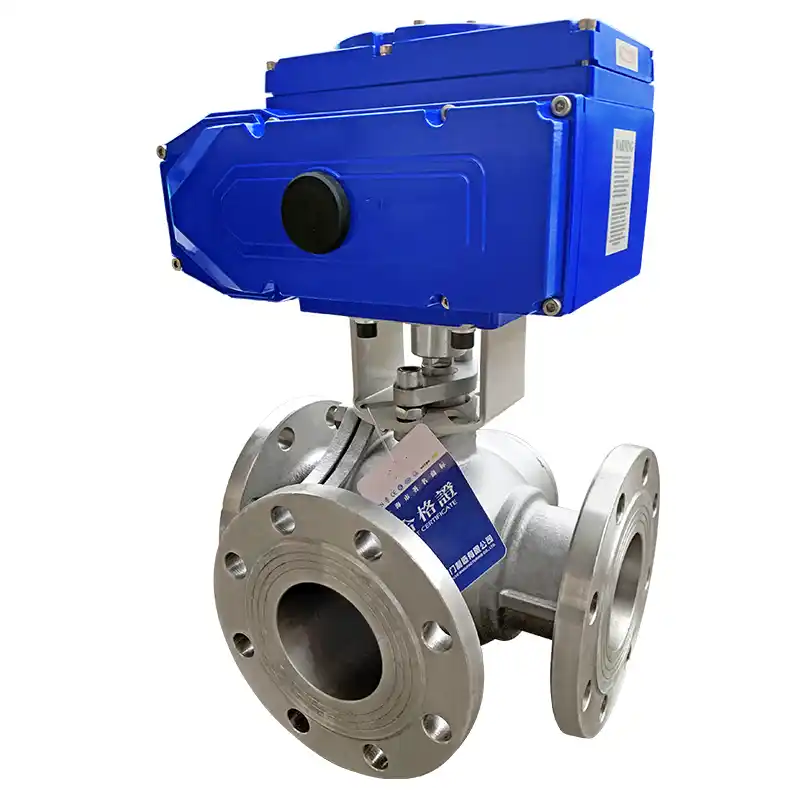

Electric three Piece Ball Valve – With 4-20mA Position Feedback
Electric three piece ball valve with 4-20mA position feedback, on-off/modulating actuator. 24V/220V, IP67, manual override. For water treatment and process automation.
Description
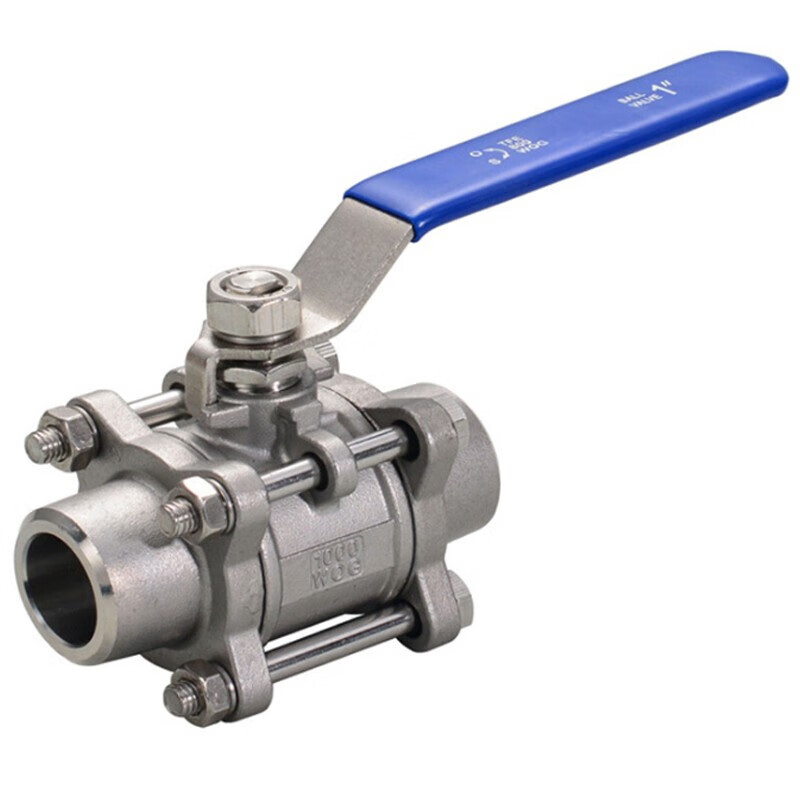
An electric three piece ball valve is an automated shut‑off assembly combining an electric actuator with a three‑piece ball valve body. The valve body consists of three bolt‑secured independent segments: left body, central body and right body. A floating‑supported ball sits inside the valve chamber; the stem connects directly to the actuator output shaft via square or flat drive interfaces. Actuator‑powered 90° stem rotation opens or closes the valve.
This three piece ball valve with electric actuator accepts 4‑20 mA discrete or analogue control signals, alongside digital communication commands (Modbus / PROFIBUS), enabling remote automatic operation and real‑time valve position monitoring. Built‑in position sensors (potentiometers or absolute encoders) within the electric actuator transmit continuous actual valve‑opening feedback via 4‑20 mA back to DCS/PLC/SCADA host systems in control rooms, delivering precise closed‑loop position supervision. For sites lacking compressed‑air supplies or suffering unstable air‑source quality, this electric actuated ball valve serves as a direct alternative to pneumatic actuated valves.
Its three‑piece architecture permits on‑site extraction of the central cartridge for seat and seal replacement, without removing the full valve or dismounting the electric actuator. The actuator fitted onto this motorized 3 piece ball valve is normally equipped with manual override hardware (handwheel or hex‑key port), allowing local manual operation during power outages.
Material and Technical Specifications
| Parameter Item | Specification Range |
|---|---|
| Valve Body Material | CF8 (304 Stainless Steel) / CF8M (316 Stainless Steel) / WCB Carbon Steel |
| Ball Material | 304 / 316 / 316L Stainless Steel |
| Stem Material | 304 / 316 / 17‑4PH Stainless Steel |
| Seat Material | PTFE / RPTFE / PEEK (selected according to process media) |
| Nominal Size | DN15 ~ DN300 (1/2″ ~ 12″) |
| Pressure Class | Class 150 / 300 / 600 |
| End Connection | Flanged (ASME B16.5) / Threaded (NPT/BSPT) / Socket‑weld / Butt‑weld |
| Actuator Type | Electric actuator (on‑off type / modulating type), standard configuration complying with norms from electric three piece ball valve supplier |
| Actuator Supply Voltage | 24V DC / 110V AC / 220V AC 50/60Hz |
| Control Signal | Discrete (open/close command) / 4‑20 mA (modulating) / Modbus / PROFIBUS (optional) |
| Position Feedback Signal | 4‑20 mA (continuous opening feedback) / Dry contact (full‑open / full‑closed status feedback) |
| Position Sensing Component | Potentiometer / Absolute encoder |
| Ingress Protection | IP67 (standard) / IP68 (submersible, optional) |
| Explosion‑Proof Rating | Ex d IIB T6 / Ex d IIC T6 (flame‑proof, optional) |
| Full‑Stroke Time | 15 s / 30 s / 60 s (subject to actuator model) |
| Manual Override | Handwheel (standard) / Hex‑key access port (small sizes) |
| Actuator Housing Material | Painted aluminium alloy / Stainless steel (optional) |
| Ambient Operating Temperature (Actuator) | ‑20 ℃ ~ +60 ℃ |
| Mounting Interface | ISO 5211 direct‑mount platform (F05/F07/F10/F12) |
| Material Certificate | EN 10204 3.1 (available upon request) |
| Applicable Standards | ASME B16.34 / ISO 5211, manufactured in line with industry specifications from electric three piece ball valve manufacturer |
Structural Highlights: Accurate Position Feedback
Precise position‑tracking performance of the electric three‑piece ball valve originates from built‑in position‑sensing hardware and signal output logic within its electric actuator.
‑ Continuous opening feedback signal: Internal sensors (potentiometers or absolute encoders) track shaft rotational angle throughout valve travel, converting angular displacement into a 4‑20 mA analogue output. 4 mA corresponds to 0 % opening (fully closed), and 20 mA represents 100 % opening (fully open). Once fed into DCS/PLC/SCADA platforms, this signal lets operators read exact opening percentage directly from HMI screens for continuous status oversight.
‑ Valve status confirmation and interlock logic: Within automated workflows, after issuing open‑ or close‑valve commands, the control system waits for feedback values to converge on target setpoints before triggering subsequent program steps. Action completion is validated when deviation between commanded position and feedback reading falls within predefined thresholds (typically ±2 %‑±5 %). If feedback fails to reach target values within a preset time window (e.g. 30 seconds), the system raises an alarm and pauses sequence execution.
‑ Superior reliability of absolute encoders: Absolute encoders report real‑time absolute opening values immediately upon power‑on with no homing required. After power loss and restoration, recalibration is unnecessary. This eliminates resistance drift caused by long‑term mechanical wear common to potentiometer‑based setups and reduces field maintenance workload.
‑ Three‑piece design supporting electric valve servicing: Repeated actuation accelerates seat wear for motor‑driven valves. Thanks to three‑piece construction, technicians can pull out the central cartridge to replace seats without detaching the actuator or the whole valve assembly. Since relative alignment between stem and actuator output shaft remains unchanged, limit switches and position feedback circuits require no readjustment after reassembly.
Application Scope
The electric three piece ball valve is widely adopted in the following sectors: ‑ Water treatment & municipal water supply: SCADA‑controlled remote valves for filter‑tank backwashing, chemical dosing circuits and pump station outlets. ‑ Process automation: Remote on‑off and modulating valves integrated with DCS/PLC systems in chemical and pharmaceutical plants. ‑ Automated installations without compressed‑air infrastructure: Laboratories, compact processing units and remote stations with no pneumatic air supply. ‑ Building automation & HVAC: Automatic valves for chilled‑water, cooling‑water and hot‑water loops inside large‑scale buildings. ‑ Hazardous classified zones (flame‑proof variant): Oil, petrochemical and natural‑gas facilities handling flammable media.
Field Reference Case
Electric three piece ball valve units were deployed to replace legacy manual valves during automation retrofitting of filter backwash piping at Nanshan Water Plant, Shenzhen Water (Group) Co., Ltd. (No. 3033 Nanhai Avenue, Nanshan District, Shenzhen, China). Covering 12 filter banks with DN100‑DN200 sizes and Class 150 pressure rating, these CF8 stainless‑steel valves are fitted with on‑off electric actuators featuring 4‑20 mA position feedback. The on‑site SCADA system orchestrates fully‑automated back‑wash cycles.
Filter‑tank back‑wash sequences demand sequential valve opening and closing following pre‑configured timelines. The SCADA platform must confirm each valve has reached its target position before dispatching subsequent commands. Each actuator incorporates an absolute encoder; real‑time valve opening (0 % = fully closed / 100 % = fully open) is transmitted back via 4‑20 mA analogue signals, with red/green status indicators visible for every valve on the central control‑room HMI.
During automatic sequence execution, the SCADA system validates valve actuation by comparing commanded setpoints against returning feedback values. Upon issuing an open‑valve command targeting 100 % opening, actuator drive moves the valve toward full‑open status and signal rises from 4 mA toward 20 mA. Once feedback reads ≥ 19.8 mA (equivalent to ≥ 99 % opening), the system confirms full‑open attainment and proceeds to the next procedural step. Should feedback fail to hit target thresholds within 30 seconds post‑command, an alarm is triggered and sequence execution is suspended to alert operators about potential valve jamming or actuator malfunction.
Since commissioning in 2021, accurate position feedback from these valves enables fully unattended filter‑tank back‑wash cycles. On‑site manual status verification is no longer required. Total back‑wash cycle duration for the 12 filter banks has dropped from approximately 4 hours under manual operation down to 2.5 hours for automated sequences, delivering roughly 38 % improvement in operational efficiency.