
What is an electric motorized ball valve?
An electric motorized ball valve is an automated control valve that combines an electric actuator with a ball valve body. The actuator receives an electrical signal and drives the ball to rotate 90°, enabling on/off control or flow regulation of the medium.
Based on control mode, electric motorized ball valves are mainly divided into two types:
-
On/Off type (Switch type): The actuator outputs only fully open or fully closed actions, suitable for applications such as pump inlet/outlet isolation, tank refill, etc., where simple shut-off or connection is required.
-
Modulating type (Regulating type): The actuator can accept continuous analog signals (e.g., 4‑20mA or 0‑10V) and positions the ball at any opening degree according to the signal value, thus precisely regulating flow, pressure, or temperature. Modulating types are typically equipped with intelligent positioners or PID controllers to enable closed‑loop control.
This article focuses on the application of modulating electric ball valves in HVAC central air‑conditioning systems.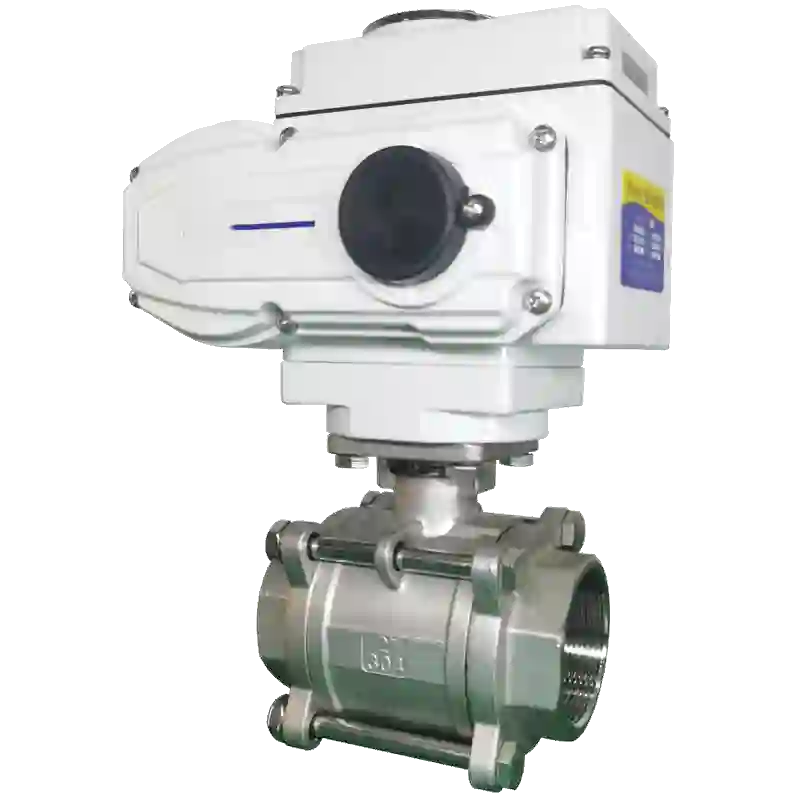
Application of modulating electric ball valves in HVAC central air‑conditioning systems
✅In HVAC central air‑conditioning systems, the flow control of chilled and hot water directly affects indoor temperature/humidity stability and system energy consumption. Modulating electric ball valves, with their equal‑percentage or linear flow characteristics, have become an ideal choice for controlling chilled water, cooling water, and hot water coils.
✅Taking a 2‑way modulating ball valve as an example, it is installed on the return water pipe of an air‑handling unit. Through a DDC controller, it continuously compares the return water temperature with the setpoint and outputs a regulating signal to dynamically adjust the valve opening. This avoids both overcooling and overheating, while significantly reducing pump energy consumption.
✅Compared with traditional modulating butterfly valves or two‑way valves, electric ball valves have lower flow resistance, higher sealing ratings (up to ANSI Class VI), and no dead zone over the full stroke, making them especially suitable for large‑temperature‑difference and variable‑flow applications.
✅A 3‑way modulating ball valve is often used for diverting or mixing control on the cold/heat source side. For example, in a boiler/chiller bypass system, the 3‑way modulating ball valve automatically distributes the primary and secondary water flows according to load changes, ensuring that the chiller/boiler always operates in its high‑efficiency range.
Key selection parameters for modulating electric ball valves in HVAC systems
-
Output signal type: Confirm whether the controller supports 4‑20mA or 0‑10V, and whether feedback signals (e.g., 0‑10V feedback) are required.
-
Actuator torque: The required torque must be calculated based on valve differential pressure and diameter, with a safety factor of 1.3~1.5.
-
Body material and sealing: WCB or 304 stainless steel is commonly used for chilled water; EPDM or PTFE sealing materials are selected to suit low‑temperature conditions.
-
Protection rating: IP54 is generally sufficient for indoor plant rooms; for outdoor rooftop installations near cooling towers, IP65 or higher is required.
Application case: Pudong Jinqiao Town Administrative Service Center Building
✅The central air‑conditioning system of this service center originally used manual regulating valves, requiring manual re‑balancing at every seasonal change—a time‑consuming process with large temperature fluctuations. During the 2023 retrofit, the project team selected CHCV’s hvac motorized ball valve series (modulating type, 4‑20mA control) to replace the old valves. These were installed on the chilled water supply and return branches serving the 7‑floor office area. Working with the building automation system, the valves adjust their openings in real time according to the return air temperature of each zone.
✅After the retrofit, during summer cooling, pump energy consumption dropped by about 18%, indoor temperature fluctuation was reduced from ±2.5°C to ±0.8°C, maintenance staff no longer needed frequent on‑site adjustments, and the failure rate decreased significantly. This project fully validates the practical value of modulating electric ball valves in energy‑saving retrofits of existing buildings.
Summary
📌For HVAC central air‑conditioning systems, choosing modulating ball valves instead of on/off types or ordinary regulating valves delivers higher control precision and lower operating costs.
📌When selecting, be sure to consider control signals, torque, materials, and protection ratings, and give priority to products with fieldbus communication capabilities for seamless integration with intelligent building systems.