
Sanitary three Piece Ball Valve – Tri-Clamp Hygienic Design
Sanitary three piece ball valve with Tri-Clamp ends, Ra≤0.8μm polished bore, EPDM/PTFE seals. 3-A compliant for food, dairy, beverage, and pharmaceutical applications.
Description
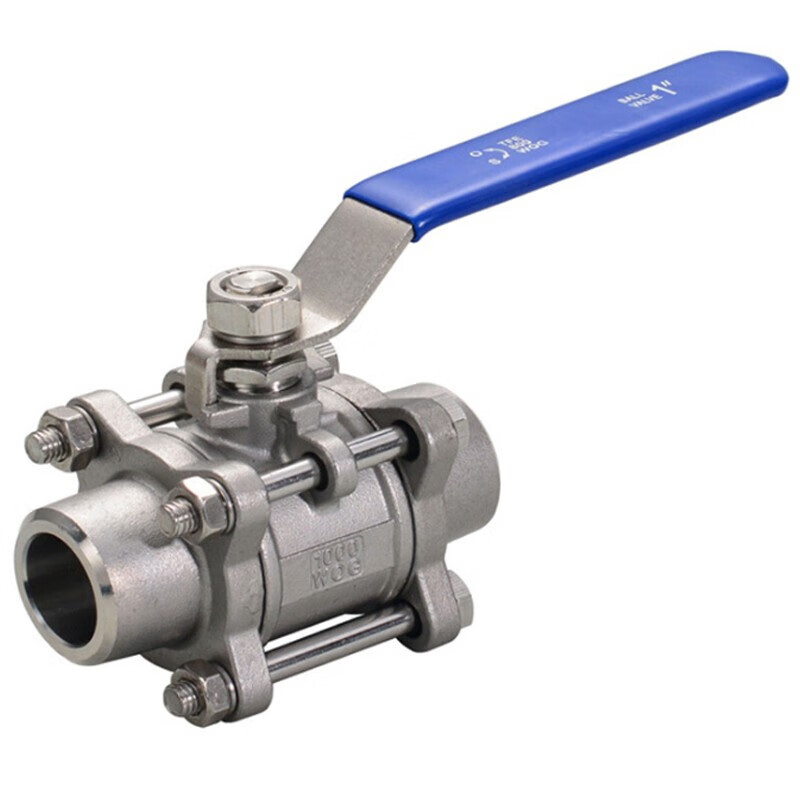
A sanitary three piece ball valve is a dedicated shut‑off valve engineered for hygienic process pipelines within food, dairy, beverage, pharmaceutical and biotech industries. Its valve body comprises three independent segments‑‑left body, central body and right body‑‑locked together by bolt fasteners. Ball and seat assemblies are housed inside the central body; stem‑driven 90° rotation of the ball enables media isolation or flow passage.
All wetted components are constructed from stainless steel, with internal surfaces mechanically or electropolished to achieve low‑roughness finishes. End connections adopt Tri‑Clamp clamp‑style fittings, eliminating thread‑related crevices and product entrapment risks. Thanks to its three‑piece layout, service technicians can remove the central cartridge for seal inspection or seat replacement without detaching clamp joints, satisfying hygienic piping requirements for clean‑in‑place performance and straightforward maintenance. Built in compliance with 3‑A Sanitary Standards and FDA food‑contact material regulations, this stainless steel sanitary ball valve finds extensive deployment in hygienic process lines requiring recurring CIP/SIP cycles.
Material and Technical Specifications
| Parameter Item | Specification Range |
|---|---|
| Valve Body Material | SS304 (ASTM A351 CF8) / SS316L (ASTM A351 CF3M), meeting material requirements for stainless steel sanitary ball valve |
| Ball Material | SS304 / SS316L |
| Stem Material | SS304 / SS316L |
| Seat Material | PTFE / EPDM / Silicone / Viton |
| Clamp Gasket Material | EPDM / Silicone / Viton / PTFE Encapsulated |
| Nominal Size | 1/2″ ~ 6″ (DN15 ~ DN150) |
| End Connection | Tri‑Clamp clamp connection (ISO 2852 / DIN 32676 / ASME BPE), standard interface for tri clamp ball valve sanitary |
| Internal Surface Roughness | Mechanically polished Ra ≤ 0.8 μm (food‑grade); Electropolished Ra ≤ 0.4 μm (pharmaceutical‑grade) |
| Body Structure | Floating type |
| Operating Temperature | ‑20 ℃ ~ 180 ℃ (subject to seat and gasket compound) |
| CIP/SIP Compatibility | Withstands CIP washing (80‑100 ℃, NaOH / nitric acid); SIP steam sterilization (121‑135 ℃) |
| Face‑to‑Face Dimension | Tri‑Clamp standard face‑to‑face dimensions |
| Valve Cavity Design | Dead‑zone‑free, full drainable construction |
| Compliance & Certifications | 3‑A Sanitary Standards / FDA 21 CFR 177 / ASME BPE, aligned with industry norms from three piece sanitary ball valve manufacturers |
| Material Certificate | EN 10204 3.1 (available upon request) |
Structural Highlights: Hygienic‑Oriented Design
Superior hygienic performance of the sanitary three‑piece ball valve originates from multi‑dimensional optimizations covering material grades, surface finishing, connection geometry and internal architecture.
- Stainless steel grades and surface finishing: SS304 and SS316L deliver robust corrosion resistance against acidic‑alkaline food fluids and aggressive CIP detergents. Mechanical or electrolytic polishing erases machining tool marks, micro‑irregularities and free‑iron contamination. Smooth wetted surfaces minimize media adhesion, allowing full flushing by CIP liquor and suppressing microbial proliferation as well as product residue buildup.
- Tri‑Clamp clamp ends: thread‑free crevice‑free joints: As the signature fitting for hygienic piping, Tri‑Clamp connections dispense with threaded grooves, PTFE tape and thread sealant, thereby excluding extrinsic contamination sources. Inner bore matches pipe inner diameter seamlessly for unobstructed CIP flow with no hidden cleaning pockets. This sanitary ball valve tri clamp configuration enables tool‑free assembly and disassembly, supporting offline inspection and cleansing.
- Maintenance benefits of three‑piece construction: The 3 piece sanitary ball valve configuration permits operators to pull out the central cartridge to inspect ball sealing surfaces and cavity interiors for residual deposits or seal damage, while keeping clamp connections intact. This mechanism avoids repeated compressive stress exerted on clamp gaskets, prolonging gasket service life and simplifying routine on‑site checks alongside CIP validation workflows.
Application Scope
The sanitary three piece ball valve is widely adopted across these sectors:
‑ Dairy processing: Product transfer pipelines and supporting CIP circuits for milk, yoghurt, cream and whey protein.
‑ Beverage manufacturing: Process lines for fruit juice, tea drinks, carbonated beverages and functional beverages.
‑ Brewing & craft beer: Material piping linked to fermenters, bright beer tanks, filter assemblies and bottling machines.
‑ Pharmaceutical & biotech: Distribution loops for purified water, water‑for‑injection, buffer solutions and cell culture media.
‑ Food ingredient handling: Conveyance pipelines for syrup, edible oil, condiments and food additives.
‑ Cosmetics production: Process piping for lotions, creams, shampoos and other personal‑care formulations.
Field Reference Case
AB InBev Brewery, Brouwerijplein 1, 3000 Leuven, Belgium, the birthplace of Stella Artois, fitted sanitary three piece ball valve as process shut‑off units for cleaning‑fluid distribution inside its fermentation‑hall CIP system. The facility operates over 40 fermenter tanks, with its CIP unit executing 2‑3 automatic cleaning cycles daily, circulating 85 ℃ caustic soda solution, hot water and acid detergent to target tanks. Specified sizes range from DN40 to DN80. Valves are SS304 build with Tri‑Clamp ends, EPDM seats delivering better alkali‑resistance and thermal stability compared with PTFE, and mechanically polished wetted surfaces at Ra ≤ 0.8 μm.
Unlike industrial threaded ball valves, these sanitary ball valve tri clamp units feature crevice‑free Tri‑Clamp interfaces with no thread sealant or PTFE tape introduced during installation, ruling out foreign‑body contamination risks. Polished inner bores eliminate product‑trapping pockets, and EPDM seating compounds satisfy FDA 21 CFR 177.2600 food‑contact requirements. Post‑CIP rinse‑water sampling has verified zero‑residue performance at valve joint locations during cleaning validation. Its three‑piece architecture allows maintenance crews to extract the central cartridge without loosening clamps, to inspect EPDM seat ageing and ball‑surface integrity. Subjected to cyclic hot‑alkali exposure, EPDM seats gradually harden over time and demand periodic visual checks. Installed since the plant’s CIP upgrade in 2018, this valve fleet has run continuously for more than seven years by the end of 2025, accumulating over 5,000 complete CIP cycles with only two preventive seat‑replacement events.