
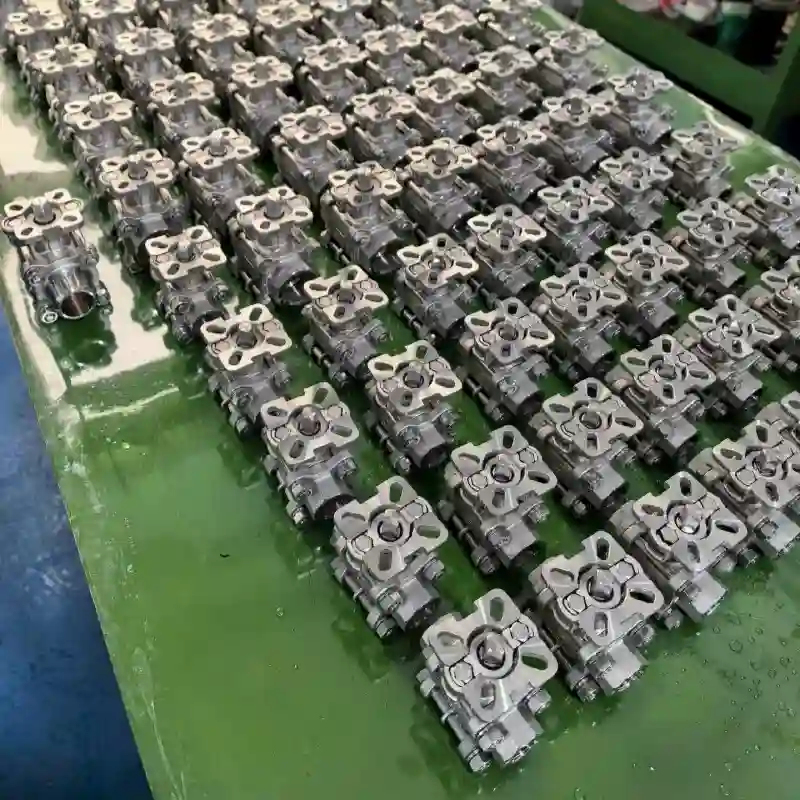
SS304 Tri Clamp three Piece Ball Valve – Sanitary Hygienic Design
SS304 tri clamp three piece ball valve with sanitary tri-clamp ends, polished bore Ra≤0.8μm for food, dairy, beverage, and pharmaceutical applications.
Description
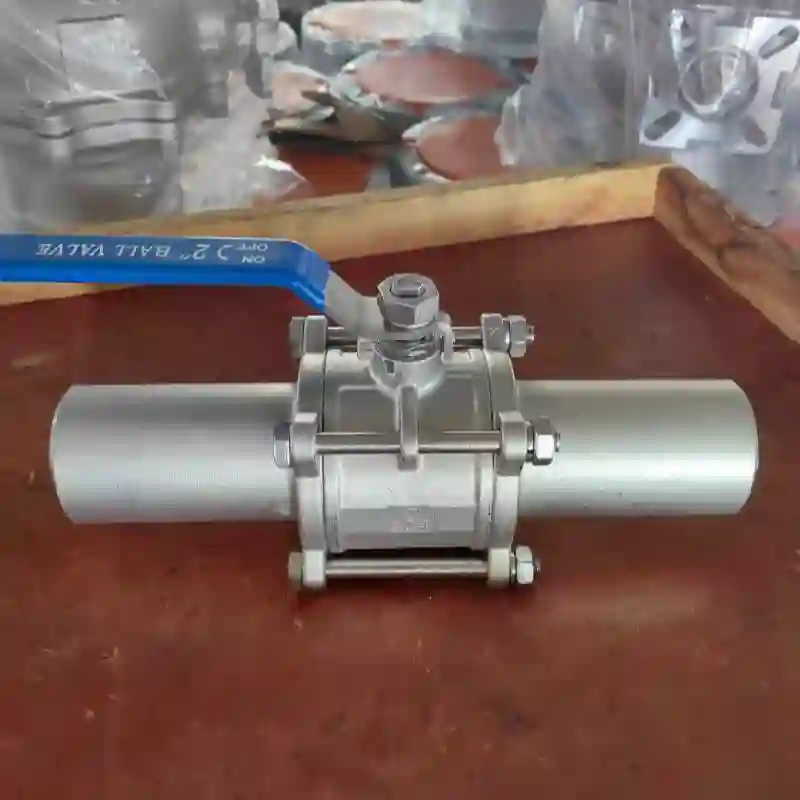
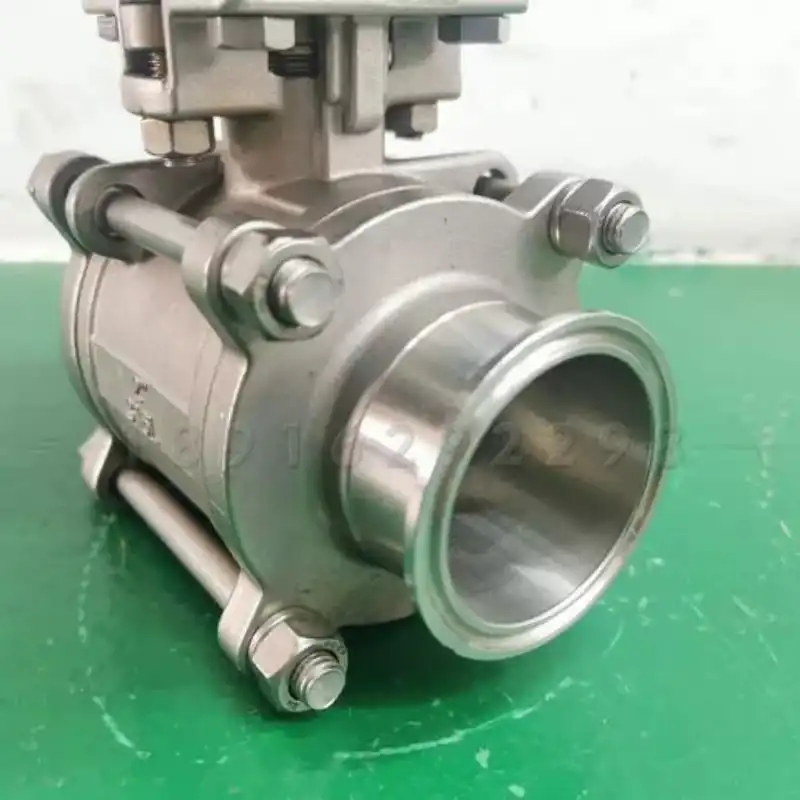
Manufactured from SS304 stainless steel, the three‑piece tri‑clamp ball valve comprises three discrete components: left‑body, middle‑body and right‑body, securely fastened by bolts. Its end connections adopt Tri‑Clamp sanitary fittings, with the ball and valve seats encapsulated inside the middle‑body. Stem‑driven 90° rotation of the ball enables media shut‑off and flow actuation within process pipelines.
The Tri‑Clamp joint creates tight compression sealing via stainless‑steel clamps and gaskets mated to sanitary ferrules. This delivers thread‑free, crevice‑free sanitary pipe connections free of product entrapment. Thanks to its three‑piece construction, technicians can extract the middle‑body assembly to inspect or replace ball and seat components without loosening tri‑clamp joints, enabling true in‑line servicing for sanitary process systems.
Material and Specification
| Parameter | Specification Range |
|---|---|
| Valve Body | SS304 (ASTM A351 CF8) |
| Ball | SS304 |
| Stem | SS304 / SS316 |
| Seat | PTFE / EPDM / Silicone / Viton |
| Tri‑Clamp Gasket | EPDM / Silicone / Viton / PTFE Encapsulated |
| Nominal Size | 1/2“ ~ 6” (DN15 ~ DN150) |
| End Connection | Tri‑Clamp (ISO 2852 / DIN 32676 / ASME BPE) |
| Internal Surface Finish | Mechanically polished Ra ≤ 0.8 μm (standard food‑grade); Electropolished Ra ≤ 0.4 μm (pharmaceutical grade, optional) |
| Body Design | Floating type |
| Operating Temperature | ‑20 ℃ ~ 180 ℃ (subject to seat material selection) |
| Face‑to‑Face Dimension | Tri‑Clamp standard dimensional requirements |
| CIP/SIP Compatibility | Resistant to CIP cleaning (80 ℃‑100 ℃ NaOH / nitric acid) and SIP steam sterilization (121 ℃‑135 ℃) |
| Drain Feature | Crevice‑free cavity; inclined drain design (optional) |
| Handle Option | Stainless‑steel handle / Plastic handle |
Structural Highlights: Sanitary‑Grade Connection
The sanitary performance of the SS304 three‑piece tri‑clamp ball valve originates from its specialized fitting architecture.
Tri‑Clamp fitting principle: As the industry‑standard interface for food‑grade, dairy, beverage and pharmaceutical piping, the Tri‑Clamp system relies on pre‑welded sanitary ferrules with precision‑flattened end faces. When two ferrules butt against each other, a surrounding stainless‑steel clamp applies uniform axial compression via its wedge‑shaped inner profile. This compresses the intermediate gasket (O‑ring or flat gasket) to achieve reliable sealing.
Thread‑free and crevice‑free internals: Unlike threaded joints, Tri‑Clamp connections contain no internal threads or abrupt steps. The inner bore remains consistent with connected pipework, eliminating flow turbulence and product accumulation. CIP fluids can fully scour every wetted surface without concealed dead zones.
Fast disassembly and off‑line sterilization: Operators release clamp bolts to detach the valve from piping quickly. No thread disassembly is required, ruling out thread abrasion and PTFE tape residue risks. The removed valve unit can be directly placed inside an autoclave for off‑line sterilization before reinstallation. Gaskets achieve stable sealing under single‑shot compression.
Synergy between three‑piece layout and sanitary maintenance: For routine overhaul, operators only loosen middle‑body bolts rather than disturbing tri‑clamp joints. Ball and seat assemblies can be pulled out for inspection or renewal. This minimizes repeated compression‑relaxation cycles on tri‑clamp gaskets and extends gasket service life.
Application Scope
SS304 three‑piece tri‑clamp ball valves are widely deployed across sanitary process pipelines: ‑ Dairy processing: Transfer lines for milk, yoghurt, cream and whey protein products. ‑ Beverage manufacturing: Process piping for fruit juice, herbal drinks, carbonated beverages and functional beverages. ‑ Brewing & craft beer: Feed and discharge lines for fermenters, bright beer tanks and filter units. ‑ Food production: Piping handling syrup, edible oil, condiments and sauces. ‑ Pharmaceutical & biotech: Purified water, Water for Injection, buffer solution and cell culture media distribution loops. ‑ Cosmetics: Process lines for lotions, creams, shampoos and other personal‑care formulations.
Field Application Case
At Mengniu Dairy Tongzhou Plant (No.1, Zone 1, Food Industrial Park, Tongzhou District, Beijing, China), SS304 three‑piece tri‑clamp ball valves serve as isolation and diversion components on process pipelines linking homogenizer outlets to filling machines within the UHT milk production line. Installed sizes cover DN40 and DN50, with mechanically polished wetted surfaces (Ra ≤ 0.8 μm), PTFE valve seats and EPDM tri‑clamp gaskets.
This facility produces UHT‑treated pure milk, and process pipelines execute automated daily CIP cycles: 30‑minute circulation with 85 ℃ sodium hydroxide solution, hot‑water flushing, 20‑minute circulation with 65 % nitric acid, followed by final purified‑water rinsing. Tri‑Clamp joints deliver multiple tangible benefits for this production site.
Pipeline sanitation validation: UHT production imposes strict internal cleanliness requirements. Mengniu quality‑control teams classify tri‑clamp joints as critical control points. Smooth inner bores free of threads prevent turbulence and material entrapment. Post‑CIP rinse‑water sampling demonstrates that microbial indicators including total bacterial count, coliform and thermophilic bacteria consistently stay below 10 % of national regulatory limits, while ATP bioluminescence readings remain steadily under 15 RLU.
Installation efficiency and service convenience: Process piping is pre‑fabricated with welded‑on sanitary ferrules. Valves are mounted directly via clamps without site welding, thread sealant or PTFE tape, thus avoiding foreign‑body contamination risks. During filler maintenance or product change‑over, operators undo clamp bolts to remove valves for off‑line inspection or autoclave sterilization. Re‑installation only requires clamp tightening; no repeated thread sealing work is needed. Plant maintenance logs show valve disassembly and reassembly via tri‑clamp connections take less than 3 minutes on average, versus over 15 minutes for comparable flanged alternatives. Meanwhile, the three‑piece architecture preserves tri‑clamp joint integrity during seat replacement: technicians pull out the middle‑body assembly alone, and tri‑clamp gaskets remain compressed from initial commissioning throughout their service cycle.
The site’s equipment‑management department has standardized this three‑piece tri‑clamp ball valve solution for isolation and diversion duties across all six UHT filling lines on the plant campus.