
English Translation
Ball valves are frequently used in pipelines for shut-off and isolation. Several key points deserve attention: cleanliness between the ball and seats, cavity pressure relief, matching between actuators and handles, and whether special end designs fit the working conditions.
The following elaborates on obstruction, low-noise operation, bull head design, valve ball, and Type B ball valve, facilitating item-by-item verification during procurement, maintenance and selection.
Ball Valve Obstruction Definition
What is a ball valve obstruction?
Ball valve obstruction refers to foreign matter, scaling, crystallization, polymers, ice, welding slag, sand grains, carbonized sealant or other substances trapped inside the ball passage, the contact surface between the ball and valve seats, valve body cavity or stem sealing area. This prevents the ball from rotating normally, achieving full closure, or causes residual medium to pass downstream even after closure.
It does not always manifest as complete seizure. More often, it shows increased torque, incomplete opening/closing, rising pressure differential, actuator overload, or dripping leakage after closure.
Based on maintenance records, obstructions commonly occur under these working conditions: slurry with solid particles, chemical media prone to crystallization, circulating water forming scale with temperature fluctuation, pipelines operating with long-term partial throttling, uncleaned welding slag after piping welding, and frozen valve cavities at low temperatures.
If the medium contains fibres or powder, such debris may wrap around the edge of the ball, resulting in crushing damage to soft seals when the ball reseats.
Do not merely replace the handle for troubleshooting. Isolate, depressurize and drain the valve first, then disassemble the middle flange or end cap to inspect scratches on the ball surface, indentations on valve seats, spring failure and deposits inside the cavity.
After cleaning, verify smooth rotation of the ball before carrying out sealing tests per pressure class. For media prone to deposition, install filters upstream, or select designs with drain ports and online cleaning capability.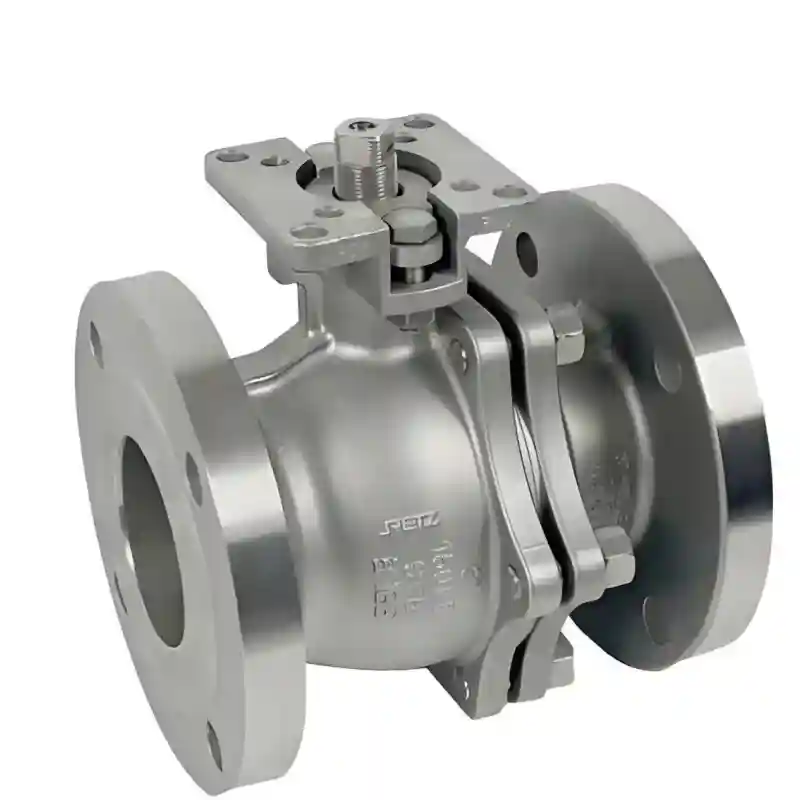
How Does a Quiet Ball Valve Work?
How does a quiet ball valve work?
A quiet ball valve does not rely on outer covers for sound absorption. Instead, it modifies the flow path and pressure drop distribution to reduce turbulence, cavitation and flashing.
Standard ball valves have low flow resistance at full opening. However, under partial throttling, fluid undergoes high-speed shearing at the ball edge, easily generating whistling, vibration and cavitation. Low-noise designs usually adopt V-notched ball cores, multi-stage pressure reduction, noise-cancelling cages, eccentric rotary structures or labyrinth flow channels. These split one-time pressure drop into multiple minor pressure drops to mitigate impacts from collapsing bubbles.
Actuator speed also affects noise. Pneumatic actuators tend to trigger water hammer if opening and closing too fast; electric actuators with slow modulation enable smoother flow velocity variation.
During installation, align flow direction with the arrow marked on the valve body to prevent the valve cavity from acting as a resonance chamber. For steam, compressed air, pump bypass and heating water systems requiring continuous flow regulation, standard ball valves are not suitable for throttling. V-port ball valves or dedicated control ball valves shall be selected instead.
Bull Head Ball Valve
What is a bull head ball valve?
Bull head ball valve is not a unified name across all standards. In some projects, manufacturer drawings and field terminology, it describes a ball valve structure with one blind end, plug or blind flange, resembling the shape of a “bull head”. It may feature only one inlet port plus a closed end, or come with a side outlet for pressure testing, draining, sampling, branch line blocking or single-end equipment connection. Compared with conventional straight-through ball valves, its port arrangement, face-to-face dimension and flow direction must be confirmed against drawings.
When procuring this type of ball valve, specifying only “bull head” is insufficient. End connection type, thread or flange standard, pressure class, ball bore size, flow direction, drain port or pressure tap requirement shall be provided. If used for pressure testing and draining, also confirm cavity depressurization capability and removability of the blind end. For bidirectional differential pressure applications, specify whether double piston effect seats or pressure relief holes are required. Otherwise, problems such as incorrect installation orientation, incomplete draining or failed sealing tests may arise after delivery.
Ball Valve Ball Material & What is a valve ball?
What is a valve ball?
The valve ball serves as the closure member of a ball valve, generally a sphere with a through bore. Rotating the ball by 90 degrees aligns or misaligns the through bore with the flow passage, thus opening or closing the valve. The ball is not an independent component; together with valve seats, stem and valve body cavity, it determines sealing performance and operating torque.
The bore diameter of the ball affects flow capacity; solid and hollow balls differ in strength, weight and cost. Roundness, surface roughness and hardness of the ball influence sealing service life.
Common ball valve ball materials include 304, 316, 316L stainless steel, duplex steel, nickel-plated carbon steel or ENP, brass, bronze, ceramics and alloys. Soft-seated ball valves are often equipped with mirror-finished stainless steel balls with low surface roughness to mate with PTFE, RPTFE, PEEK and other valve seats. Metal-seated ball valves normally have hardened ball and seat surfaces, such as hard chrome plating, tungsten carbide or Stellite alloy overlay, to withstand high temperature and particle erosion. For media containing chlorine, ammonia, oxygen or strong corrosive components, ball material and seat material must be checked together instead of checking valve body material alone.
Ball Valve Cavity Relief & Ball Valve with Drain Port
After the ball valve closes, a confined middle cavity forms between the ball and seats. If liquid inside the cavity heats up, liquid expansion may cause rapid pressure rise, potentially lifting valve seats or making the ball hard to rotate. Ball valve cavity relief is the design addressing this issue. Common solutions include pressure relief holes drilled in the ball, self-relieving valve seats, double piston effect or single piston effect structures, and pressure relief ports on the valve body. Under standards such as API 6D and API 608, middle cavity relief and testing requirements shall be confirmed according to working conditions.
Ball valve with drain port refers to an additional drain or emptying connection on the valve body, used to drain residual liquid in the valve cavity, prevent freezing, clean deposits, take samples or connect flushing pipelines. It is practical for valves installed at low points, outdoors or in pipelines subject to freezing in winter.
Drain ports can reduce valve disassembly frequency for media prone to crystallization. However, drain ports are not substitutes for pressure relief ports: pressure relief addresses pressure build-up in confined middle cavities while drain ports are for emptying and cleaning. The two functions differ and must be clearly specified during selection.
What is a Type B ball valve? & Ball Valve Seat Leakage Class
What is a Type B ball valve?
Within procurement contexts of API 608, ASME B16.10, a Type B ball valve usually refers to a long pattern ball valve whose end-to-end dimension matches that of long pattern gate valves, facilitating gate valve replacement on existing pipelines.
Different manufacturers and standards may also use Type A / Type B to denote structural or connection codes. Therefore, stating only Type B is inadequate. Corresponding standard, pressure class, flange or thread standard, face-to-face dimension and bore size must be provided simultaneously.
Ball valve seat leakage class is another parameter prone to misunderstanding. On-off ball valves commonly reference API 598 or ISO 5208 for leakage classes; ANSI/FCI 70-2 Class VI may appear for control valve scenarios. Soft-seated ball valves can achieve extremely low leakage rates under normal-temperature clean water tests, but high temperature, solid particles, frequent operation or metal sealing will alter the results. Metal-seated ball valves normally permit a certain amount of leakage and cannot be held to the zero-leakage criteria for soft seals. During procurement, specify test medium, pressure, duration, leakage class and test direction.
Selection & Maintenance Checklist
- Does the medium contain particles, crystallize, freeze or expand?
- Is ball valve cavity relief required, or only a ball valve with drain port?
- Are ball, valve seat and stem materials compatible with the medium?
- Manual, pneumatic, electric or hydraulic actuation? Is actuator torque calculated based on differential pressure?
- Soft seal or metal seal required? Leakage class per API 598, ISO 5208 or other standards?
- Installation orientation, flow arrow, sufficient space for handle or actuator?
- Are anti-static, fire-safe, anti-blowout stem, locking device or ISO 5211 mounting pad required?
At CHCV Valve, medium, temperature, pressure, connection standard, operation mode, leakage class and special connections will be confirmed during quotation and selection stages.
For issues including obstruction, noise, bull head structure and Type B long pattern dimensions, providing drawings, material specifications and pressure test records is more beneficial for on-site installation and later maintenance than offering merely a model number.