
What is a Trunnion Mounted Ball Valve?
For pipeline and process engineers, selecting the correct isolation valve directly impacts system safety, operating cost and long-term maintenance. Among ball valve designs, the trunnion mounted ball valve is the industry standard for large-bore, high-pressure hydrocarbon, chemical and energy applications. This article explains its working principle, key components, DBB capability, and how it differs from floating ball valves, to support your valve specification and vendor selection work.
Trunnion mounted ball valve meaning | What is trunnion mounting?
Trunnion mounting describes a mechanical support design where the ball is anchored at the top and bottom by short precision-machined shafts called trunnions. The trunnions sit within bearings integrated into the valve body, carrying the hydraulic thrust generated by line pressure. This is the core trunnion mounted ball valve meaning: the ball is fixed and only rotates in place; it cannot shift axially toward one seat under differential pressure.
In a floating ball design, the ball is pushed by fluid pressure against the downstream seat to create sealing. By contrast, trunnion mounting transfers pressure loads to the valve body and bearings, not to the seat rings. Spring-loaded seats move toward the ball to maintain contact. At low pressure, spring force provides sealing; at high operating pressure, line pressure energises the seat and reinforces the seal.
This design delivers significantly lower operating torque. That advantage becomes critical for large size and high class valves, where floating ball valves would require oversized actuators and experience accelerated seat wear. Trunnion mounted ball valves are commonly built to API 6D for pipeline service, with pressure classes ranging from Class 150 up to Class 2500.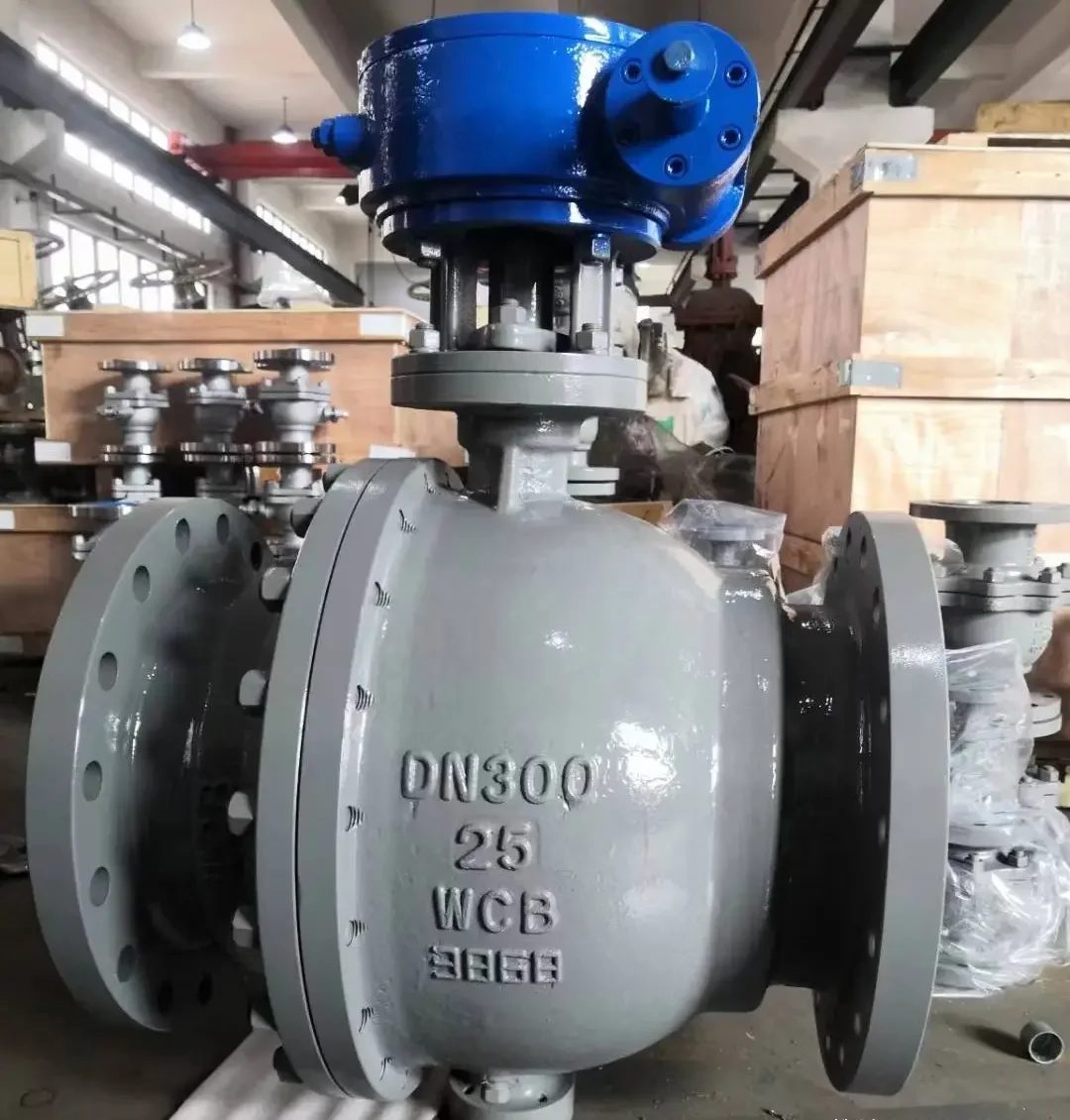
Trunnion mounted ball valve parts
Understanding trunnion mounted ball valve parts helps engineers conduct technical reviews, prepare maintenance plans and verify manufacturer drawings. The main components are listed below:
- Valve Body: The primary pressure-containing housing, typically forged or cast steel. It holds all internal components and bears system loads. End connections include flanged (ASME B16.5) and butt-weld ends (ASME B16.25).
- Ball: Hollow perforated sphere. Full bore versions maintain unobstructed pigging flow; reduced bore types reduce valve weight and cost for non-pigging lines.
- Upper and Lower Trunnions: Machined shafts fixed to the ball. The lower trunnion rests in a bearing; the upper trunnion connects to the stem. They absorb pressure thrust and prevent ball movement.
- Bearings: Low-friction bushings fitted around trunnions to reduce rotation torque and minimise metal-to-metal wear.
- Spring-Loaded Seats: Floating seat rings with preloaded springs. Springs maintain seat contact at low pressure; process pressure energises the seat at high pressure.
- Stem: Transmits rotary torque from the manual handwheel or actuator to the ball. Anti-blowout stem design is standard for safety.
- Seals and O-rings: Secondary sealing elements for stem and body joints. Fire-safe metal backup seats are specified for fire hazard service per API 607.
- Body Cavity Bleed Port: Required for DBB configurations, used to vent trapped pressure between the two seats during isolation.
Trunnion mounted ball valve with double block and bleed (DBB)
One major advantage of a trunnion mounted ball valve with double block and bleed is its ability to perform two independent sealing barriers inside a single valve assembly. When fully closed, both upstream and downstream seats seal separately. The cavity between the two seats can be vented through the bleed port on the valve body.
For maintenance and isolation scenarios, operators can close the valve, bleed trapped medium from the centre cavity, and verify seat integrity before opening downstream equipment. This eliminates the need to install three separate valves (two block valves plus one bleed valve), saving footprint, material cost and potential leak points.
It is important to note that DBB does not mean zero-risk isolation. For high-hazard process lines, site safety procedures still require proper lockout-tagout and seat leakage testing. DBB trunnion ball valves are widely adopted on transmission pipelines, terminal manifolds and refinery process headers where positive isolation is mandatory.
Trunnion mounted vs floating ball valve
What is the difference between a floating and a trunnion-mounted ball valve?
The core distinction lies in how the ball handles hydraulic thrust. The comparison table below summarises key technical differences for specification reference:
| Feature | Trunnion Mounted Ball Valve | Floating Ball Valve |
|---|---|---|
| Ball Support | Anchored by upper/lower trunnions; ball cannot float | Ball connected only to stem; free to shift axially |
| Load Path | Pressure thrust carried by trunnions, bearings and valve body | Pressure thrust pushes ball against downstream seat |
| Operating Torque | Low and stable, suitable for large bore & high pressure | Torque rises sharply with pressure, limited to smaller sizes |
| DBB Capability | Yes, dual independent seats with cavity bleed | Not available, only downstream seat seals |
| Typical Size & Class | 2″ to 56″, Class 150–2500 | Up to roughly 6″, Class 150–600 |
| Actuation | Compatible with smaller actuators for large valves | Requires larger actuators at higher pressure |
When to choose trunnion mounted ball valve:
- Pipeline isolation, large diameter lines, high pressure classes
- Automated valve stations, frequent operation
- Applications requiring DBB for maintenance safety
- Oil & gas transmission, LNG, petrochemical and offshore topside systems
When to choose floating ball valve:
- Small bore, low to medium pressure utility lines
- Budget non-critical isolation where DBB is not required
Tips for selecting trunnion mounted ball valve manufacturers
Choosing qualified trunnion mounted ball valve manufacturers is as important as selecting the valve design itself. Poor manufacturing quality can lead to seat leakage, high operating torque, cavity pressure issues and premature failure in critical service.
Use these criteria to evaluate potential suppliers:
- Relevant Standards Certification: Confirm compliance with API 6D, ASME B16.10, fire-safe API 607, NACE MR0175 for sour gas service where applicable.
- Material Traceability: Verify material test certificates for body, ball, trunnion and seat materials, matching process fluid and temperature range.
- Testing Capability: The manufacturer must perform hydrostatic shell test, seat leakage test and cavity relief testing as per API 6D requirements.
- Application Experience: Prefer manufacturers with proven track record delivering valves for your industry, whether long-distance gas pipelines, refinery or LNG projects.
- Technical Support: Check whether the vendor can provide engineering data, drawing review, on-site commissioning guidance and spare parts availability.
Always share full service conditions with your manufacturer: fluid composition, operating pressure, temperature, required bore size, end connection type, actuation requirement and safety features such as DBB or fire-safe design.
Conclusion
The trunnion mounted ball valve is a robust quarter-turn isolation valve built for demanding high-pressure and large-bore industrial systems. Its trunnion support mechanism reduces operating torque and protects seat components from excessive hydraulic load. The optional double block and bleed function delivers a compact, validated isolation solution for pipeline maintenance and safety operations.
When comparing trunnion mounted vs floating ball valve, remember that floating designs work well for small, low-pressure applications, while trunnion ball valves are the preferred solution for critical process and pipeline isolation. Working with experienced trunnion mounted ball valve manufacturers ensures your valve meets specification, passes field acceptance and delivers reliable performance over its service life.
FAQ
- What is a trunnion mounted ball valve? A trunnion mounted ball valve is a quarter-turn ball valve with the ball mechanically anchored by upper and lower trunnion shafts. The trunnions absorb hydraulic pressure thrust, resulting in low operating torque, making it suitable for large bore and high-pressure pipeline isolation.
- What is trunnion mounting? Trunnion mounting refers to a support structure where the ball is fixed by top and bottom trunnion shafts and bearings inside the valve body. The ball only rotates and cannot move axially under line pressure.
- What is the difference between a floating and a trunnion-mounted ball valve? A floating ball valve relies on fluid pressure pushing the ball against the downstream seat for sealing and is limited to smaller sizes. A trunnion-mounted ball valve fixes the ball with trunnions; pressure loads transfer to the valve body, enabling large bore, high-pressure service and DBB functionality.