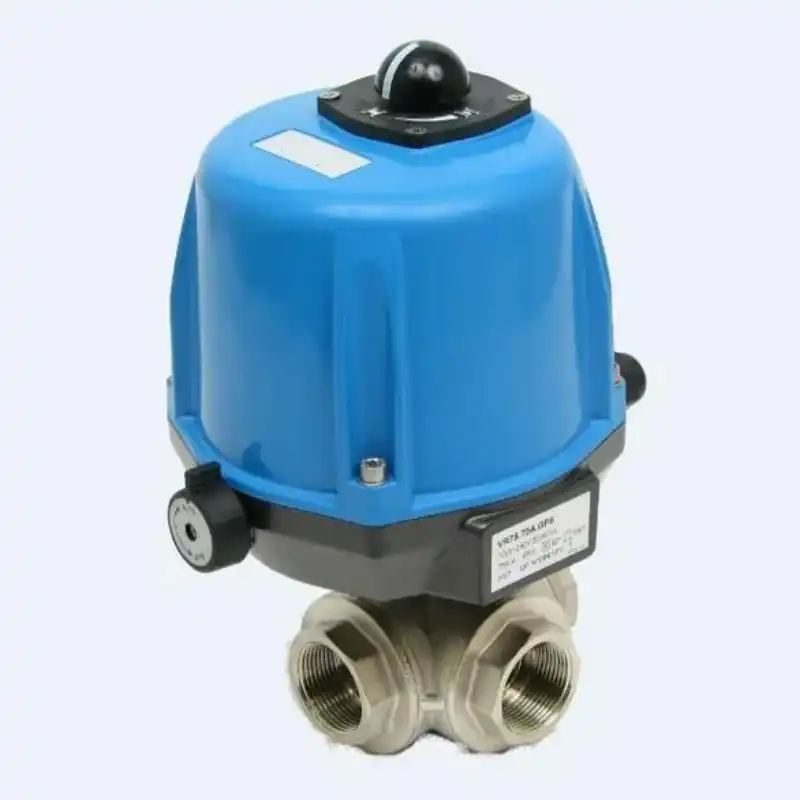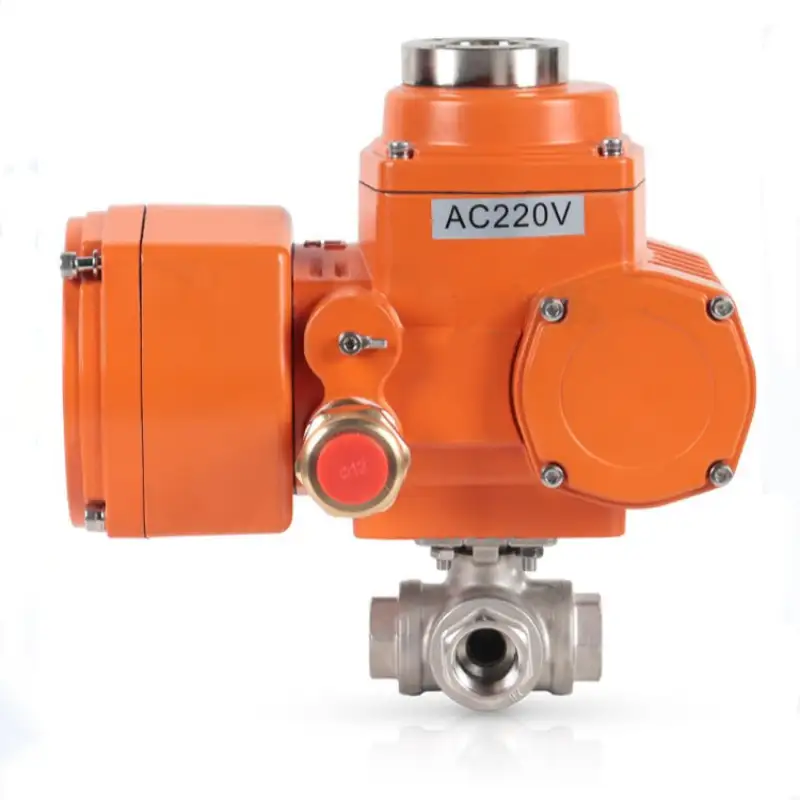

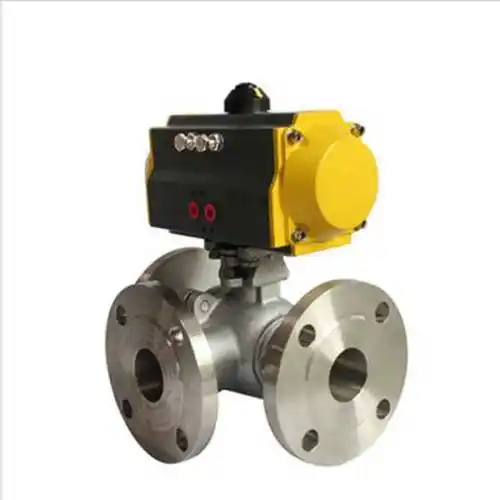
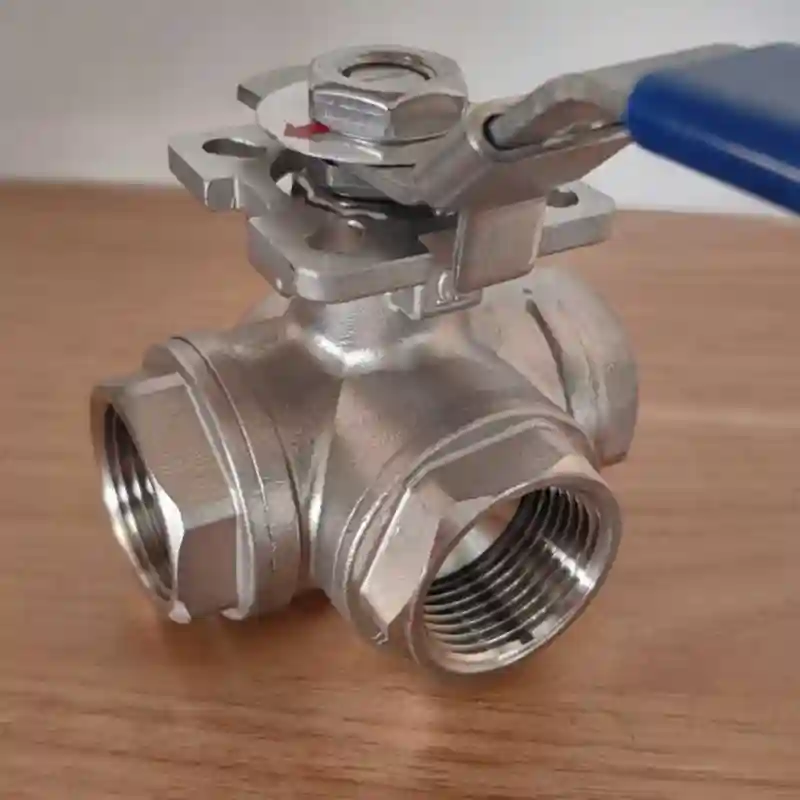
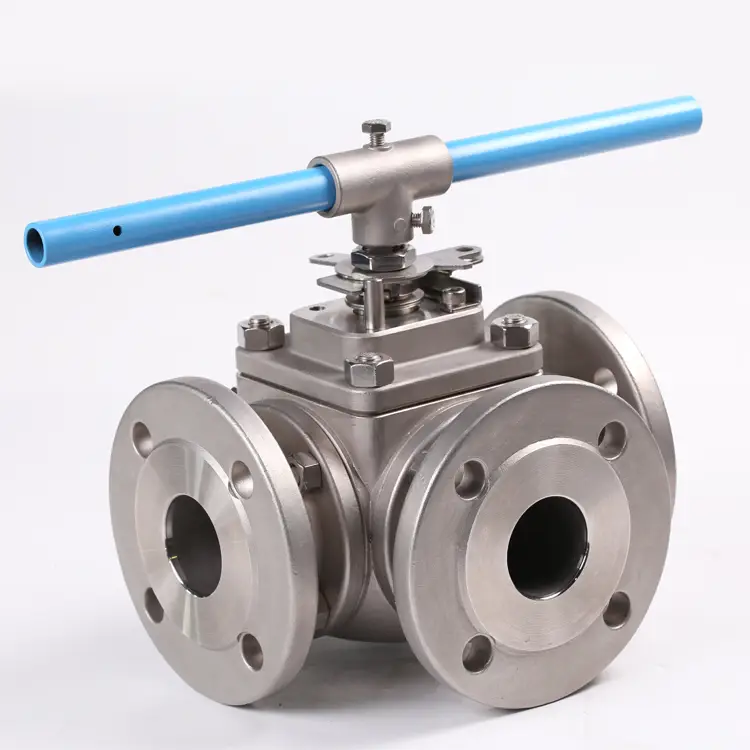
3 Inch Three Way Ball Valve – Flanged Full Port for Pipeline Switching
3 inch three way ball valve in WCB/CF8M, L-port and T-port designs for flow diversion. Full port, Class 150/300 flanged. Reduces leak points vs multi-valve systems. Ideal for water treatment and pipelines.
Description
A 3 inch three way ball valve is a large‑bore three‑way ball valve with nominal size of 3‑inch (DN80). Ball rotation enables flow diversion, splitting and merging within three‑way piping circuits.
For full‑port variants, its flow coefficient Cv typically ranges from 300 to 800. It is a widely‑adopted specification for oil‑and‑gas gathering manifolds, power‑plant circulating‑water loops, backwash pipelines of large‑scale water treatment plants and main industrial cooling piping.
Compared with conventional assemblies consisting of multiple two‑way ball valves plus large‑bore T‑fittings, its core value lies in enabling complete three‑way flow switching with just one single valve, replacing hardware that would otherwise demand two two‑way valves and numerous fittings.
Flanged joints are cut from more than 10 down to merely three, delivering a 60%‑75% reduction in potential leak points. Within large‑bore piping, every flange joint represents both a leakage risk and a maintenance concern. Fewer flange connections translate into lower fugitive‑emission hazards, reduced routine‑maintenance man‑hours and improved overall system reliability.
Structural Advantages from Minimized Leak Points
Large‑bore piping systems (3‑inch and above) mostly adopt flanged connections. Each flange assembly incorporates 4‑12 bolts plus one gasket, constituting the primary source of potential leakage across the whole installation. A typical switching setup built with “two two‑way ball valves + one T‑fitting” generally contains 8‑10 flange joints. By contrast, a single 3 inch three way ball valve only requires three flanged connections: one inlet flange and two outlet flanges.
During long‑term service, flange joints are far more prone to leakage triggered by thermal cycling, pipeline vibration or bolt creep relaxation than valve‑body sealing surfaces. Reducing flange quantities not only mitigates leakage probability directly, but also cuts down inspection points for bolt retightening and leak detection during routine rounds, as well as the number of gaskets to be replaced during major overhauls.
Material and Construction
Body materials are selectable according to service conditions:
‑ ASTM A216 WCB cast carbon steel: For water, oil, gas and general‑industrial duties; operating temperature ‑29°C ~ 425°C.
‑ ASTM A351 CF8M (316L stainless steel): For corrosive media, food‑and‑beverage processing, seawater and comparable applications.
‑ Ductile Iron: Cost‑effective choice for medium‑low‑pressure water‑treatment and municipal water‑supply‑and‑drainage systems.
Precision‑machined and hardened balls and stems are mated with reinforced‑PTFE seats to achieve bi‑directional zero‑leak sealing across the full rated‑pressure scope. Large‑bore units come factory‑fitted with gearbox actuation to substantially cut operating torque.
Specifications & End Connections
| Parameter Item | Specification Details |
|---|---|
| Nominal Size | 3 inch (DN80) |
| End Connection | Flange (ANSI Class 150 / 300 / 600 RF/RF) / Butt Weld |
| Pressure Rating | Class 150 / 300 / 600 (max 1480 PSI) |
| Temperature Range | ‑29°C ~ 180°C (PTFE seat) / ‑29°C ~ 250°C (PEEK seat) |
| Flow‑Port Variant | L‑Port (flow switching) / T‑Port (mixing or diverting) |
| Body Material | WCB cast carbon steel / CF8M stainless steel / Ductile Iron |
| Ball Material | 13Cr stainless steel / 316L stainless steel |
| Seat Material | Reinforced PTFE / PEEK |
| Operation Type | Gearbox (standard) / Manual lever / Pneumatic actuator / Electric actuator |
| ISO 5211 Mounting Flange | F10 / F12 / F14 (subject to torque requirements) |
Flow‑Port Selection Guidance
‑ L‑Port: Intended for diverting one incoming fluid stream between two separate outlet branches. Typical scenarios include backwash water supply switching for filter tanks, pump‑train inlet re‑routing and heat‑exchanger supply‑return flow change‑over.
‑ T‑Port: Suited for combining two incoming streams into a single discharge, or dividing one feed flow into two separate outputs. Representative applications comprise combined‑feed liquid delivery from dual pumps and multi‑stream medium distribution.
Typical Application Sectors
This valve demonstrates proven field performance in diverse large‑bore process environments:
‑ Water Treatment & Municipal Water Utilities: Sequential unit switching for filter‑tank backwash pipelines at waterworks, plus influent‑effluent flow distribution within wastewater‑treatment facilities.
‑ Oil & Gas Gathering & Processing: Multi‑path flow switching for station‑side gathering manifolds and metering skids at oil‑and‑gas fields.
‑ Power‑Industry Circulating‑Water & Cooling Systems: Backwash change‑over for filters within circulating‑cooling‑water loops of thermal‑power and nuclear‑power plants.
‑ Large‑Scale Industrial Cooling & HVAC Systems: Bypass switching and supply‑return reconfiguration for main cooling piping at district‑cooling stations and hyperscale data‑centre sites.
Reference Application Case
At the filter‑tank backwash distribution‑system project for Changi NEWater Plant in Singapore (Case 3) delivered by Suez Water Technologies & Solutions (now Veolia Water Technologies), 3in ball valve units (L‑Port, ductile‑iron body with EPDM lining, full‑port bore, ANSI Class 150 flange, single‑acting spring‑return pneumatic actuator) were installed on branch‑supply switching manifolds for backwash service.
As one of Singapore’s largest NEWater facilities, Changi NEWater Plant possesses a treatment capacity of 218 000 cubic metres per day. Its 3‑inch backwash supply branch piping needs to deliver backwash water sequentially to eight filter banks.
The original setup adopted manual gate valves matched with pipe fittings; every two filter banks shared one switching manifold containing roughly 12 flange and threaded joints. High‑velocity backwash flow plus frequent actuation caused recurring dripping at joints, resulting in persistent water pooling inside the backwash pump‑house, with 5‑6 maintenance work orders generated each week.
After retrofitting with these 3‑inch three‑way ball valves, only one valve is required to serve each pair of filter banks. Flanged joint count dropped from approximately 12 down to three, achieving a 75 % reduction in leak points.
The full‑port profile preserves backwash‑water flow capacity without valve‑induced throttling, maintaining flow velocity within 2.5‑3.0 m/s and keeping backwash efficiency unchanged.
Following commissioning, the pump‑house floor stays free of accumulated water; weekly maintenance tickets fell from 5‑6 to merely 1‑2 per month, yielding around 180 000 Singapore‑dollar annual operational‑cost savings for the plant. This solution has been incorporated into official water‑plant design‑guideline documents published by Singapore’s Public Utilities Board (PUB).
Quality Assurance
The product is engineered in compliance with API 6D pipeline‑valve standards and ASME B16.34 design specifications, with optional API 607 fire‑safe certification and standard‑fit Anti‑static Device. Every large‑bore unit undergoes 100 % hydrostatic shell‑strength testing as well as bi‑directional seat tightness inspection. Gearbox operators hold IP65 ingress‑protection rating, suitable for outdoor installation conditions.