
3 Piece Full Port Ball Valve – Zero Pressure Drop,Full Bore Design
3 piece full port ball valve with zero pressure drop and no flow dead zones. Full bore design for viscous fluids, slurries, and CIP lines. Stainless steel, Class 150-600.
Description
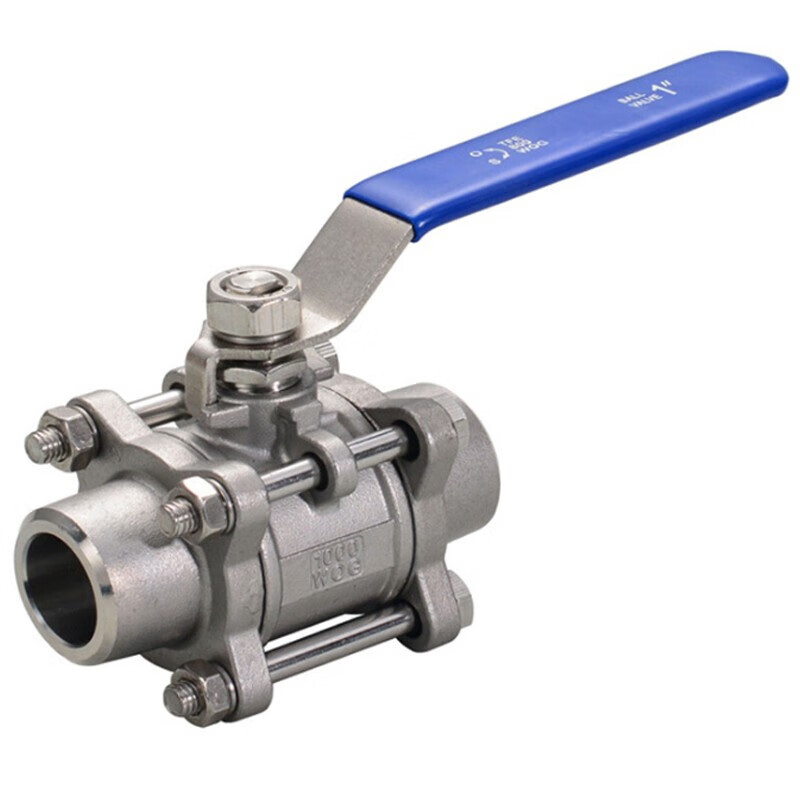
A 3 piece full port ball valve features a bolt‑connected assembly made up of three independent components: left‑hand body, central body and right‑hand body. The bore diameter through the ball matches the nominal pipe size. When fully open, the ball bore aligns flush with the inner pipe wall so that fluid passes through without flow contraction, abrupt profile transitions or extra local resistance. Thanks to this full port ball valve configuration, pressure drop across the fully‑opened valve approximates the frictional loss of an equivalent straight pipe segment of identical diameter.
Its three‑piece construction permits on‑site removal of the central cartridge for seat and seal replacement without taking the entire valve out of service, greatly simplifying servicing for large‑size or critical‑line valves. The 3 piece full port ball valve suits viscous fluids, particle‑laden media, CIP/SIP cleaning circuits and process piping with strict pressure‑drop constraints.
Material and Technical Specifications
| Parameter Item | Specification Range |
|---|---|
| Valve Body Material | CF8 (304 Stainless Steel) / CF8M (316 Stainless Steel) / WCB Carbon Steel |
| Ball Material | 304 / 316 / 316L Stainless Steel |
| Stem Material | 304 / 316 / 17‑4PH Stainless Steel |
| Seat Material | PTFE / RPTFE / PEEK / Metal seat (selected according to service media) |
| Nominal Size | DN15 ~ DN300 (1/2″ ~ 12″) |
| Pressure Class | Class 150 / 300 / 600 |
| Ball Bore | Full Port — bore matches nominal pipe size |
| End Connection | Flanged (ASME B16.5) / Threaded (NPT/BSPT) / Socket‑weld / Butt‑weld / Tri‑Clamp ferrule |
| Pressure Drop at Full Opening | Approximate straight‑pipe frictional loss (no additional local resistance) |
| Flow‑Path Profile | Ball bore sits flush with pipe inner wall; no reducing steps or dead retention zones |
| Body Structure | Floating type — DN ≤ 200 / Class ≤ 600 |
| Face‑to‑Face Standard | ASME B16.10 / EN 558 |
| Mounting Platform | ISO 5211 direct‑mount platform (optional) |
| Material Certificate | EN 10204 3.1 (available upon request) |
Structural Highlights: Minimal Pressure Drop & Dead‑Zone‑Free Flow
The “low‑pressure‑drop” and “dead‑zone‑free” performance of the 3‑piece full‑port ball valve originates from matched sizing between the ball bore and pipe inner diameter.
‑ Minimal pressure drop: hydrodynamic advantages of full‑port geometry: Within the 3 piece full port ball valve, the ball bore shares the identical diameter as the connected pipeline. At full opening, the ball bore aligns flush with pipe walls so fluid encounters no flow‑area reduction or abrupt geometry shifts. Unlike reduced‑bore ball valves, this full port ball valve eliminates local resistance losses triggered by fluid acceleration‑deceleration across constricted sections. For long‑distance transfer lines and process systems sensitive to pumping energy consumption, reduced pressure drop translates directly into lower pump power draw or increased throughput capacity. Under identical piping and pumping conditions, the 3 piece full port ball valve delivers noticeably higher conveying capacity compared with reduced‑bore ball valves of equal nominal size.
‑ Dead‑zone‑free design: improved media passage and cleanability: Reduced‑bore ball valves feature a smaller ball bore than the pipe ID, creating annular retention pockets at diameter transition steps. Viscous fluids tend to accumulate and solidify at these locations; particle‑carrying streams may deposit and build up blockages. CIP cleaning media slow down within these low‑velocity zones and leave incomplete sanitisation.The three‑piece full‑port ball valve removes such steps and stagnant pockets by matching ball bore and pipe internal dimensions, allowing unobstructed passage for both process fluid and cleaning solution. An optional sloped drain geometry at the bottom of valve cavities enables complete liquid evacuation with no trapped‑liquid pockets when the valve sits in closed position.
‑ Maintenance benefits of three‑piece architecture: Full‑port ball valves are frequently deployed on critical service lines handling viscous media or CIP cycles, where valve downtime strongly impacts production continuity. Three‑piece construction lets maintenance crews extract the central cartridge for seat replacement without complete valve disassembly, offering particular operational convenience for large‑bore full‑port variants.
Application Scope
The 3 piece full port ball valve is widely implemented for piping handling particle‑containing or high‑viscosity fluids:
‑ Viscous‑media pipelines: Syrup, honey, grease, polymer solutions, coatings and other high‑viscosity streams
‑ Particle‑laden media: Mineral slurry, mud, oil slurry, process fluids carrying catalyst fines
‑ CIP/SIP cleaning circuits: In‑place cleaning systems within food, dairy, beverage and pharmaceutical facilities
‑ Long‑distance transmission pipelines with low‑pressure‑drop requirements: Natural gas, crude oil and refined‑product transport lines
‑ Upstream and downstream of high‑precision flow meters: Minimises flow‑field disturbance to enhance metering accuracy
Field Reference Case
3 piece full port ball valve units are installed as shut‑off valves for lime milk dosing lines and gypsum slurry discharge piping inside the desulphurisation wastewater treatment system of Huaneng Dalian Thermal Power Co., Ltd. (Dalianwan Sub‑district, Ganjingzi District, Dalian City, Liaoning Province). Specified sizes range DN50‑DN100 at Class 150 pressure rating. Bodies are manufactured from CF8 stainless steel fitted with PTFE seats for lime‑milk chemical feeding and periodic gypsum‑slurry discharge duties.
Both process streams impose strict requirements on internal valve flow‑path geometry. Lime‑milk (Ca(OH)₂ suspension) carries solid particles. Reduced‑bore valves with internal steps or profile discontinuities would trigger rapid particle deposition and scaling, resulting in blockages and inconsistent chemical dosing rates.
Gypsum slurry containing CaSO₄·2H₂O crystalline particles exhibits strong adhesion; inner‑wall steps inside reduced‑bore valves act as nucleation points for crystal build‑up, progressively shrinking the effective flow cross‑section. Previously‑deployed reduced‑bore ball valves suffered obvious flow‑path clogging and rising pressure drop after only 3‑4 months of runtime, necessitating frequent teardown and cleaning work.
These 3‑piece full‑port ball valves eliminate constricting steps by matching ball bore diameter to pipe inner dimensions. Ca(OH)₂ particles within lime‑milk pass smoothly without depositing on valve internals. Gypsum crystals are carried downstream with the main flow and avoid adhesion at internal ledges. During CIP cycles, cleaning fluid reaches every interior surface of the valve cavity with no low‑velocity stagnant pockets. Commissioned in 2022, this valve fleet has operated continuously for over four years without system‑level failures caused by valve clogging or elevated pressure drop. Maintenance workload has been reduced from teardown‑and‑clean cycles every 3‑4 months to scheduled annual inspections only.