
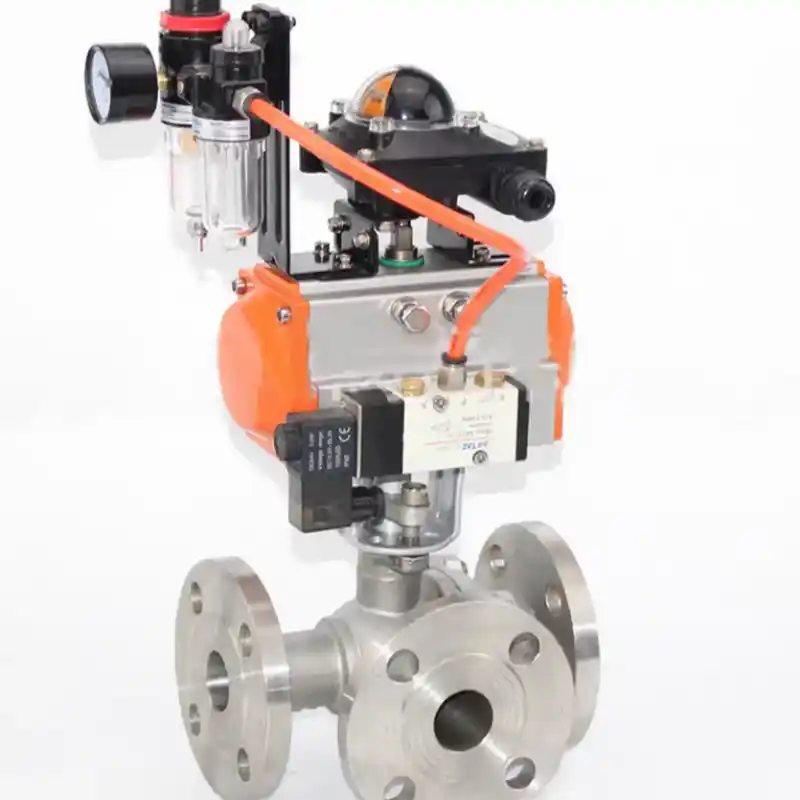
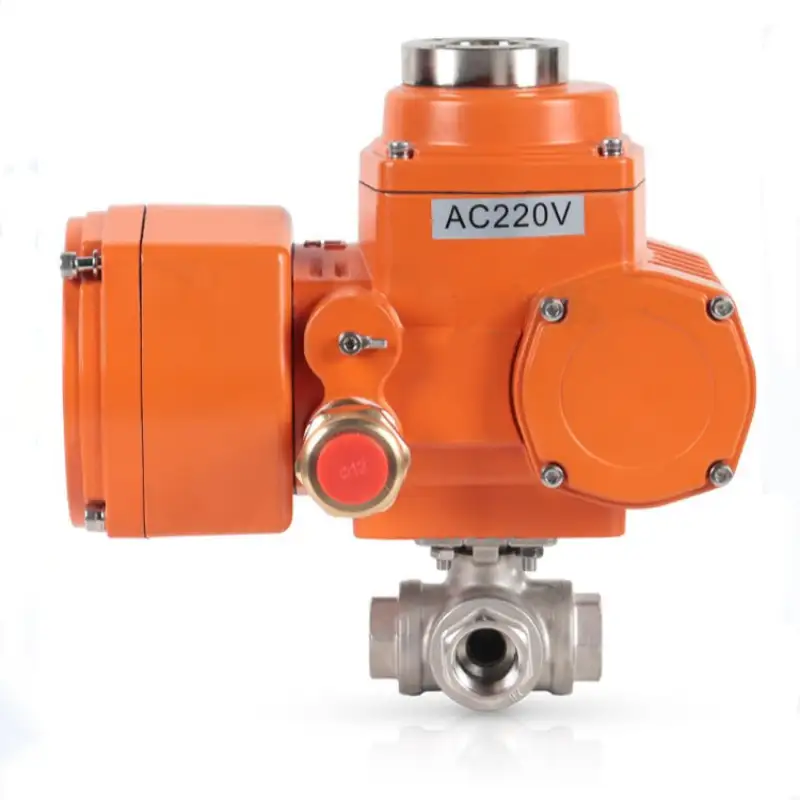
Electric Three Way Ball Valve – Actuated L/T Port for Automated Control
Electric three way ball valve with 316L stainless steel body, L-port and T-port designs. Accepts 4-20mA control signal for precise flow switching and mixing. Ideal for automated process control in wine filtration and water treatment.
Description
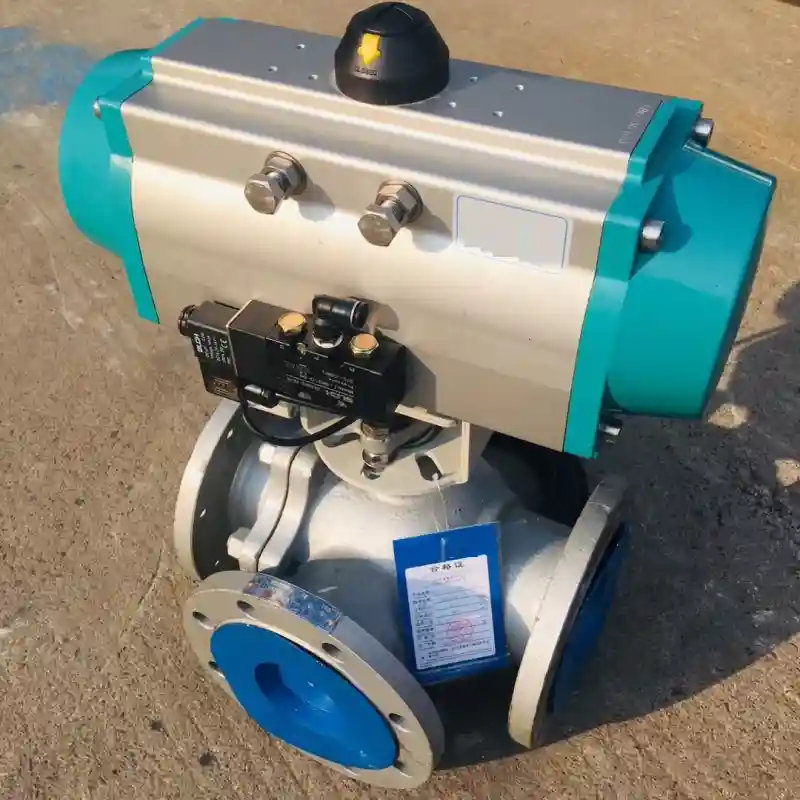
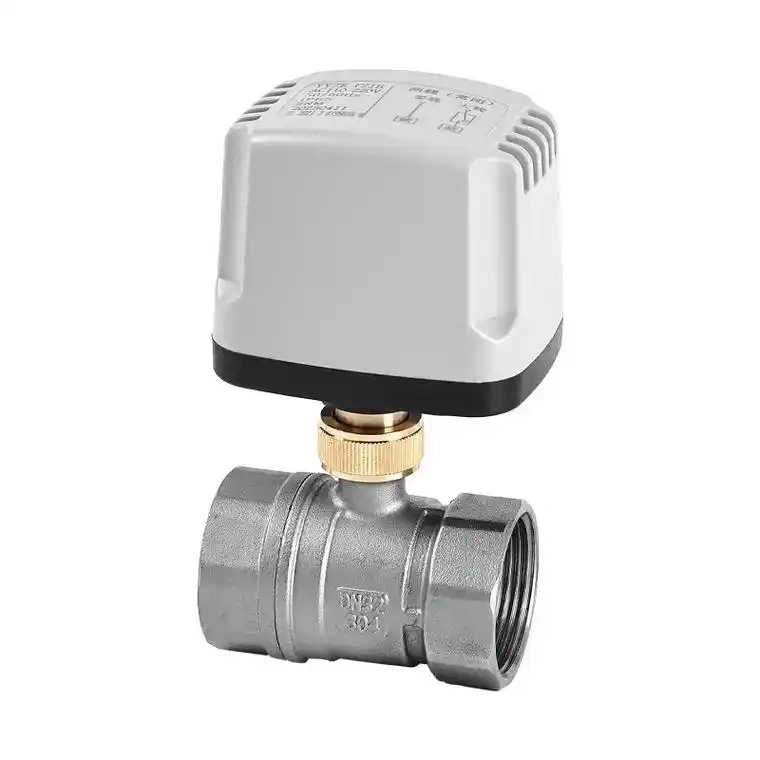
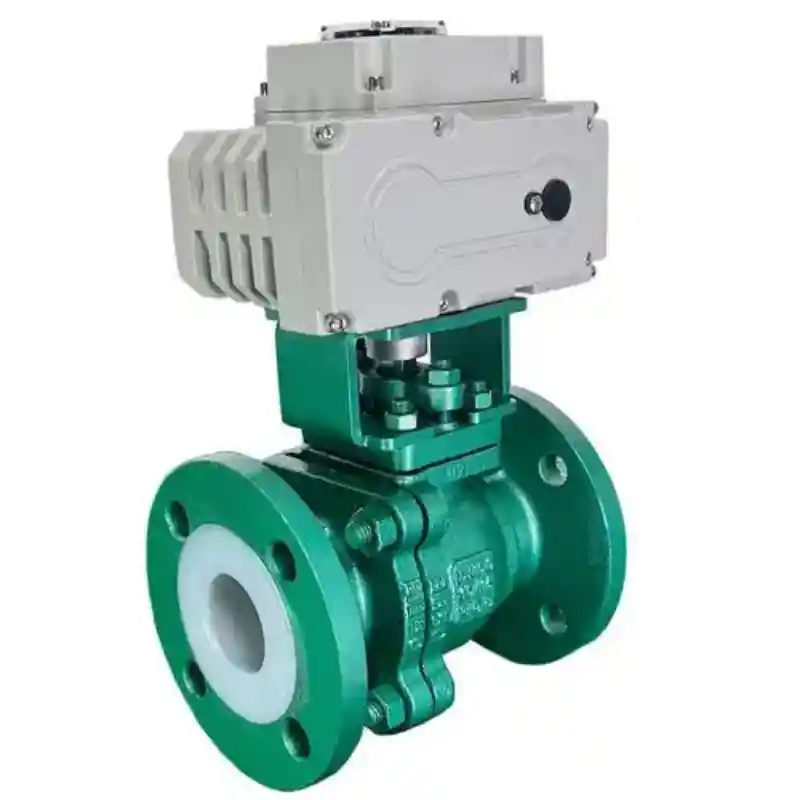
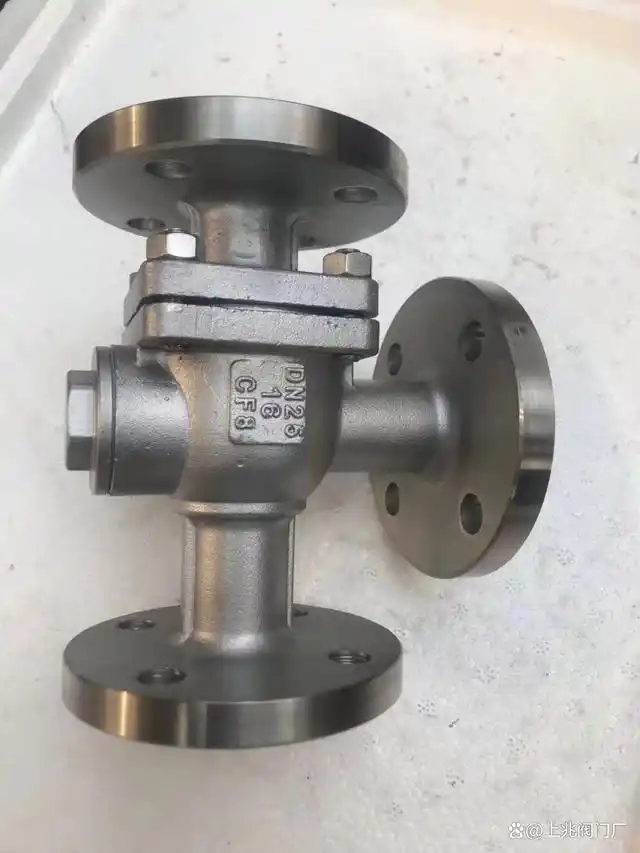
An electric three‑way ball valve is actuated by an electric actuator to enable automatic flow switching, diversion or media confluence within process pipelines.
It combines the flow‑path management capability of three‑way ball valves with high‑precision electric actuation. Rotated through 90°, the valve delivers rapid flow‑path reconfiguration, serving as an alternative to manually‑operated on‑site valves or air‑driven pneumatic units.
The core advantage of an electric three‑way ball valve lies in its independence from on‑site manual operation. It can be readily integrated into DCS (Distributed Control System) or PLC (Programmable Logic Controller) networks to support remote monitoring, automated sequence logic and accurate positioning. Such strengths make it well‑suited for applications demanding high operational repeatability and reduced human intervention.
Automation & Precision Control Features
Its reliable automation and accurate regulation stem from the following design attributes:
- Standardized control signals: Electric actuators accept industry‑standard 4‑20 mA or 0‑10 V DC analog signals for modulating control, or dry‑contact signals for on‑off operation. No extra signal conditioning hardware is required, allowing seamless integration with existing plant‑wide automation platforms.
- Adjustable operating speed: Actuator stroke time can be configured for specific process requirements. Options cover fast‑acting on‑off mode (approx. 10‑second full 90° travel) and slow modulation mode (full stroke completed over several minutes). Slow‑speed actuation mitigates water hammer and pressure surges in sensitive systems, protecting piping and process equipment from shock‑related damage.
- Position feedback & status indication: Actuators are fitted with visual position indicators. Optional mechanical or proximity limit switches transmit real‑time valve‑position feedback to control systems, supporting interlock logic and fault diagnostics to secure automated process reliability.
Valve Body Specifications & Parameters
| Parameter | Specification |
|---|---|
| Nominal Size | 1/2″ ~ 6″ (DN15 ~ DN150) |
| End Connection | NPT thread / BSP thread / ANSI‑EN flanges / Tri‑Clamp sanitary connections |
| Pressure Rating | 600 PSI WOG / 300 PSI Steam (standard); higher ratings available upon custom request |
| Temperature Range | ‑20°C ~ 180°C (PTFE seat) |
| Flow Pattern | L‑Port (flow switching) / T‑Port (mixing & diversion) |
| Body Material | CF8M (316L) stainless steel / Brass / UPVC |
| Ball Material | 316L stainless steel |
| Seat Material | Reinforced PTFE / PEEK (optional) |
| Actuator Power Supply | 24V DC / 110V AC / 220V AC |
| Control Signal | 4‑20 mA / 0‑10V DC / Dry‑contact (on‑off) |
| Ingress Protection | IP67 (standard); IP68 / Explosion‑proof versions optional |
| Actuator Mounting | Direct mounting per ISO 5211 |
| Special Configurations | Anti‑static device (standard) / API 607 fire‑safe design (optional) |
Flow‑Pattern Selection Guidance
- L‑Port: Routes incoming fluid alternately toward one of two separate outlet ports. Typical deployments include filter back‑wash switching, heat‑exchanger bypass adjustment and pump‑suction port selection. Within automated architectures, a single control signal triggers L‑Port valves to switch supply‑line routing or activate emergency venting sequences.
- T‑Port: Merges two incoming fluid streams into a single output, or divides one inlet flow across two outlets. Common use‑cases cover sequenced CIP cleaning‑fluid distribution, dual‑component chemical dosing blending and multi‑loop fluid allocation. When paired with 4‑20 mA control signals, T‑Port hardware supports precise modulating adjustment for continuous flow‑rate tuning.
Typical Application Sectors
motorized three way ball valves are widely deployed across diverse automated process workflows:
- Food & beverage processing: Automated sequenced delivery of CIP cleaning media, product‑stream switching during batch production and filtration‑line management. Sanitary‑grade variants with hygienic end connections, electropolished finishes and cavity‑free construction are frequently specified. Programmable electric actuators enable fully‑autonomous cleaning cycles, cutting manual workload and cleaning‑agent consumption.
- HVAC & building automation: Hot‑cold water switching for air‑handling units, zonal regulation inside large commercial premises and transition duties within district cooling‑heating networks. Based on feedback from indoor temperature sensors, electric three‑way ball valves modulate water flow to optimise building energy efficiency.
- Water & wastewater treatment: Automated proportioning for chemical‑dosing packages, sequenced filter‑tank back‑wash routines and flow management for membrane‑system permeate / concentrate streams. Actuators driven by 4‑20 mA signals deliver accurate dosing‑ratio tuning.
- Pharmaceutical & bio‑engineering: Switching of sterile‑media transfer paths and automatic sampling‑loop control under hygienic conditions, where high cleanness and full traceability are mandatory. Integration with batch‑control systems enables automated production logging and process validation.
- Industrial process control: Automated blending duties, temperature‑control loop management and reactor feed‑line switching for chemical and petrochemical plants. Fast‑response electric actuators with high positioning accuracy excel in continuously‑running processes requiring frequent modulation and remote supervision.
Reference Application Case
A Chilean wine producer upgraded its filtration‑line automation control system. Previously, manual valves handled all flow‑path transitions, which demanded frequent on‑site labour and delivered inconsistent flow‑rate accuracy across production batches. Minor fluctuations in filtration pressure and flow velocity would compromise wine flavour and quality stability during vinification.
The site adopted CHCV electric three‑way sanitary ball valves, featuring 316L stainless‑steel bodies, PTFE seats, full‑electric actuators and Tri‑Clamp ends. These units execute rapid flow‑direction transitions; their cavity‑free design eliminates fluid entrapment and cross‑contamination risks, a critical requirement for wine filtration.
Electric actuators integrate seamlessly with the winery’s central control platform to realise end‑to‑end filtration automation: pre‑filtration, fine filtration and tank filling cycles run fully under pre‑programmed logic.
Following commissioning, precise control over filtration flow‑rate and pressure was achieved, and batch‑to‑batch consistency improved significantly. Pressure and flow‑rate fluctuation margins were constrained within ±2%, bringing inter‑batch quality variance down to historic lows. Downtime during cleaning cycles was greatly reduced, and operators can supervise multiple production lines centrally without constant site patrols.
Quality Assurance
CHCV 3 way motorized ball valves are manufactured and inspected in compliance with ASME B16.34 and ISO 9001 quality‑management protocols. Every unit undergoes 100% hydrostatic shell‑strength testing plus bidirectional seat‑tightness verification per API 598 before shipment. Complete material traceability certificates and full test reports are supplied with each order. Third‑party inspection services (DNV, BV, TÜV etc.) can be arranged upon client request.