1. API 607 Fire Safe Ball Valve – Product Function and Design Logic
In refining, natural gas transmission, and oil & gas production, once a valve is exposed to an external fire, conventional soft seals will rapidly carbonize and fail, leading to medium leakage. The role of the API 607 Fire Safe Ball Valve is not to actively extinguish the fire, but rather, after a fire occurs, to rely on its metal-to-metal secondary sealing structure. When the soft seal (PTFE/RPTFE) is burned away, the spring-loaded metal seat presses against the ball to form a reliable hard seal, controlling leakage within the limits permitted by API 607. This blocks the path for fire spread and buys critical time for personnel evacuation and emergency response.
2. Anti-Static Device – Electrostatic Protection in Fire Environments
During the opening and closing cycles of a fire ball valve, static electricity may accumulate between the ball and the stem. When an external fire causes the insulating coating to fail, electrostatic sparks can easily ignite leaking flammable media.
We equip every API 607 Fire Safe Ball Valve as standard with an Anti-Static Device, which ensures that static charges are continuously conducted to the valve body ground through metallic contact points between the stem and the ball, eliminating potential ignition sources.
3. Fire Safe Carbon Steel Ball Valve – Material and Pressure Parameters
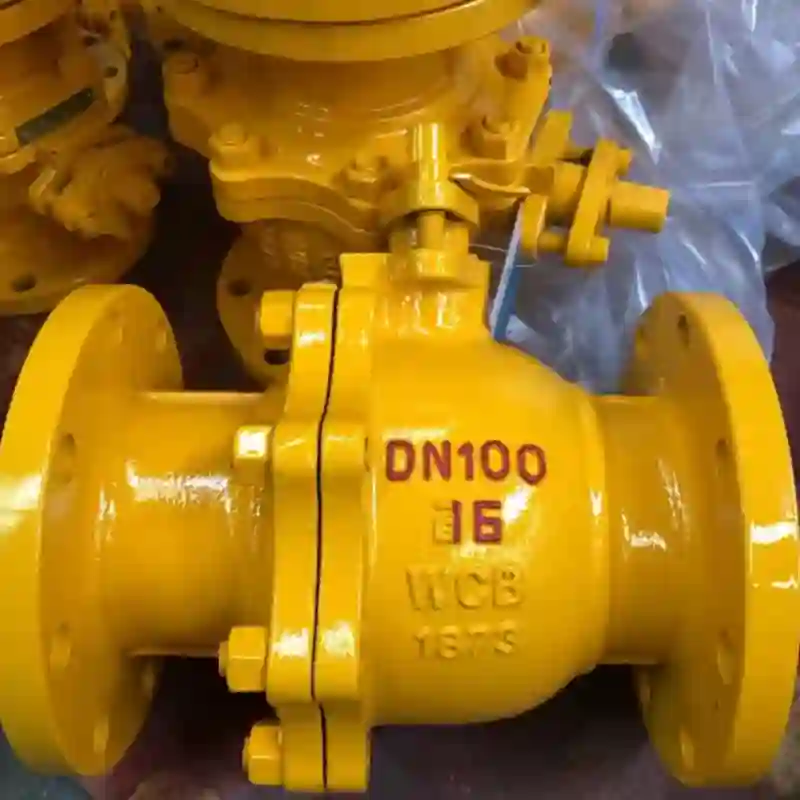
Common valve body materials are A216 WCB or A351 CF8M. The Fire Safe Carbon Steel Ball Valve is suitable for high‑temperature, high‑pressure hydrocarbon services, while CF8M is used for sour or mildly corrosive conditions.
The fire ball valve is designed in accordance with ASME B16.34, and fire testing is performed per API 607 5th Edition, while also meeting ISO 10497 requirements. Key technical data are as follows:
4. Fire Safe Test for Metal Seated Ball Valves – Validation Standard
True fire‑safe performance must be verified through the Fire Safe Test for Metal Seated Ball Valves. This test requires the fire ball valve, in both fully open and fully closed positions, to be exposed to a flame above 760°C for 30 minutes, followed by a hydrostatic pressure test.
Our fire ball valve has passed this test in a third‑party laboratory in a single attempt, with seat leakage and external body leakage rates better than the standard limits, ensuring basic shut‑off capability under extreme fire conditions.
5. Fire Rated Ball Valve Pneumatic Actuator – Actuator Selection
For applications requiring remote emergency shutdown, we offer the Fire Rated Ball Valve Pneumatic Actuator option. This actuator features a fire‑resistant coating and is equipped with a stainless steel fire protection cover, ensuring that the pneumatic spring‑return mechanism functions properly even under high fire temperatures, enabling automatic valve closure.
Together with limit switches and solenoid valves, it can be interlocked with the plant’s Fire & Gas (F&G) system to form a fully automatic safety protection loop.
Typical applications:
Refinery heater feed lines, natural gas compressor unit outlets, LPG storage tank root valves, offshore platform wellhead manifolds, and flammable solvent transfer piping in chemical plants. Proper selection of API 607 Fire Safe Ball Valve is not merely an equipment investment, but a fundamental safeguard for overall process safety and reliability.