Features & Advantages
-
Fully welded body: The valve body is integrally welded, providing a robust structure and eliminating external leakage risks at body joints. This makes it especially suitable for flammable, explosive, or toxic media.
-
Low operating torque: Precision-machined ball and seat technology ensure low switching torque even under high pressure, facilitating easy operation.
-
Bidirectional sealing: Advanced seat design guarantees reliable sealing in any flow direction, complying with international standards such as API 6D.
-
Fire-safe design (optional): An optional fire safe ball valve design ensures seat sealing during fire incidents to prevent media leakage, complying with API 607 – providing a final safety barrier for your pipeline system.
Technical Parameters
Main Application Scenarios
The Four way welded ball valve, with its powerful functionality, plays a key role in multiple industrial sectors:
-
Oil & gas pipelines: As an essential component of pipeline ball valve systems, it is used for flow switching in launcher/receiver stations for pigging, or as bypass valves on main lines.
-
Chemical & petrochemical: Used for switching feed lines to different reactors, or for mixing and diverting two different media through a single valve.
-
Heating & district heating: In large thermal networks, it is used to switch heat sources or to alternate between different heating circuits.
-
LNG & cryogenic service: With stainless steel construction and special cryogenic treatment, the cryogenic ball valve version can be applied to LNG loading/unloading and transfer systems at temperatures as low as -196°C.
The Four way welded ball valve is an indispensable control element in complex piping systems. Its fully welded robust design and flexible flow control help optimize processes, save installation space, and significantly reduce leakage risks. For high‑reliability and long‑service‑life pipeline ball valve applications, this is a highly recommended option.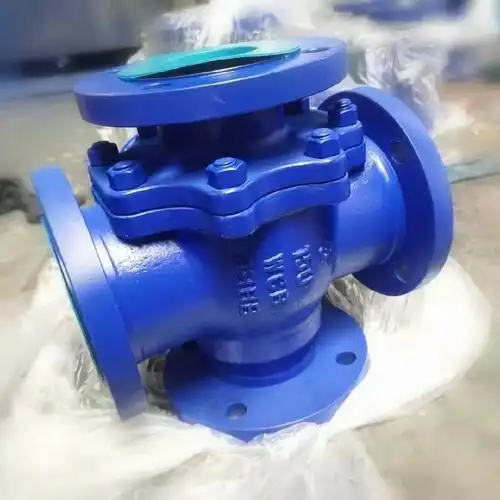
Frequently Asked Questions (FAQ)
Q: What is the difference between a Four way welded ball valve and an ordinary four-way flanged ball valve?
A: The difference lies in the body connection structure. A flanged ball valve uses bolted connections, which present potential external leakage points. In contrast, the Four way welded ball valve adopts a full welded ball valve design – the entire body is integrally welded, fundamentally eliminating leakage risks at body joints. It also offers higher structural strength, making it especially suitable for high‑pressure, high‑temperature, or highly hazardous media applications.
Q: How do I choose between an L‑port and a TT‑port four‑way ball valve for my system?
A: The choice depends on your process requirements. The L‑port configuration is mainly used for flow direction switching – for example, diverting the inlet medium from outlet A to outlet B. The TT‑port configuration, on the other hand, allows two inlets to enter simultaneously and then split or mix the flows from two outlets, enabling diverting or mixing functions.