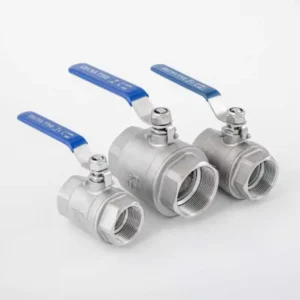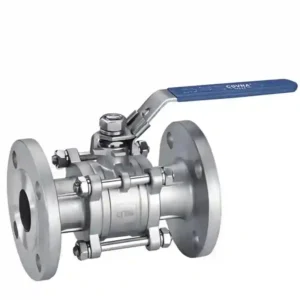

When selecting or replacing a ball valve, we often start by searching for “1/2 inch ball valve in mm”, hoping to get a simple millimeter value.
✅But in actual procurement, you will find that different suppliers give different answers – some say 12.7 mm, some say 15 mm, and others say 21.3 mm. Which one is correct?
✅In fact, all three numbers are correct – they just represent different dimensional aspects of the ball valve. Understanding this is the key to avoiding the wrong specification.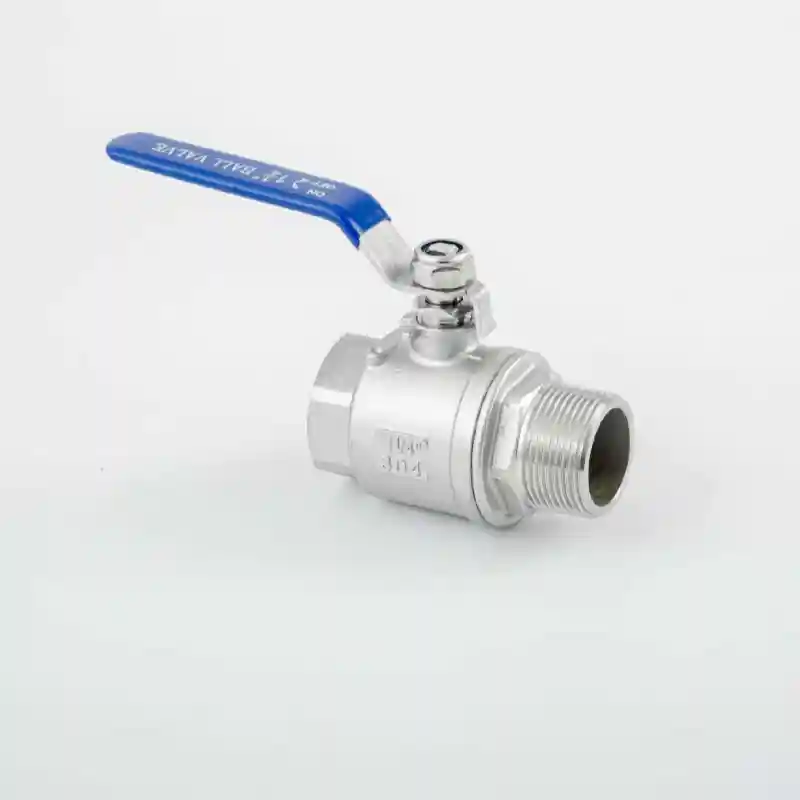
1/2 inch ball valve dimensions: three key values
Theoretical conversion: 12.7 mm
1 inch = 25.4 mm, so 1/2 inch directly converts to 12.7 mm. But this value is only for mathematical calculation and is almost never used in actual valve specifications. If you go to a supplier with 12.7 mm, they will be confused.
Nominal diameter (DN): 15 mm
This is the most commonly used specification code in the valve industry. A 1/2‑inch ball valve corresponds to a nominal diameter of DN15. DN is a “size label”, not an exact measured internal diameter, but a standard size for design and compatibility. In international standards such as ASME B16.34 and API 6D, 1/2″ valves are uniformly designated as DN15.
Pipe outer diameter (OD): 21.3 mm
If you measure the outer diameter of the pipe connecting to the ball valve, the actual OD of a 1/2‑inch steel pipe is 21.3 mm (some standards state 21.34 mm). This value comes from pipe size standards (e.g., ASTM A53), not from the valve’s own bore size.
| Dimension type | Corresponding mm | Application scenario |
|---|---|---|
| Theoretical conversion | 12.7 mm | Mathematical calculation, practically useless |
| Nominal diameter DN | 15 mm | Selection, quotation, drawings |
| Pipe outer diameter OD | 21.3 mm | Piping, welding, compression fittings |
Material and connection type are equally critical
Beyond the millimeter conversion, you also need to clarify two other parameters to truly lock in the correct product.
1/2 inch npt ball valve – NPT (National Pipe Taper) is the most common thread standard in North America, suitable for piping systems with high sealing requirements. NPT threads are tapered and require sealing tape.
1/2 inch threaded ball valve – This generally refers to various threaded connections, including BSP, BSPT, etc. European and Asian markets more commonly use BSP parallel threads, which are not interchangeable with NPT.
1/2 inch brass ball valve – Brass is the first choice for domestic water supply, HVAC, and compressed air systems, offering good corrosion resistance, machinability, and moderate cost.
1/2 inch stainless steel ball valve – Stainless steel (e.g., SS304, SS316) is suitable for corrosive media, high‑temperature steam, or food/pharmaceutical industries. 316L is particularly preferred for resistance to chloride corrosion.
Based on your medium temperature, pressure rating, and installation space, after confirming DN15, you should then select the corresponding thread standard and body material to ensure long‑term reliable operation.
Purchasing advice
✅Next time you order, directly tell the supplier “I need a 1/2‑inch (DN15) ball valve” and specify the thread standard and material, for example: “1/2 inch NPT brass ball valve” or “1/2 inch BSP stainless steel ball valve”. Do not just say “12.7 mm” – that will cause unnecessary communication errors.
✅If you already have the pipe on hand, simply measure the pipe outer diameter – if it is 21.3 mm, then you have a 1/2‑inch pipe and need a DN15 ball valve.
📌Accurately understanding the true meaning of 1/2 inch ball valve in mm will ensure you never make a mistake in selection again.