
Air Operated Ball Valve for LNG Loading Arm ESD Shut-Off
Air operated ball valve provides 0.8-second quick closure for LNG truck loading ESD systems. On off ball valve with pneumatic actuator used at Ningbo LNG terminal. SIL 2 rated. Inquire now.
Description
In LNG terminals, chemical plants, and oil‑and‑gas storage and transport facilities, emergency shutdown (ESD) valves and quick‑acting on‑off valves serve as critical final control elements within safety instrumented systems (SIS). Their response speed directly determines how long a hazardous fluid can escape in an accident scenario, which in turn influences the severity of consequences.
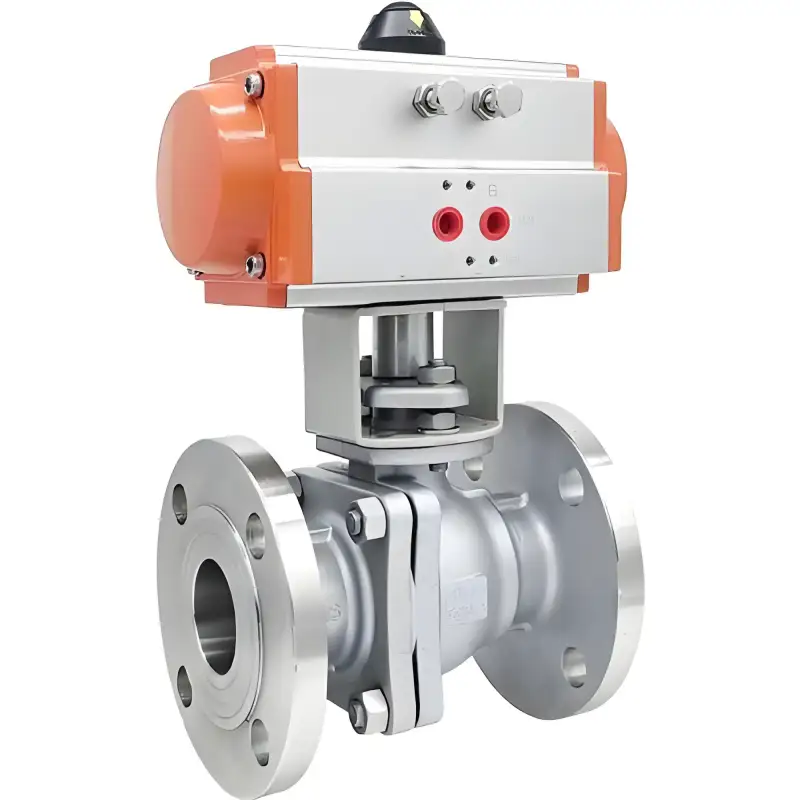
The air‑operated ball valve—also referred to as an on‑off ball valve with a pneumatic actuator—uses compressed air as its power source. Driven by a pneumatic actuator that rotates the ball, it can complete a full stroke in less than one second, making it one of the fastest‑responding valve types for emergency isolation duties.
Factors Affecting Response Speed
The opening and closing time of a pneumatically actuated ball valve depends on several variables: supply air pressure, actuator volume, port size, valve torque, and line differential pressure. For a given valve and actuator combination, response time can be further reduced by increasing the air supply pressure, installing a quick‑exhaust valve, or upsizing the inlet tubing.
For ESD applications, the valve is typically equipped with a single‑acting spring‑return actuator to ensure that, upon loss of air supply, the valve automatically moves to its pre‑defined safe position. The closing time under spring action is determined by both the spring force and the rate at which air exhausts from the cylinder.
This exhaust can be accelerated to millisecond‑range speeds by adding pilot‑operated control valves and high‑flow quick‑exhaust devices.
Key Technical Specifications
| Parameter | Specification |
|---|---|
| Nominal Diameter (DN) | DN15 – DN600 (½″ – 24″) |
| Pressure Rating | PN10 – PN420 / Class 150 – Class 2500 |
| Body Material | WCB Carbon Steel / CF8M Stainless / LF2 Low‑Temp Steel / Duplex Stainless |
| Ball Material | Same as body + surface hardening treatment |
| Seat Material | Reinforced PTFE / PEEK / Metal‑to‑Metal (hard‑seated) |
| End Connections | Flanged (RF/RTJ) / Butt‑Weld (BW) / Threaded |
| Actuator Type | Double‑Acting (air‑to‑open and air‑to‑close) / Single‑Acting Spring‑Return (fail‑safe) |
| Operating Air Pressure | 0.4 – 0.8 MPa (standard), up to 1.0 MPa |
| Full‑Stroke Time | 0.5 – 5 seconds (depends on size, actuator, and accessories) |
| Explosion Protection | Intrinsically safe (no electrical components inside); optional explosion‑proof solenoid valves/limit switches |
| Design Standards | API 608 / ISO 17292 / ASME B16.34 |
| Temperature Range | –196 °C to 260 °C (depending on seat material) |
Typical Applications
-
Emergency shutdown during truck/ marine loading arms for LNG, LPG, and chemical products
-
Fast‑opening for anti‑surge loops on natural gas compressors
-
Fuel‑gas quick‑shutoff valves for furnaces and reactors
-
Remote emergency isolation of toxic or hazardous media pipelines
-
Fire‑safe isolation on tank farm feed/effluent lines (with fusible plug integration)
-
Automatic switching in water treatment and CIP systems
Field Case – Ningbo LNG Receiving Terminal (Truck Loading ESD System)
At this terminal, the truck loading area comprises 20 loading bays. Each bay has a DN50 Class 150 pneumatically actuated ball valve installed on both the liquid and vapour lines as the ESD isolation valve. During loading operations, if a hose detaches or a leak occurs, gas detectors at the bay sense excess LNG vapour and transmit a signal to the SIS. The system issues a valve‑close command within 0.5 seconds.
These on‑off ball valves with pneumatic actuators are fitted with single‑acting spring‑return units, so they close automatically upon air failure. In actual tests, the time from command receipt to complete closure (full 90° stroke) measured 0.8 seconds.
The terminal’s ESD system documentation explicitly states: “The fast‑closing characteristic of the pneumatically actuated ball valve is the key factor that allows the loading‑bay ESD function to meet SIL 2 safety integrity requirements.” Since commissioning in 2017, the ESD system has been triggered 17 times, and in every instance the ball valve closed within one second—with no leakage escalation caused by delayed valve response.
Selection Guidelines for ESD and Fast‑Acting Services
When selecting a pneumatically actuated ball valve for emergency shutdown or rapid on‑off duty, pay special attention to the following three aspects:
-
Response‑time verification – Full‑stroke times vary significantly across different sizes and actuator configurations. During project design, require the supplier to provide a response‑time test report based on actual site air supply conditions, rather than relying solely on theoretical calculations. As a rough guide: DN50 and smaller can typically achieve 0.5–1 s; DN100–200 about 1–2 s; and DN300 and above may need special design measures (oversized ports, quick‑exhaust valves) to meet tight timing requirements.
-
Single‑acting versus double‑acting selection – For ESD duties, a single‑acting spring‑return actuator (fail‑close or fail‑open) is mandatory to guarantee fail‑safe behaviour. For routine remote on‑off service, a double‑acting actuator (air‑to‑open and air‑to‑close, with position held on air failure) is more economical and its response speed is not hindered by spring resistance.
-
Adding accessory delays – The total system response time must include solenoid valve actuation (typically 20–50 ms), limit‑switch signal latency, and other auxiliary delays. For systems requiring a total response time below 2 seconds, choose low‑power, fast‑response solenoid valves (actuation < 15 ms) and keep air supply tubing as short as possible to minimise pneumatic lag.