
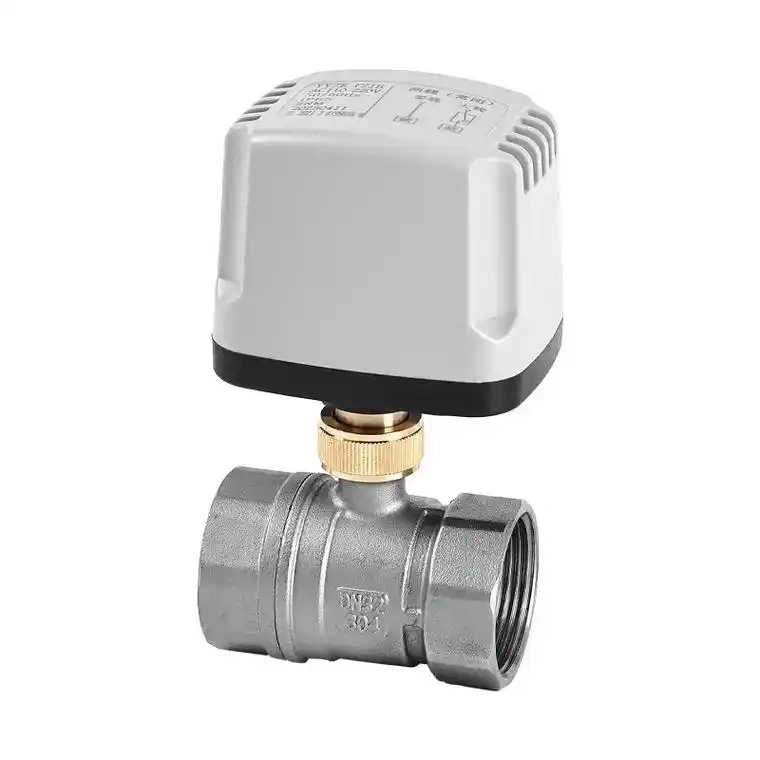
Electric Ball Valve 1 1/2″ for Remote Flow Control
Optimize your pipeline with our 1 1/2″ electric ball valve. Offers precise on/off control, low torque, and IP67 protection for HVAC and industrial automation systems.
Description
1-1/2″ Electric Ball Valve: An Intelligent Fluid Control Solution for HVAC and Industrial Automation
In building automation and industrial process control, the 1-1/2″ electric ball valve is rapidly becoming the standard replacement for conventional manual valves. For pipelines that require remote monitoring or integration into PLC systems, electrically actuated ball valves deliver unmatched convenience and dependability.
This article examines technical specifications, industry applications, and a real‑world case study to illustrate why this valve size is an ideal choice for water treatment and HVAC retrofits.
Electrically Actuated Ball Valve – Core Materials and Technical Data
Designed for frequent cycling and applications demanding precise regulation, our electric actuated ball valve features a stainless‑steel body (CF8/CF8M) paired with an explosion‑proof electric actuator. This combination ensures stable performance under high‑pressure conditions (PN16–PN40) and across a wide temperature range (−20°C to +150°C).
Detailed technical parameters for this model are provided below:
| Parameter | Specification |
|---|---|
| Nominal size | 1‑1/2″ (DN40) |
| Connection type | Female thread (BSPP/NPT) or flange (ANSI 150/PN16) |
| Body material | Stainless steel (CF8/CF8M) / Brass |
| Ball material | Stainless steel (SS304/SS316) |
| Seat material | PTFE |
| Working pressure | Max. 40 Bar (580 PSI) |
| Actuator power supply | AC 110V / 220V or DC 24V |
| Control signal | On‑Off type or modulating (4‑20mA / 0‑10V) |
| Enclosure rating | IP67 (dust‑tight and waterproof) |
| Explosion protection | Exd II BT4 (optional) |
1.5‑Inch Electric Ball Valve – Diverse Application Scenarios
The 1.5‑inch electric ball valve is sized to perfectly suit small‑ to medium‑bore piping. Common uses include:
-
HVAC systems – Controlling chilled or cooling water flow for remote on/off switching or proportional regulation based on temperature sensor feedback.
-
Water treatment and irrigation – In agricultural irrigation or water purification equipment, this electrically actuated valve serves as a reliable supply/drain switch, eliminating the inconvenience of manual operation.
-
Industrial gas / oil lines – In chemical plants requiring explosion‑proof environments, the valve combined with an explosion‑proof actuator safely isolates flammable media.
Selection Guidance for the 2″ Electric Actuated Ball Valve and a Case Study from Vietnam
Although this article focuses on the 1‑1/2″ size, larger systems often require selection of the 2″ electric actuated ball valve. The primary differences between the two lie in flow coefficient (Cv) and required driving torque. For 2‑inch pipes with higher flow velocities, it is advisable to calculate torque based on differential pressure; oversizing a valve to control a small flow should be avoided, as it may create a dead band in regulation.
Real‑World Case: HVAC Retrofit at the Ba Dinh District Government Office, Hanoi, Vietnam
In the third quarter of 2023, our products were successfully deployed in an energy‑saving renovation project for the Ba Dinh District government office building. The existing manual butterfly valves had deteriorated over time, causing uneven chilled‑water distribution and severely poor cooling performance on several floors.
We supplied dozens of 1‑1/2″ electric ball valves for this project, integrated with the building automation system (BAS). With these motorized valves installed, facility operators could remotely adjust chilled‑water flow on each floor’s main supply line based on return‑water temperature readings. After the retrofit, overall cooling energy consumption dropped by approximately 18%, and the problem of excessive temperature differences at terminal units was completely resolved – earning high recognition from the building management.
Motorized Ball Valve – Reliability and Long Service Life
As a type of motorized ball valve, this electrically operated version offers superior resistance to fouling and lower pressure drop compared to solenoid valves. In circulating water systems that contain minor impurities, the ball valve’s shearing action easily cuts through soft particulates, effectively avoiding the jamming failures commonly seen with solenoid valves.