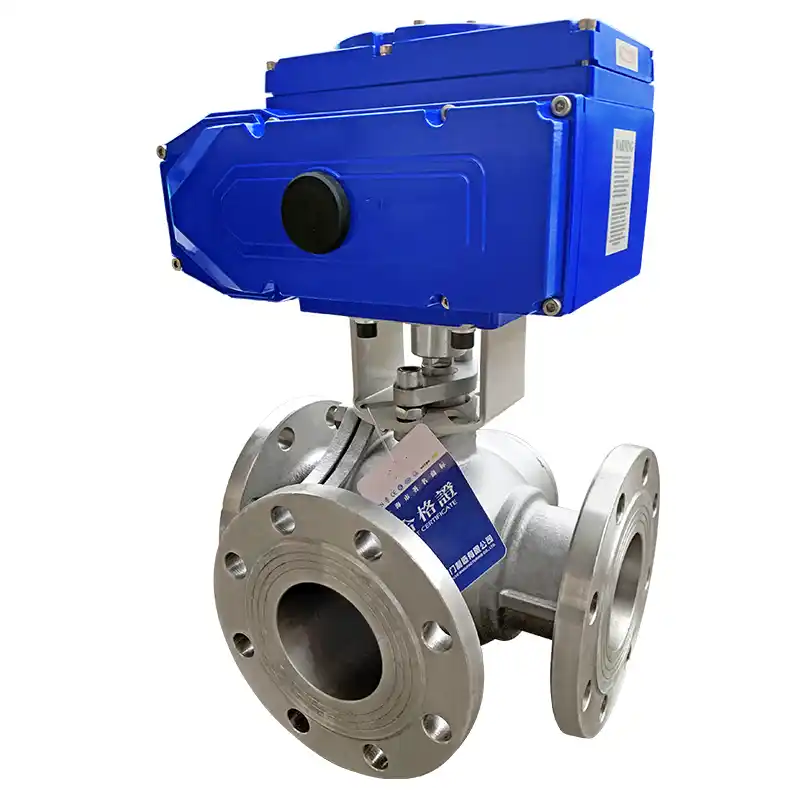

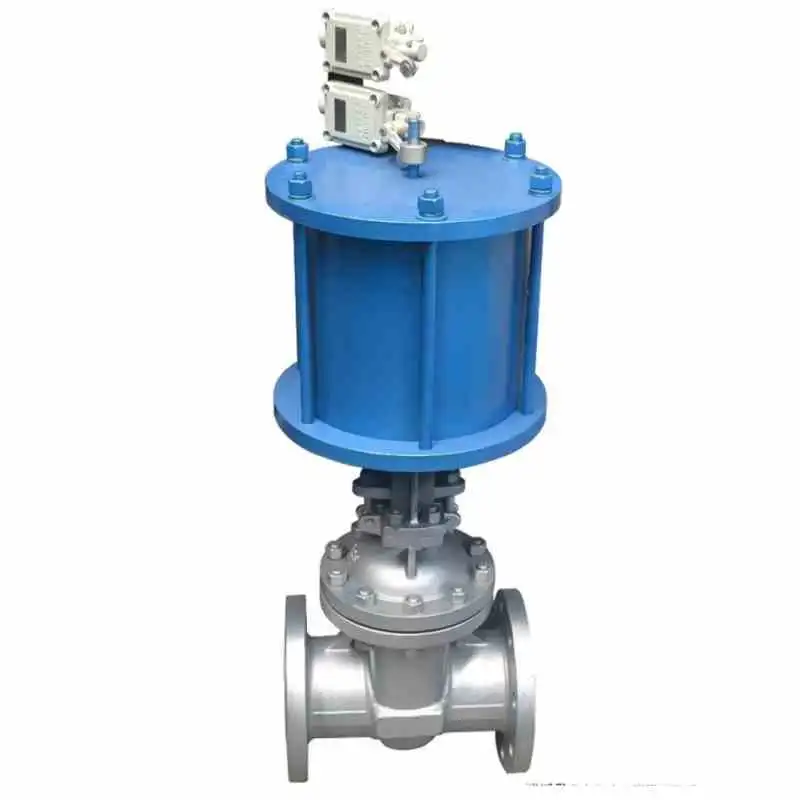
Pneumatic 3 Way Ball Valve for Flow Diversion & Fast Switching
Fast-acting pneumatic 3 way ball valve with L-port and T-port options. Ideal for flow diversion, mixing, and filter backwash. Fast response within 1.5 seconds.
Description
Pneumatic 3 Way Ball Valves are three‑port pneumatic ball valve units. Driven by pneumatic actuators to rotate the ball, they divert, split or combine process media within pipelines. Breaking the limitation of simple on‑off functionality inherent to 2‑way piping layouts, they serve as critical hardware for flow switching and media blending in fluid handling systems.
Compared with the conventional setup of two separate 2‑way ball valves, a single pneumatic 3‑way ball valve consolidates two switching functions inside one compact valve body. It cuts down the quantity of pipe joints, flanges, gaskets and mounting supports, lowering system complexity as well as potential leak sources while saving valuable installation footprint. Such merits prove especially valuable for space‑constrained sites including offshore platforms, skid‑mounted assemblies and densely‑arranged chemical plants.
Two ball path configurations are available for flow‑path design: L‑port and T‑port. L‑port ball valves handle flow diversion with one inlet and two outlets or vice versa, suited for media distribution or flow merging. T‑port variants enable pairwise connection between any two ports or full opening of all three ports, catering to mixing, splitting and multi‑path switching scenarios. End‑users may pick double‑acting actuators for air‑open‑air‑close operation or single‑acting spring‑return actuators that shift to pre‑defined safe positions upon air loss. The maximum explosion‑proof rating reaches Ex d IIB T6 to satisfy installation requirements for Zone 1/2 hazardous zones.
In real‑world industrial operations, media diversion often demands rapid valve actuation to sustain process continuity and prevent hazardous incidents. Working with solenoid valves and DCS/PLC platforms, Pneumatic 3 Way Ball Valves complete full‑stroke 90° or 180° rotation within 0.5‑3 seconds to realize fast flow rerouting and isolation. This quick‑response characteristic makes them ideal for automated systems requiring frequent switching or multi‑stream distribution.
Core Technical Advantages (Why Pneumatic 3 Way Ball Valves?)
Against dual‑valve 2‑way assemblies and manual 3‑way valves, Pneumatic 3 Way Ball Valves deliver distinct strengths:
- Integrated construction for reduced leakage risks: Consolidating functions of two 2‑way valves into one housing, it reduces pipe connections from four (for two 2‑way units) down to three, cutting potential leak points by 25 %. This brings notable benefits for services involving highly toxic or high‑value media.
- Fast actuation for automated diversion: Pneumatic actuators finish flow re‑direction within 0.5‑3 seconds. Linked with DCS/PLC systems, it supports remote automated switching and sequenced procedural control without on‑site manual operation. The advantage stands out for cyclic duties such as filter backwashing and CIP cleaning loops.
- Flexible flow‑path alternatives: L‑port and T‑port ball designs are offered to match diverse process requirements. L‑port suits flow diversion and merging; T‑port applies to multi‑stream distribution, blending and splitting. One valve model covers multiple working conditions.
- Intrinsic explosion‑proof performance: Pneumatic actuators operate without electric power and generate no spark hazards. Supported by ATEX / IECEx certification, they can be deployed safely within Zone 1/2 explosive hazardous atmospheres.
- Space‑saving compact layout: Compared with assemblies built from two 2‑way valves plus connecting piping, a 3‑way ball valve reduces overall footprint by 40‑60 %, well‑suited for offshore platforms, skid‑mounted packages and retrofitting projects with limited available space.
Product Specifications
| Parameter | Specification |
|---|---|
| Valve Type | 3‑Way Ball Valve(L‑Port / T‑Port) |
| Actuator Type | Pneumatic Double Acting / Spring Return(ISO 5211) |
| Nominal Size | DN15 ~ DN300(1/2″ ~ 12″) |
| Pressure Rating | PN16 ~ PN100(Class 150 ~ Class 600) |
| Body Material | WCB(Carbon Steel), CF8/CF8M(Stainless Steel 304/316), Duplex, Inconel |
| Seat Material | PTFE / RPTFE / PEEK / Metal Seated |
| End Connection | Flanged(RF, RTJ), Threaded(NPT, BSP), Socket Weld, Tri‑Clamp |
| Operating Temperature | -40°C ~ +350°C(Subject to seal material) |
| Stroke Time | 0.5 ~ 3 seconds(Subject to actuator dimension and supply air pressure) |
| Explosion‑proof Rating | Ex d IIB T4 / Ex ia IIB T6(Optional) |
| Shut‑off Class | ANSI/FCI 70‑2 Class VI(Bubble‑tight sealing) |
Typical Applications & Case Study
Pneumatic 3 Way Ball Valves serve as standard process components for flow diversion and media blending across petrochemical, water‑treatment, food‑beverage and pharmaceutical industries.
Project Reference The V‑type sand filter backwash system upgrade for a drinking‑water treatment plant operated by SUEZ Eau France in the Paris metropolitan area. The facility supplies potable water for urban Paris. Each filter cell follows sequential air‑scour and water‑wash backwash cycles.
The original layout adopted separate 2‑way valves for air and water circuits, suffering from complex piping, long switching intervals and abundant pipe joints. During automation retrofitting, 3 way pneumatic ball valve (T‑port) was selected to integrate air‑scour and water‑wash flow switching within one single unit.
Under PLC logic control, this pneumatic L‑port ball valve reroutes different media streams and completes air‑water switch within 1.5 seconds, shortening overall backwash cycle duration by roughly 15 %. Meanwhile, the adopted pneumatic T‑port ball valve cut pipe joints from six down to three, lowering leakage risks and routine maintenance workload.
Custom‑configured 3 way ball valve for filter backwash was implemented to deliver fully automatic sequenced backwash operations. Since the retrofit finished in 2020, filter operational stability has improved visibly, and maintenance frequency has dropped by approximately 40 %.
FAQs for Overseas Buyers
Q1: What differentiates L‑port and T‑port for pneumatic 3‑way ball valves? How should I make the selection? A: An L‑port ball features an L‑shaped internal flow passage. It enables flow diversion between one inlet and two outlets or vice versa, yet cannot open all three ports simultaneously. It fits standby‑line switching, sampling diversion and filter bypass duties. A T‑port ball adopts a T‑shaped flow channel, supporting arbitrary pairwise port connection or full opening of all three ports. It is chosen for media blending and stream splitting applications. For pure flow diversion (A→B or A→C), select L‑port. For blending or simultaneous distribution (A→B+C or A+B→C), opt for T‑port.
Q2: What core advantages does a pneumatic 3‑way ball valve hold over a setup with two 2‑way ball valves? A: Three major benefits stand out. First, fewer potential leak points: one 3‑way valve contains merely three pipe‑connection interfaces, while two assembled 2‑way valves require at least four to six joints.
Every removed joint reduces leak hazards, which carries high significance for toxic‑medium service. Second, reduced footprint and weight: a 3‑way ball valve shrinks physical dimensions by 40‑60 % and cuts weight by around 50 %, ideal for offshore platforms, skid‑mounted units and renovation projects. Third, faster switching response: flow rerouting is completed by driving only one actuator. Dual‑2‑way‑valve solutions demand sequential actuation of two separate actuators, which brings longer transition time and more complicated control logic.
Why Choose Our Pneumatic 3 Way Ball Valves?
We deliver highly‑reliable, fast‑response solution packages for Pneumatic 3 Way Ball Valves. All products are engineered and manufactured in compliance with API 6D, ISO 5211 and IEC 61508, subject to 100 % hydrostatic test and tightness inspection. Whether you handle high‑temperature‑high‑pressure hydrocarbons, corrosive chemicals or hygienic food‑grade fluids, we provide custom‑tailored selection proposals with either L‑port or T‑port ball configurations.