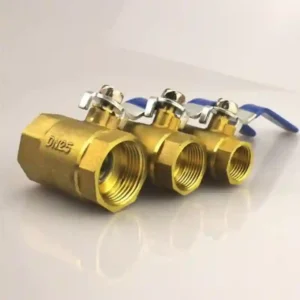











1/4″ NPT Brass Ball Valve – Reliable Seal, Easy Installation

1/4″ NPT brass ball valve with PTFE seats, 3000 psi rating. Tapered thread seal ensures leak-tight performance. Easy install with PTFE tape. Ideal for instrumentation.

Description

The 1/4″ NPT brass ball valve is a miniature 90‑degree quick shut‑off valve equipped with National Pipe Taper American‑standard tapered threads. It sees extensive deployment within instrument pressure‑tap tubing, high‑pressure gas assemblies, pneumatic control circuits and chemical analytical equipment. It delivers fast, trustworthy on‑off regulation for high‑pressure gas and liquid media via 90‑degree ball rotation.

During tightening, NPT tapered threads produce both radial expansion and axial locking effects. Higher medium pressure drives tighter thread engagement to create pressure‑energized metal‑to‑metal sealing. Combined with PTFE seats, dual‑barrier leak prevention is achieved. This valve is particularly well‑suited for industrial instrumentation and high‑pressure gas applications demanding strict sealing performance and straightforward assembly.

Material & Specification

Item Parameter
Body Material Forged Brass (CW617N / ASTM B124)
Ball Material Chrome‑plated brass / 304 stainless steel
Seat Material PTFE
Seal Material PTFE + NBR / FKM (optional)
Nominal Size DN6 (1/4″)
End Connection Female NPT (ASME B1.20.1)
Pressure Rating 3000 psi (gas), 600 WOG (water, oil)
Temperature Range -20°C ~ +120°C (PTFE seat)
Operation Lever‑operated 1/4‑turn (90°) fast open‑close
Operating Torque < 1.2 N·m (low‑torque actuation)
Body Length 42 ~ 50 mm (subject to end configuration)
Stem Structure Blow‑out Proof design
Installation Requirement PTFE tape plus pipe‑wrench tightening; no gaskets or O‑rings required
Compliance Standard MSS SP‑110 / ASME B16.34 / API 598 (testing)

Typical Applications

  • Instrument pressure‑tap and drain lines: Isolation valves fitted upstream of pressure gauges, differential‑pressure transmitters, pressure switches and level transmitters. NPT tapered threads maintain reliable sealing under high‑pressure operating conditions.
  • High‑pressure gas cylinders and manifolds: Shut‑off and switching hardware for outlets of hydrogen, nitrogen, argon, compressed‑gas cylinders and manifold branch ports.
  • Pneumatic control systems: Pilot‑gas loop switches and bypass units for precision pressure regulators, pneumatic positioners and solenoid valves.
  • Chemical‑analysis and laboratory instruments: Carrier‑gas and sample‑stream switching for gas chromatographs, mass spectrometers and TOC analyzers.
  • Oil‑field wellhead instrument manifolds: Multi‑port integrated valve assemblies on pressure‑tap lines for production and gas‑production trees.
  • Portable test equipment: Panel‑mount manifold valves for mobile pressure calibration benches and flow‑calibration devices.

Core Advantages: Reliable Seal & Easy Installation

For instrumentation and high‑pressure gas infrastructure, valve leakage not only introduces measurement deviations but also poses substantial safety risks. This valve is purpose‑engineered around two core merits: Reliable Seal and Easy Installation.

  1. NPT tapered threads — pressure‑energized sealing performance NPT (National Pipe Taper) threads adopt a taper angle of 1°47’. When male and female threads mate, tapered contact surfaces generate radial expansion force. Axial separating force induced by high‑pressure gas or liquid further wedges thread profiles together. This self‑energizing sealing principle yields tighter joints as system pressure rises.

Unlike BSP parallel threads or compression connections that rely on O‑rings, gaskets or ferrules for sealing, NPT joints establish sealing purely via metal‑to‑metal interference fit. It eliminates leakage risks stemming from elastic‑seal extrusion, material aging and chemical degradation, which carries critical importance for 3000‑psi‑rated high‑pressure gas service.

Furthermore, the stem incorporates Blow‑out Proof construction with a retaining shoulder at its base. Even when abnormal cavity overpressure or unexpected seal failure occurs, the stem cannot eject outwards, safeguarding operators and preserving system integrity.

  1. Easy Installation — O‑ring and gasket‑free assembly Conventional parallel‑thread ball valves generally require O‑rings, flat gaskets or composite sealing washers to achieve leak‑tight joints. Such components expand spare‑part inventories and suffer aging‑related failure under high‑pressure or high‑temperature service.

The 1/4″ npt brass ball valve supports highly streamlined field mounting:

  • Wrap 3‑4 uniform layers of PTFE tape onto male NPT threads
  • Hand‑thread the valve onto mating female threads until finger‑tight
  • Apply 2‑3 additional turns with a pipe wrench (roughly 1.5‑2 thread pitches) to finish installation

No sealing gaskets, O‑rings, thread sealant or specialty tools are needed. Single‑valve installation is normally completed within three minutes. For mobile test rigs and laboratory setups subject to frequent disassembly‑reassembly cycles, this feature cuts maintenance downtime and reduces spare‑part varieties.

Field Case: Luoyang Pris Detection Technology Co., Ltd. — Pressure‑Tap Manifold for Mobile Pressure‑Gauge Calibration Bench

Project: Integrated Pressure‑Tap Manifold Project for Mobile Pressure‑Gauge Calibration Bench Location: Luoyang City, Henan Province, China

Luoyang Pris Detection Technology Co., Ltd. functions as a third‑party testing institute specializing in on‑site calibration for pressure gauges and transmitters deployed within petrochemical facilities. Its flagship mobile calibration bench integrates four pressure‑tap valves on a roughly 250 mm × 200 mm control panel, interfacing with reference gauges, units under calibration, high‑pressure nitrogen supply and system vent ports.

Operating media is high‑purity nitrogen with maximum working pressure reaching 40 MPa (≈5800 psi). Frequently transported to diverse customer sites, the equipment imposes stringent requirements on valve sealing stability and service‑friendliness.

The company’s prior‑generation calibration benches adopted BSP parallel‑thread brass ball valves sealed by O‑rings. Under 40 MPa high‑pressure conditions, O‑ring components frequently extruded or fractured, driving a leakage rate as high as 15 %. Considerable working hours were consumed inspecting and replacing seals before each field assignment, impairing service efficiency and undermining client confidence.

In 2022, the facility fully retrofitted all pressure‑tap positions with 1/4″ NPT brass ball valves. The pressure‑energized sealing characteristic of NPT tapered threads delivers progressively tighter joints under 40 MPa working pressure and eliminates external leakage entirely. Simplified assembly allows field technicians to replace valves merely by applying PTFE tape and tightening threads. Stockpiles of assorted O‑rings and gaskets are no longer required. Single‑valve replacement duration dropped from 15 minutes down to less than five minutes.

Since the retrofit, four mobile calibration benches have completed more than 200 field‑calibration assignments for enterprises including Sinopec Luoyang Branch, Zhongyuan Oilfield and Henan Energy Chemical Group. Valves have endured over 3 000 actuation cycles with zero leakage and zero malfunctions.

According to equipment‑maintenance personnel, the dependable sealing and hassle‑free installation of NPT ball valves “fundamentally resolved our long‑standing high‑pressure sealing pain‑points for mobile test hardware”. This product has been listed as the designated option within the company’s Calibration Bench Standard‑Configuration Checklist.