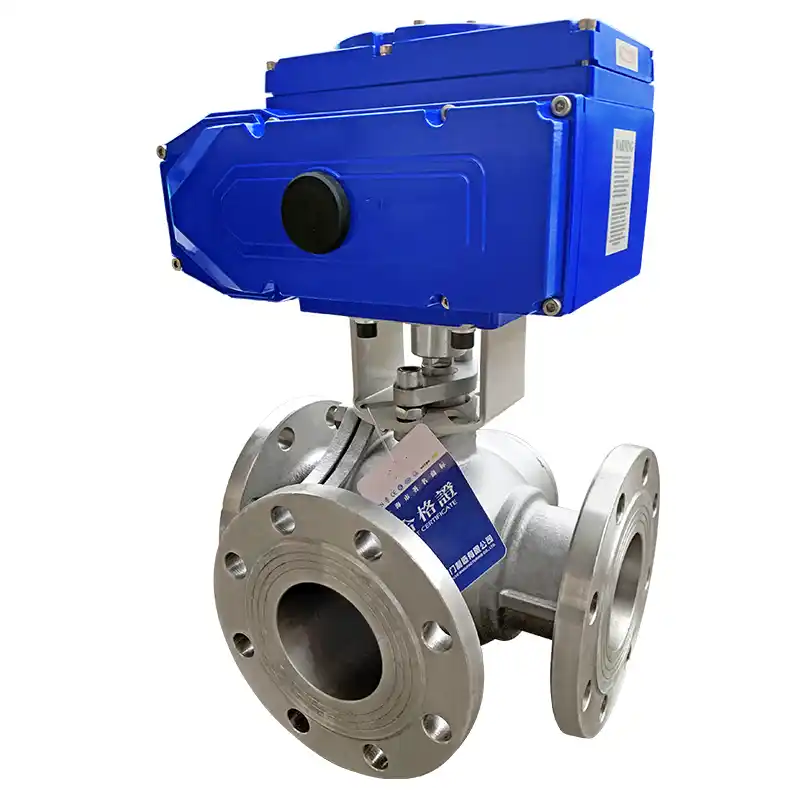

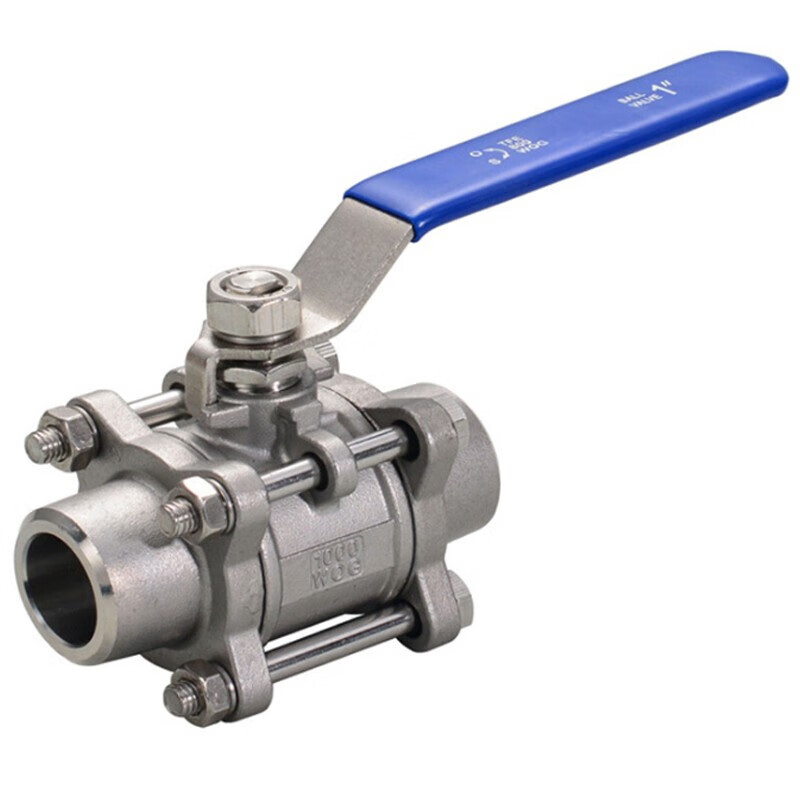
Pneumatic three Piece Welded Ball Valve – Low Emission BW End
Pneumatic three piece welded ball valve with butt weld ends for zero flange leakage, ISO 15848 low emission, and remote actuator control for pipeline and chemical services.
Description
A pneumatic three piece welded ball valve integrates a pneumatic actuator, three‑piece valve body and butt‑weld end connections into one automated shut‑off valve. Its valve body consists of three independent components — left body, central body and right body — fastened together by bolts. The ball is supported in the valve cavity in either floating or trunnion‑mounted configuration, and the stem rotates the ball through 90° to block or open media flow.
End sections adopt Butt Weld End connections; the valve is welded directly to process piping without flange gasket sealing faces, eliminating potential leakage paths at flange joints. A pneumatic actuator is mounted on top. Solenoid valves receive 4‑20 mA analog signals or digital communication commands from DCS/PLC/SCADA systems to enable remote automatic on‑off operation. Thanks to the three‑piece construction, technicians can extract the central body and replace seats and ball components without cutting existing weld joints.
This welded ball valve with pneumatic actuator is widely deployed in automated piping systems with strict leak‑tightness requirements, such as high‑pressure gas, high‑temperature steam and toxic‑medium service. Products of this type have been applied in batches for long‑distance pipelines, chemical plants and city‑gate gas stations as pneumatic three piece welded ball valve in china.
Material and Technical Specifications
| Parameter Item | Specification Range |
|---|---|
| Valve Body Material | WCB Carbon Steel / CF8M (316 Stainless Steel) / LF2 Low‑temperature Carbon Steel / F91 Chromium‑Molybdenum Steel / Duplex Stainless Steel 2205 |
| Ball Material | Body‑matched material / 316L / Stellite hard‑facing / Tungsten‑carbide coating |
| Stem Material | 316L / 17‑4PH / Inconel 718 |
| Seat Material | PTFE / RPTFE / PEEK / Metallic seat (Stellite / Tungsten‑carbide) |
| Nominal Size | DN15 ~ DN600 (1/2″ ~ 24″) |
| Pressure Class | Class 150 / 300 / 600 / 900 / 1500 / 2500 |
| End Connection | Butt Weld End, complying with ASME B16.25 |
| Body Structure | Floating type — DN ≤ 200 / Class ≤ 600; Trunnion mounted — DN ≥ 250 / Class ≥ 900, corresponding to welded‑end variants of three piece flanged trunnion ball valve body |
| Actuator Type | Pneumatic actuator (double‑acting / spring‑return Fail‑Safe) |
| Actuator‑to‑Body Interface | ISO 5211 direct mounting platform / bracket mounting (subject to actuator size), complying with standard interfaces of pneumatic three piece welded ball valve manufacturer |
| Control Accessories | Solenoid valve (single‑/double‑coil, 24VDC / 220VAC) / Limit switch (open‑closed position feedback) / Pneumatic positioner (modulating service) / Filter‑regulator / Speed‑control valve |
| Stem Sealing | Low‑emission graphite packing / PTFE V‑ring packing (conforming to ISO 15848‑1) |
| Central‑body Gasket | Metal spiral‑wound gasket plus flexible graphite |
| Fire‑Safe Design | API 607 / ISO 10497 (optional) |
| Operating Temperature | ‑46 ℃ ~ 400 ℃ (seat‑material dependent) |
| Material Certificates | EN 10204 3.1 / 3.2 (available upon request) |
| Non‑destructive Testing | Weld RT / PT inspection per ASME Section V |
Butt‑Weld End Connection
Butt‑weld ends are directly joined to process piping via butt welds under ASME B16.25. Completed welds undergo 100 % radiographic testing (RT) and penetrant testing (PT) to guarantee joint quality. Unlike flange‑connected alternatives, butt‑weld construction removes flange‑gasket sealing faces and their associated leakage risks. It represents the preferred end‑connection solution for high‑pressure gas, toxic media and high‑temperature steam where leak containment is critical.
Structural Advantages: Low‑Emission Performance & Remote Automation
Low fugitive‑emission capability and remote operability stem from optimised end‑connection geometry, sealing arrangements and control architecture.
- Elimination of flange‑related leak points: Butt‑weld joints remove two flange‑gasket sealing interfaces found on flanged valves. External leakage paths are reduced to stem packing and two central‑body gasket joints. For high‑pressure gas pipelines, every eliminated flange gasket mitigates failure modes such as bolt‑preload relaxation, gasket creep and thermally‑induced seal degradation.
- Low‑fugitive‑emission stem sealing: The stem utilises low‑emission graphite packing or PTFE V‑ring packing, while the central‑body joint adopts combined spiral‑wound metal‑flexible‑graphite gaskets. The whole valve can pass ISO 15848‑1 fugitive‑emission qualification, limiting stem‑side leakage below 50 ppmv and meeting EU Industrial Emissions Directive (IED) and German TA‑Luft regulatory requirements.
- Pneumatic actuation for remote‑site operation: Equipped with double‑acting or spring‑return pneumatic actuators, the valve receives set‑point commands via solenoid valves from DCS/PLC/SCADA systems (4‑20 mA analogue or digital protocols including PROFIBUS and Modbus). Limit switches feed back open‑closed status for remote monitoring. Spring‑return units drive the valve to a predefined safe position (Fail‑Safe Open / Closed) upon instrument‑air loss, making them suitable for ESD emergency‑shutdown systems.
- Maintainability for welded‑in‑place valves: Once welded into a line, the valve cannot be physically removed without cutting piping. Two‑piece welded ball valves demand pipe cutting for seat replacement. By contrast, the three piece butt welded ball valve allows maintenance crews to loosen central‑body bolts and extract the middle cartridge for seat and ball servicing, delivering serviceability comparable to flanged‑body hardware.
Application Scope
The pneumatic three piece welded ball valve is widely used in the following sectors:
- Long‑distance oil‑and‑gas transmission pipelines: SCADA‑controlled block valves and ESD emergency‑shut‑down valves for natural‑gas, crude‑oil and refined‑product transport lines.
- High‑pressure chemical piping: Emergency shutdown valves within SIS safety‑instrumented systems for high‑pressure polyethylene, polypropylene and other polymer‑process loops.
- High‑temperature steam circuits: Main‑steam and reheat‑steam lines in power plants (Class 900 ~ 2500, service temperatures above 540 ℃).
- City‑gate natural‑gas stations: Remotely‑operated block valves for high‑pressure process‑area piping.
- Coal‑to‑chemical and syngas facilities: Valves for crude‑syngas outlets downstream of gasifiers, handling particulate‑laden corrosive process streams.
- Off‑shore platforms and sub‑sea pipelines: Sub‑sea manifolds and riser‑line valves, where butt‑welded joints are the proven reliable connection method for sub‑sea service.
Field Reference Case
Pneumatic three‑piece welded ball valves were deployed as line block valves and vent‑valve assemblies within valve‑chamber ESD systems on the middle section of the China‑Russia East‑Route Natural‑Gas Pipeline. Running from Heihe in Heilongjiang province southwards to Shanghai, this pipeline features a design pressure of 12 MPa, nominal sizes DN400 ~ DN600 and Class 900 pressure rating. Valves adopt A350 LF2 low‑temperature carbon‑steel bodies, metallic valve seats, spring‑return pneumatic actuators plus supporting solenoid valves and limit switches, and are commanded via the SCADA platform.
All valve‑chambers along this route operate as unattended stations. Fully‑welded valve‑to‑pipe joints dispense with flange gaskets, cutting external leakage pathways by roughly 40 % compared with flanged‑valve layouts. Only stem packing and two central‑body gasket joints remain as external sealing interfaces. Low‑emission graphite‑based stem packing and dual‑layer central‑body gaskets are implemented. Since commissioning in 2019, thousands of installed welded ball valves across the trunk‑line have recorded zero‑reported external‑body‑leakage incidents.
On the automation side, pneumatic actuators in each valve‑chamber execute open‑close actions driven by solenoid valves receiving SCADA commands; limit‑switch feedback transmits real‑valve‑position data back to the central control room. Upon detecting pipeline rupture or leakage via pressure‑drop‑rate algorithms, the SCADA system issues remote shutdown orders to isolate affected segments. Full sequence from fault identification to valve completion takes 30‑60 seconds. Routine functional testing and simulated emergency drills have been executed multiple times, achieving 100 % remote‑control success rate.