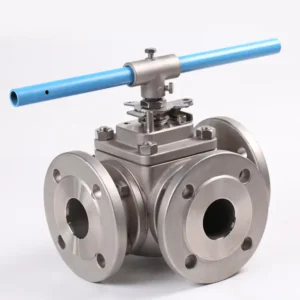

The 3‑way control valve body is equipped with three medium ports. It relies on spool displacement to change the flow cross‑sectional area of each passage to realize two basic working conditions: medium mixing or medium diverting. The internal flow path design of the valve body means these two types cannot be interchanged arbitrarily.
For medium mixing service, the 3 way mixing control valve is applied. Two streams of fluid at different temperatures enter through two inlets, and mixed medium is discharged from a single outlet after spool modulation. It is widely used for temperature control in heat‑exchange systems to stabilize the output medium temperature.
The 3 way mixing control valve requires good anti‑erosion performance for its spool. Excessive differential pressure between the two fluid streams will accelerate wear of internal components.
For medium diverting service, a single medium flows in via the inlet, and the valve distributes fluid to two outlet pipelines to complete flow diversion. Diverting‑type three‑way valves shall not be directly used for medium mixing; their internal flow channel design will lead to degraded modulation accuracy.
Functional Characteristics of 3 way control valve
- Flow regulation: When matched with electric or pneumatic actuators and positioners, spool position is adjusted to continuously modulate flow in each pipeline, instead of simple on‑off two‑position operation. Corresponding search term: pneumatic 3 way control valve manufacturers. Pneumatic versions are driven by air supply and suitable for explosion‑proof process sites; electric models require no air source and are mostly deployed in HVAC systems.
- Working condition differentiation: Flow path structures differ between mixing and diverting services. 3‑way mixing diverting control valve OEM manufacturer can customize valve body flow path structures according to project operating conditions.
- Leakage class: Metal‑seated and soft‑seated versions deliver different leakage rates. Chemical projects tend to refer to test reports on functional safety and leakage provided by SIL certified 3 way control valve manufacturers.
- Kv flow coefficient: The Kv value defines the maximum flow capacity of the valve. Selection must match pipeline flow rate. Deviation in Kv selection will result in temperature control failure. For 3 way control valve for HVAC process system, parameters including Kv, medium temperature and differential pressure shall be verified with priority.
- Material compatibility: Cast iron, cast steel and stainless steel valve bodies are suitable for water, steam and corrosive media respectively. Domestic suppliers 3 way control valve manufacturers China offer optional valve body materials.
When procurement and EPC engineers source from 3 way control valve manufacturers, they aim to obtain application‑matched product parameters, test reports and reliable supply solutions.
Many buyers prioritize pneumatic 3 way control valve manufacturers to verify production and assembly competence for pneumatically actuated variants.
Functional positioning of the valve must be clarified during the selection phase. The 3 way mixing control valve serves mixing‑type temperature control with two incoming media. Mixing‑designed valve bodies cannot be directly adopted for diverting duties. Improper selection will trigger on‑site failures such as temperature fluctuation and spool erosion.
For HVAC and process pipeline projects, Kv value, allowable differential pressure and leakage class of the 3 way mixing control valve shall be cross‑checked one‑by‑one against actual system operating parameters.
For projects with custom requirements, buyers may refer to 3‑way mixing diverting control valve OEM manufacturer and confirm whether the factory supports modifications on valve body material, actuator selection and nameplate customization.
For chemical, oil and gas projects, purchasers filter SIL certified 3 way control valve manufacturers and verify whether functional‑safety test documents comply with IEC 61508 standards.
For building heat‑exchange stations and district heating applications, bulk purchasers look for 3 way control valve for HVAC process system, with focus on valve body material, protection class and applicable medium temperature range.
Numerous buyers also search 3 way control valve manufacturers China to compare local factories on lead time, inspection procedures and export certifications.
When engaging suppliers, purchasers shall request material test reports for valve bodies and performance test records, and confirm availability of datasheets and CAD drawings.
Confirm whether the manufacturer can calibrate flow characteristics in accordance with ISA‑75.01.01 standard, rather than relying solely on nominal parameters from product brochures.
After validating manufacturing capabilities, further evaluate MOQ, lead time, trade terms and spare‑part delivery cycle. Only after completing all above checks can the relevant manufacturer be added to the approved vendor list.