
In water supply, irrigation and HVAC piping, many users fall into a common misconception: maximum flow can be achieved simply by selecting the correct connection size.
In reality, to unlock the full flow capacity of a 3/4 inch piping system, the hose, internal bore of valves, pressure loss and operating conditions will all directly limit the actual water output. Even if all fittings are 3/4 inch, the flow will still be restricted if the internal bore diameter is small.
Understanding the actual water delivery capacity of 3/4 inch hoses
When searching for what does a 3/4 water hose flow and how much water can a 3/4 inch hose push, we mainly distinguish between the theoretical capacity of the hose and the actual on-site output.
Theoretically, the inner wall of a 3/4 inch hose can handle relatively high flow rates, yet the actual flow is constrained by supply pressure, hose length, reduced bore at fittings and end nozzles. With identical inlet pressure, longer hoses create greater frictional loss along the pipeline, resulting in lower outlet flow.
There is no fixed value for the question how much water is 3/4 inch. Flow is higher for short hoses with sufficient pressure; flow drops significantly when the piping is extended or multiple fittings feature reduced bores.
One critical point to note: hose connection size is not equal to hose inner diameter. Some low-cost 3/4 external thread hose fittings have a necked-down internal design. Even if the hose body has a compliant inner diameter, the fitting section becomes the throttling point for the entire pipeline.
When selecting and purchasing a 3/4″ brass ball valve, do not only check the thread specification. You must verify the valve’s internal bore. If a reduced port ball valve is selected, even though the inlet and outlet threads are 3/4 inch, the reduced ball bore will cap the maximum flow of the whole piping system.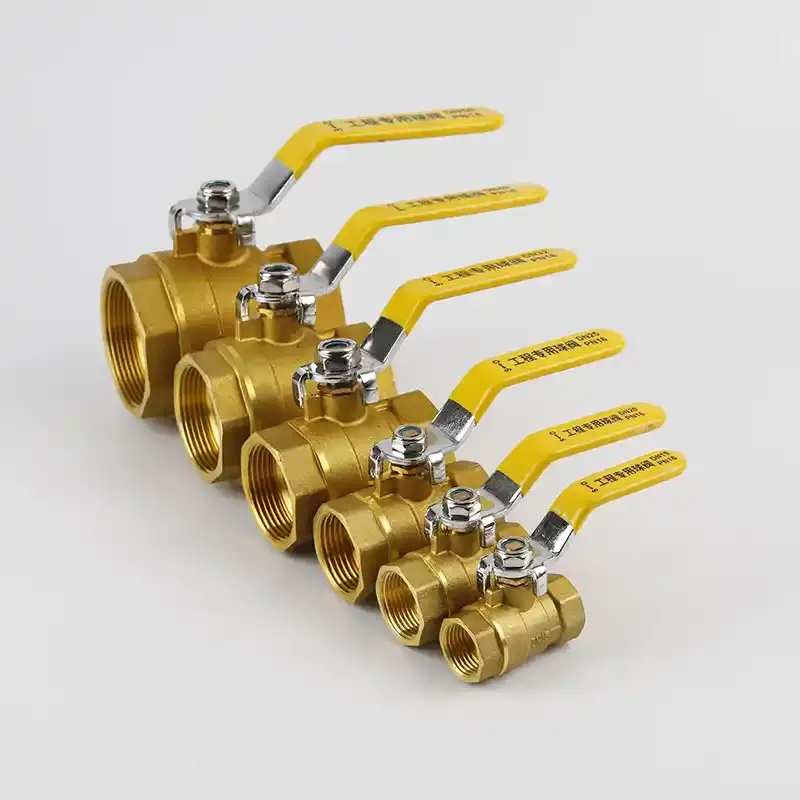
Valve selection: prioritize bore size over thread rating for maximum flow
To achieve max flow in a piping system, there must be no obvious bottleneck in the internal flow cross-section across the entire line. Any component — hose, fitting, ball valve or pipe — with a narrowed inner diameter will become a restriction point.
Ball valves marked with the same 3/4 inch thread are available in two designs: full port ball valve and reduced port. A full port ball valve features a ball bore close to the pipe inner diameter with minimal pressure loss. A reduced port ball valve has 3/4 inch threads but a smaller internal through bore. It is suitable for isolation shutoff only, scenarios where flow rate is not a concern, and is not recommended for irrigation or water supply systems requiring high flow.
Many purchasers refer to the ball valve Cv flow coefficient. The Cv value represents the flow capacity of the valve. For the same nominal size, a higher Cv means higher water flow under the same pressure differential. The Cv value of a 3/4 inch full port ball valve can be nearly double that of a reduced port model, so this parameter must be verified on the selection datasheet.
Practical tip: avoid combining a large bore hose with a reduced port valve in one system. The hose can deliver high flow, yet the valve throttles the flow, and the performance advantage of the hose cannot be utilized at all.
3/4 inch valve selection reference for different applications
HVAC radiator applications
Many users look up what is a 3/4 inch valve for a radiator. 3/4 inch valves are widely used in hot water radiator systems, but not all radiator valves are designed for maximum flow.
Radiator thermostatic valves require flow regulation. Some radiator ball valves intentionally adopt a smaller bore to control hot water flow in the circuit and achieve room temperature adjustment.
Do not directly use high-flow full port ball valves designed for irrigation water supply in radiator circuits. Radiator systems prioritize adjustable flow. Blindly pursuing max flow will cause hydraulic imbalance in the circuit, resulting in overheating in some rooms and insufficient heating in others.
For isolation shutoff on HVAC piping, a 3/4″ npt ball valve can be used for maintenance isolation. For regulating branch circuit flow, use dedicated radiator control valves.
Irrigation, water supply and tank drain applications
Garden irrigation, high-volume draining and car wash systems are typical scenarios where maximum flow of a 3/4 inch system is required.
- Hose: confirm the actual inner diameter of the hose instead of the thread fitting size; avoid fittings with necked-down bores.
- Valve: select full port ball valve as the first choice and check the Cv flow coefficient.
- Fittings: minimize multiple reducers and small-bore nozzles in the pipeline; every bore reduction adds cumulative pressure loss.
- Water source: if the incoming water pressure is inherently insufficient, upgrading to larger bore valves and hoses cannot increase flow out of nothing.
Common pitfalls in size matching
- Matching connection specification ≠ matching flow capacity: all threads may be 3/4 inch, yet flow rates differ greatly due to varying internal through bores.
- Blindly upgrading hoses: switching to a larger inner diameter hose while retaining reduced port valves and fittings yields almost no flow improvement, resulting in wasted investment.
- Applying water supply ball valves to radiators: full port water supply ball valves deliver high flow but lack regulating capability, leading to hydraulic imbalance in radiator circuits.
- Ignoring frictional loss from hose length: even if all components are full port, hose lengths exceeding 100 feet will see obvious flow reduction at the outlet due to friction loss.
Simple on-site troubleshooting method
If your 3/4 inch piping fails to deliver the expected water output, locate the bottleneck step by step:
- Remove the end nozzle and run water directly to check whether the nozzle is causing throttling.
- Bypass the valve and connect the hose directly to the water supply, then compare flow rates to determine if the valve is the restriction point.
- Check hose product specifications to confirm the true inner diameter and rule out necked-down fittings.
To achieve maximum flow for a 3/4 inch system, the core principle is to eliminate throttling bottlenecks throughout the pipeline. Thread size only determines whether parts can be threaded together. The actual water delivery capacity is determined by the internal flow bore and Cv flow coefficient of every component, combined with supply pressure and pipe length for comprehensive evaluation.