
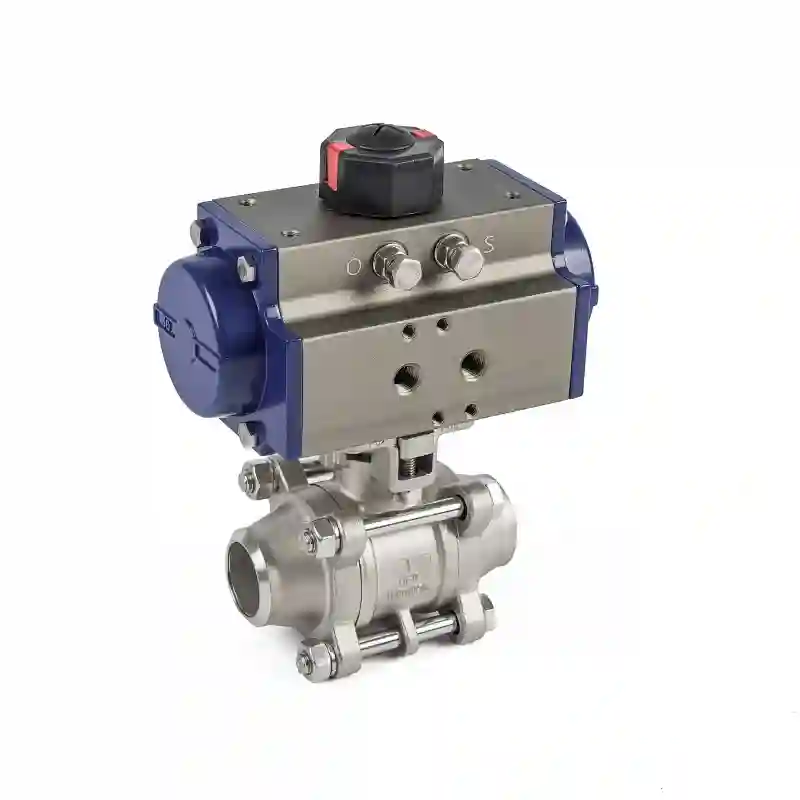
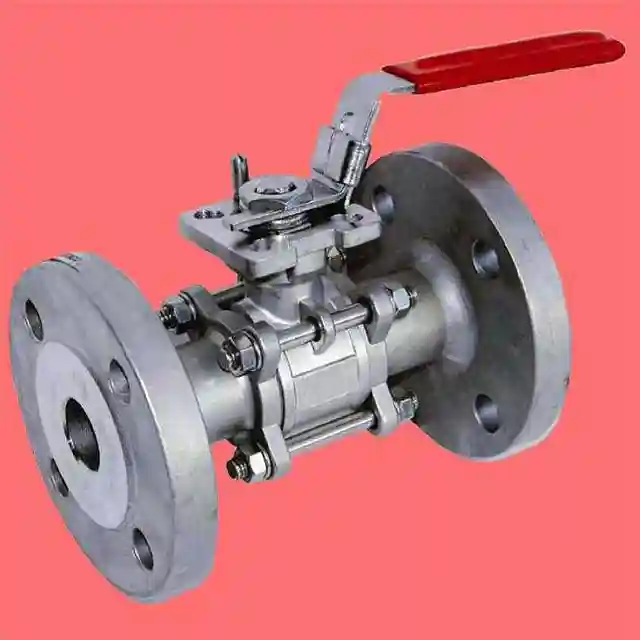
Metal 3 Piece Floating Ball Valve – Wear Resistant Carbide Coated
Metal three piece floating ball valve with Stellite/tungsten carbide seats, wear and erosion resistant for high temperature slurry, steam, and thermal oil services.
Description
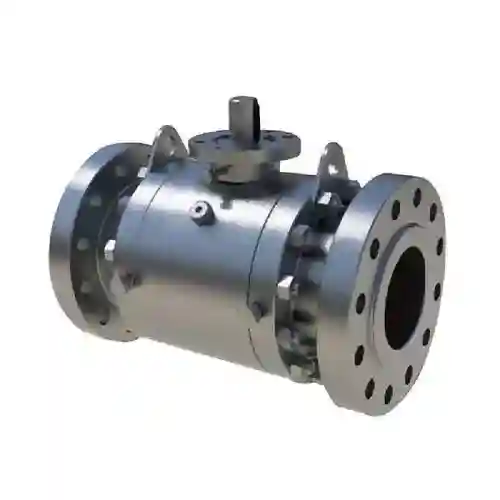
The metal three‑piece floating ball valve is a metal seated ball valve. Its body consists of three independent segments‑left‑hand body, central body and right‑hand body‑clamped together by high‑strength bolts. Suspended within the cavity, the ball rests against bilateral metal seats without dedicated bearing supports. Stem‑driven 90‑degree rotation enables media shut‑off and flow modulation. It follows the pressure‑assisted self‑sealing principle: upstream process pressure forces the ball against the downstream seat, generating higher sealing contact pressure as system pressure rises.
Replacing conventional polymer seats such as PTFE or PEEK, hard‑faced metal seats (Stellite / tungsten carbide overlay) equip this metal seat ball valve to withstand operating temperatures up to 400 ℃ as well as erosive particle‑laden process streams. Its three‑piece construction permits on‑site extraction of the central cartridge for renewal of metal seats and ball without removing the full valve. Such three piece ball valve metal seated architecture delivers service‑friendly performance for abrasive‑duty applications.
Floating‑type implementation applies within DN ≤ 200 and Class ≤ 600. For service conditions beyond this scope, specify trunnion‑supported variants with three piece flanged trunnion ball valve body construction.
Material and Specification
| Parameter | Specification Range |
|---|---|
| Valve Body | WCB (carbon steel) / CF8M (316) / Duplex 2205 / Alloy 20 |
| Ball | 316L / Duplex stainless steel / Stellite or tungsten carbide hard‑faced overlay |
| Stem | 316L / 17‑4PH / Inconel 718 |
| Seat | Metal seat: Stellite 6 / Stellite 12 (HRC 45‑50), tungsten‑carbide coating (HRC 70+), 17‑4PH (HRC 38‑42); three piece ball valve metal seated configuration |
| Nominal Size | DN15 ~ DN200 (1/2“ ~ 8”) |
| Pressure Class | Class 150 / 300 / 600 |
| Operating Temperature | ‑196 ℃ ~ 400 ℃ (subject to seat material); suited for high temperature ball valve service |
| End Connection | Flange (ASME B16.5 / EN 1092‑1) / Butt weld / Socket weld |
| Body Design | Floating type — ball supported by dual metal seats |
| Sealing Rating | ISO 5208 Rate B / Rate C (metal‑to‑metal seating permits controlled minor leakage) |
| Sealing‑Surface Finish | Lapped mating surfaces, Ra ≤ 0.2 μm |
| Anti‑Blow‑Out Stem | Standard supply |
| Actuator Mounting Platform | ISO 5211 direct‑mount platform (optional) |
| Material Certificate | EN 10204 3.1 (available upon request) |
Structural Features: Abrasion and Erosion Resistance
Superior wear‑resistant performance of the metal three‑piece floating ball valve originates from hard metal‑seat material selection and precision lapping between ball and seat pairs.
Hard‑faced metal seating: In particle‑bearing services, hard solid contaminants embed into or cut through polymer seats (PTFE / PEEK), rapidly destroying sealing geometry. As a metal seated ball valve, this unit adopts overlay or coating techniques to deposit high‑hardness alloy layers onto seat sealing faces. Stellite 6/12 cobalt‑base alloys reach HRC 45‑50, while tungsten‑carbide coatings achieve HRC 70 and above. These hard‑phase surfaces resist erosive grooving under particle impingement and preserve sealing‑surface integrity, forming the core technical foundation for extended service life of this metal seat ball valve within abrasive process environments.
Matched‑pair lapping: Prior to assembly, each ball‑and‑seat set undergoes dedicated l‑apping treatment. Lapping compound removes microscopic surface peaks, creating continuous conformal contact bands between spherical and seat sealing faces. Finished sealing surfaces achieve Ra ≤ 0.2 μm, supporting controlled‑leakage metal‑to‑metal sealing performance.
Application boundaries for floating‑type layout: Metal floating ball valves target medium‑pressure duties within DN ≤ 200 and Class ≤ 600. Process pressure thrusts the ball firmly against downstream metal seats. Sustained contact pressure inhibits particle entrapment within sealing gaps for particle‑laden fluids. Once nominal size exceeds DN200 or pressure surpasses Class 600, ball dead‑weight plus process‑induced thrust overburden seat load‑bearing capacity; three piece flanged trunnion ball valve body trunnion‑mounted designs shall be selected instead.
Maintainability for abrasive‑duty service: Progressive material loss still occurs on metal seats after prolonged exposure to particle‑rich media. The three‑piece design enables field technicians to pull out the central cartridge for visual inspection of ball and seat wear. Damaged seats can be replaced or sealing surfaces repaired via on‑site re‑lapping before reassembly. Complete valve removal from flanged joints is unnecessary, making the design well‑suited for pipe‑rack installations with constrained workspace or where overhead lifting equipment is unavailable.
Application Scenarios
The metal seated ball valve is widely deployed within medium‑to‑low‑pressure piping handling high‑temperature and particle‑carrying media:
‑ FCC slurry systems: High‑temperature (~350 ℃) oil‑slurry lines laden with fine catalyst powders under severe particle erosion.
‑ Mineral‑ore slurry and tailings transport: Slurry pipelines carrying hard mineral particles such as quartz subject to intensive abrasive wear.
‑ FGD gypsum slurry: Discharge piping for gypsum slurries loaded with calcium‑sulfate crystalline solids in flue‑gas desulfurization circuits.
‑ High‑temperature steam and thermal‑oil loops: Steam and heat‑transfer‑oil circuits operating at 250 ℃‑400 ℃, where polymer seats fail; high temperature ball valve hardware is required.
‑ Hot process gas: High‑temperature flue‑gas and off‑gas piping carrying dust particulates.
‑ Syngas and coal‑chemical processes: High‑temperature syngas pipelines containing coal dust or carbon‑black particles.
Field Application Case
Metal three‑piece floating ball valve units serve as manifold diversion valves for flotation‑tailings slurry feeding into different thickener tanks at the flotation section of Chuquicamata Division concentrator (Codelco, Corporación Nacional del Cobre de Chile, Calama, Antofagasta Region, Chile). These DN150, Class 150 valves feature duplex 2205 bodies, tungsten‑carbide‑overlaid balls (HRC 70+), and tungsten‑carbide alloy seats, representing a typical metal seated ball valve configuration.
Chuquicamata ranks among the world’s largest open‑pit copper mines, with concentrator ore throughput exceeding 200 000 tons per day. Flotation tailings slurry carries 30‑40 wt % solid residues including quartz and sulfide minerals (Mohs hardness 7), subjecting valve internals and sealing interfaces to persistent abrasive and erosive attack.
Multiple alternative valve concepts were previously trialled at this location. Rubber‑lined ball valves suffered liner rupture within weeks due to cutting action from coarse tailings particles. Ceramic‑lined ball valves exhibited cracking and spalling triggered by thermal shock from diurnal temperature swings. Soft‑seat (PTFE / PEEK) ball valves developed erosive grooves across sealing surfaces within several weeks, resulting in severe internal leakage.
As a metal seat ball valve, this metal three‑piece floating ball valve incorporates tungsten‑carbide coated seats and balls whose hardness greatly outperforms earlier solutions. Hard‑phase tungsten‑carbide surfaces resisted erosive grooving under continuous impingement of high‑concentration quartz‑rich tailings slurry. These valves achieved service lifetimes beyond 18 months at the same duty point, outperforming all prior hardware options.
During scheduled plant outages, maintenance crews loosen central‑cartridge bolts and extract the middle assembly on‑site for ball‑and‑seat wear inspection before reassembly; full‑valve lifting from flanged connections is not required. Given narrow pipe‑rack layouts across the concentrator site with no room for heavy‑duty lifting gear, three‑piece architecture eliminates practical obstacles associated with complete valve dismounting.