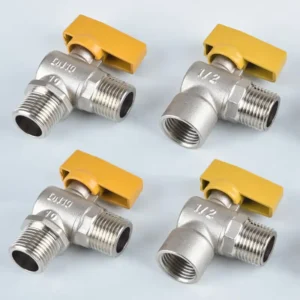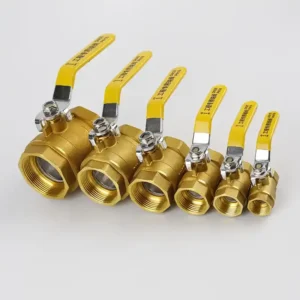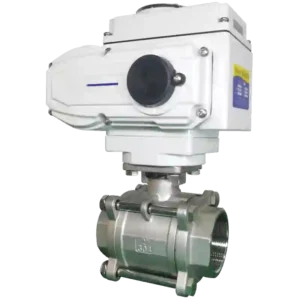

Short answer: Yes, but standard ball valves are not recommended for long-term use as regulating valves. They can reduce flow occasionally for rough flow limiting. If stable regulation, precise control, frequent operation are required, or the media is steam, gas, or liquid with high pressure differential, standard ball valves are generally not a suitable choice.
This is why many purchasers and engineers ask can a ball valve be used for throttling. The answer is not simply “yes” or “no”; it depends on valve design, opening degree, pressure differential, media and regulation frequency.
Why can ball valves perform throttling?
A ball valve opens and closes by rotating the ball. When fully open, the bore of the ball aligns with the pipeline, delivering low flow resistance. When partially rotated, the bore of the ball is offset from the pipeline, the flow area shrinks and flow is restricted.
So in principle, can you throttle a ball valve? Yes. However, standard ball valves are designed for quick on-off and isolation, not precise regulation. Their ball valve throttling characteristics differ from globe valves and control valves.
At low opening degrees, the flow rate of a ball valve may change rapidly, while the change slows down near full opening. The actual ball valve flow vs percent open is often non-linear. It is difficult to judge the real flow rate merely by the handle angle.
Are Ball Valves Good for Throttling?
Throttling with ball valves is acceptable for temporary, rough, non-critical working conditions. For example, irrigation bypass, rough adjustment of cooling water, flow limiting for flushing pipelines, equipment draining, etc. Standard ball valves can work for short periods.
But if throttling is the primary function, the answer is usually no. The reason is that when a standard ball valve is half-open, the edges of the ball and seat are exposed to erosion by high-velocity fluid over long periods. Soft seat materials such as PTFE and RPTFE may wear and deform, resulting in internal leakage. Metal-seated ball valves feature better temperature resistance and wear resistance, yet sealing class and torque also need re-evaluation.
Cavitation in ball valves must be considered for liquid throttling under high pressure differential. Bubbles form in the low-pressure zone and collapse in the high-pressure zone, impacting the ball, seat and valve body, and causing noise, vibration and material damage.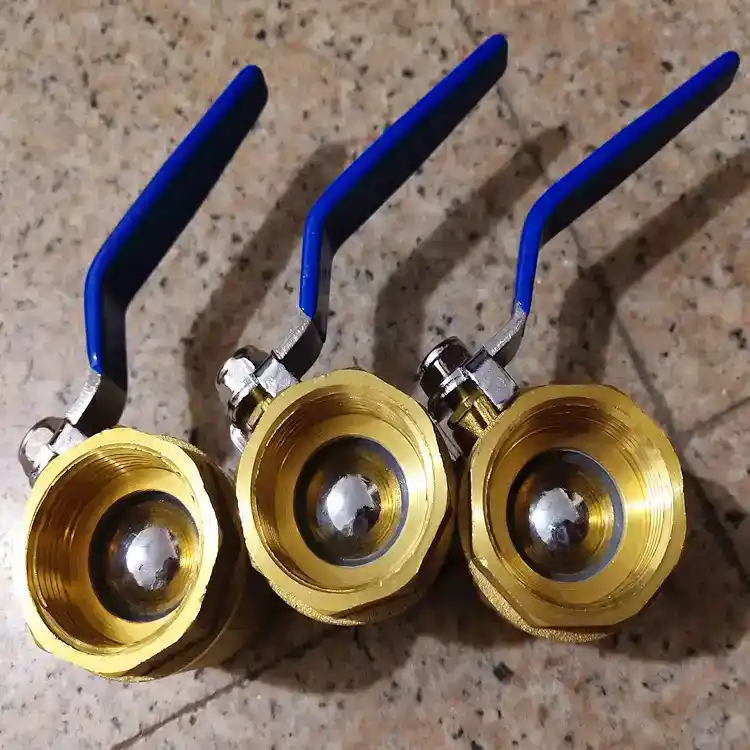
Three limitations of throttling with standard ball valves
- Unfavorable regulation characteristics. Standard ball valves have a narrow adjustable range, and flow is hard to stabilize at partial opening degrees. If the actuator only performs on-off control, precise positioning cannot be achieved.
- Susceptible damage to sealing surfaces. A ball valve seals by the contact between the ball and seat when closed. Long-term half-open operation exposes sealing surfaces to high-velocity flow streams; particulate media may also scratch the ball surface.
- Pressure differential and torque issues. The ball valve pressure drop is low at full opening; under half-open conditions, pressure differential concentrates near the ball port. High pressure differential may make manual operation heavy and also affect the selection of pneumatic or electric actuators.
When can ball valves be used for throttling?
Ball valves can be adopted in the following scenarios:
- Only rough flow reduction is needed, without precise control requirements.
- Throttling action is infrequent, and the valve stays fully open or fully closed most of the time.
- The media is clean and free of particles that would rapidly abrade the seat.
- Pressure differential is low, and temperature is within the allowable range of seat materials.
- Other regulating valves are installed in the system, and the ball valve is only for isolation and bypass flow limiting.
Under these conditions, ball valves can serve as a temporary throttling method. Mark the opening degree to avoid misoperation, and inspect internal leakage and handle position regularly.
When NOT to use standard ball valves for throttling
Standard ball valves are not recommended for throttling under the following working conditions:
- Steam, gas, or liquid with high pressure differential.
- Media containing particles, slurry, fiber, or easy-to-crystallize substances.
- Stable control of flow rate, temperature and pressure is required.
- Frequent regulation is needed, or automatic control by actuators.
- Strict requirements on leakage class, noise and cavitation.
In the comparison of ball valve vs globe valve for throttling, globe valves are generally more suitable for throttling. The plug shape of a globe valve enables a smoother relationship between flow rate and opening degree for more stable regulation. Needle valves fit precise fine regulation of small flow rates, while control valves are used for automatic control loops.
V-port ball valves and regulating ball valves
If ball valve construction is required for process flow regulation, V-port ball valves, V-notched ball valves or segmented ball valves can be considered. These valves have a V-shaped notch machined on the ball, delivering flow characteristics close to equal percentage, a wider adjustable range and better shearing capacity.
Selection cannot be based only on nominal size. Check the ball valve flow coefficient cv curve to confirm the opening degrees under normal flow, minimum flow and maximum flow. The Cv value varies with opening degree and valve structure, and differs greatly among manufacturers.
V-port ball valves may be more suitable than standard ball valves for media with particles. However, cavitation, flashing and noise still need to be assessed for liquids under high pressure differential.
Sourcing and selection checklist
Before deciding whether to use a ball valve for throttling, confirm the following information:
- Media: water, gas, steam, oil, slurry or chemicals?
- Temperature: whether it exceeds the allowable range of PTFE, RPTFE or metal sealing?
- Pressure differential: pressure differential at full opening and throttling pressure differential respectively?
- Flow rate: minimum, normal and maximum flow rate?
- Regulation frequency: several times per day or continuous automatic regulation?
- Precision: allowable flow fluctuation range?
- Actuator: manual, pneumatic or electric? Is a positioner required?
- Leakage requirements: zero leakage or metal hard sealing required?
This information directly affects valve selection. Standard ball valves are for isolation, V-port ball valves for regulation, globe valves and needle valves for fine throttling, and control valves for automatic control loops.
Conclusion
So, can ball valves be used to throttle flow? Yes, but standard ball valves are only suitable for temporary, rough, non-critical throttling. If the question is are ball valves good for throttling, the answer depends on circumstances: rough adjustment is acceptable, while precise regulation and long-term throttling are usually not appropriate.
Do not confuse “capable of shutoff” with “capable of regulation” during procurement. Standard ball valves are preferred for on-off isolation. When throttling is required, evaluate working conditions first, then consider V-port ball valves, globe valves, needle valves or control valves.
CHCV Valve supplies standard ball valves, V-port ball valves as well as pneumatic and electric actuators. If you provide media, temperature, pressure differential and flow range, we can help you determine whether to select an isolation ball valve or a regulating ball valve.