In piping systems, the core value of a three-way ball valve lies in its internal flow path design. The most common question during selection is: Should I choose an L-port or a T-port flow path?
This choice depends entirely on whether your process objective is “flow switching” or “fluid mixing.”
To make the right decision, you must first understand the fundamental difference between these two designs. This is not just a matter of technical parameters; it directly affects the efficiency and safety of the entire system.
This guide will analyze the functions and suitable applications of both types in detail, and incorporate some key long-tail keywords such as l pattern three way ball valve and t port three way ball valve, to help you understand more precisely.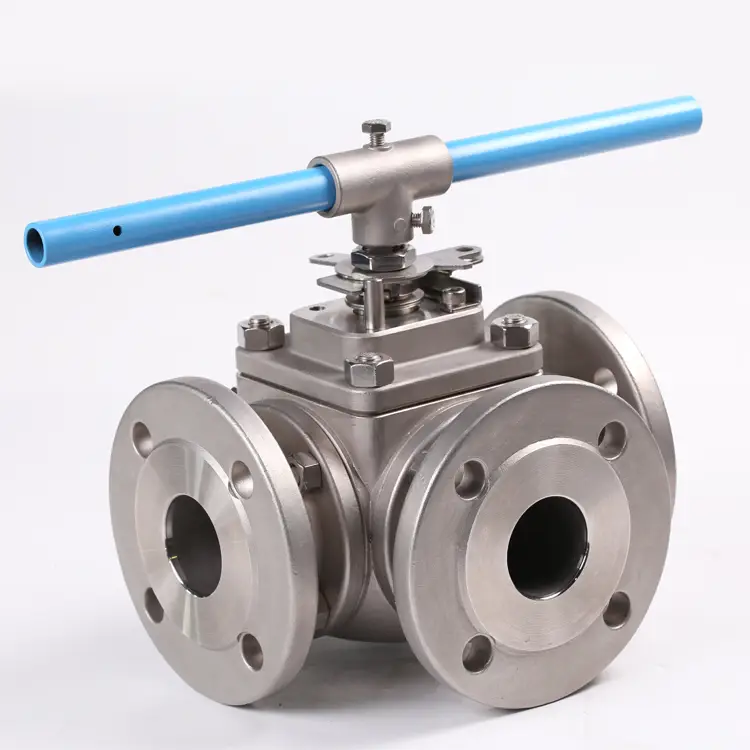
L-Port: The Precise Flow Diverter
When your task is to distribute one fluid stream to one of two different outlets, the l pattern three way ball valve is the ideal choice. Its internal passage is shaped like an “L.” When operated, a 90‑degree rotation of the ball connects the inlet to one of the outlets while simultaneously shutting off the other.
-
Core Function: Primarily used as a diverter or switching valve. It can switch the pumped medium between two storage tanks or two pipeline branches.
-
Key Feature: The L-port design has a shut‑off capability. In addition to selecting the flow direction, it can also completely close all passages, acting as a stop valve.
-
Applicable Scenarios: Commonly found in applications requiring simple switching, such as bypass lines in filtration systems, or for switching between two different feed points.
T-Port: The Flexible Mixing and Distribution Station
If you need to combine two fluid streams into one, or distribute one stream to two outlets simultaneously, then you need a t port three way ball valve. Its “T”-shaped flow path allows the ball, when rotated, to connect all three ports at once, or to connect any two ports in combination.
-
Core Function: Its three way ball valve function is more focused on mixing and distributing. In HVAC systems, it is commonly used for mixing hot and cold water to achieve a target temperature.
-
Key Feature: The T-port design does not have the ability to fully shut off all ports. At any rotation angle, at least two ports remain connected.
-
Applicable Scenarios: Widely used in processes that require precise mixing ratios, such as chemical reagent proportioning, or fluid blending in food and beverage processing.
For a more intuitive comparison, refer to the table below:
| Characteristic | L-Port | T-Port |
|---|---|---|
| Primary Function | Diverter / Switching | Mixing / Distributing |
| Port Connection | Only two ports connected; third port closed | Can connect all three ports simultaneously or any two in combination |
| Shut‑off Capability | Can completely shut off fluid flow | Cannot fully close all passages; at least one path remains open |
| Best Applications | Tank switching, bypass lines, dual‑line feeding | Temperature control, chemical mixing, single‑pump multi‑line distribution |
Summary
Which flow path to choose depends on your ultimate goal. If you need switching, choose the L‑port three‑way ball valve; if you need mixing or simultaneous distribution, you must choose the T‑port three‑way ball valve.
When selecting, we recommend testing or consulting with professional engineers to confirm valve performance under your specific operating conditions. CHCV offers comprehensive three‑way ball valve solutions to ensure long‑term, stable system operation.