
How to Evaluate the Capability of a Pneumatic Ball Valve Manufacturer?
In industrial fluid control projects, the selection quality of pneumatic ball valves directly impacts system safety and operation and maintenance costs. Faced with manufacturers of different regions and scales, purchasers need a quantifiable evaluation method rather than relying solely on brochures or quotation sheets.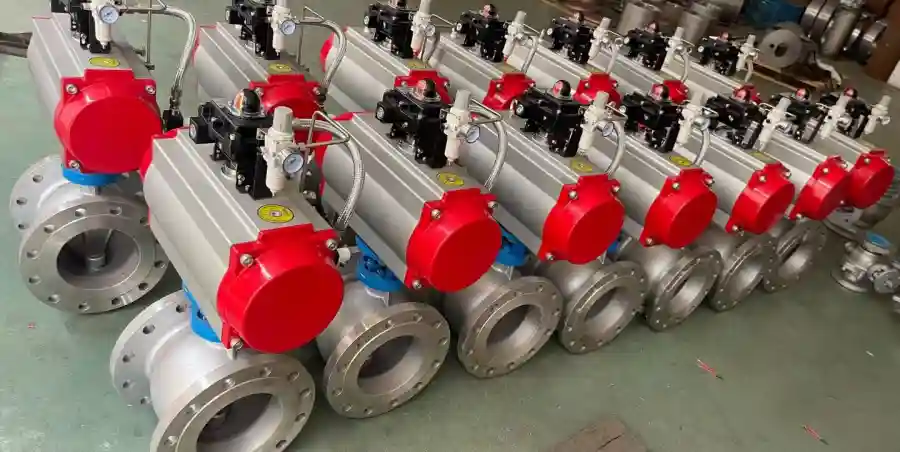
1. Certification Systems and Quality Traceability
A qualified pneumatic ball valve factory must be able to provide complete material certificates, pressure test records, and fire-safe and explosion-proof certifications. ISO 9001 is just the baseline; for export-oriented projects, certificates such as API 607, ATEX, or PED should also be required.
For projects located in China, Southeast Asia, or the Middle East, choosing a pneumatic actuated ball valve manufacturers in China often shortens delivery lead times, provided that the factory owns an independent testing laboratory and accepts third-party on-site supervision and inspection.
2. Application Adaptability and Customization Capability
Pneumatic ball valves are not universal parts. Scenarios involving high-temperature steam, corrosive media, high-frequency operation, or low-pressure actuation impose different requirements on body materials (e.g., CF8M, duplex stainless steel), sealing materials (PTFE, PEEK, graphite), and actuator torque.
An experienced customized pneumatic actuated ball valve suppliers will proactively inquire about medium temperature, allowable differential pressure, air supply pressure, and switching frequency before quoting, rather than directly applying standard models.
For example, for fail-to-close conditions, they will recommend a pneumatic actuated ball valve with spring return; for mixing or diverting processes, they will offer a 3-way pneumatic ball valve along with flow characteristic curves.
Such customization capability reflects the manufacturer’s engineering experience and helps avoid additional costs from later retrofits.
3. Supply Chain Flexibility and Delivery Track Record
Industrial projects often have tight construction schedules; delayed valve delivery can halt the entire site. When evaluating a pneumatic actuated ball valve supplier, attention should be paid to their casting blank inventory, number of machining equipment, and sourcing sources for actuators.
If the supplier can provide shipment records of similar bore sizes and materials within the past year, it indicates mature production scheduling and supply chain management.
Moreover, for emergency repairs or additional orders, a high quality pneumatic actuated ball valve factory typically maintains some semi-finished inventory and has the capability for rapid assembly and testing – this is a key differentiator between an “assembly shop” and a true “manufacturing plant.”
4. After-Sales Response and Spare Parts Guarantee
After years of operation, pneumatic ball valves may face issues such as seal ring aging, positioner drift, or pneumatic diaphragm rupture.
Reliable pneumatic actuated ball valve manufacturers should provide a clear spare parts list and supply lead times, and support remote fault diagnosis.
It is recommended to ask in advance whether they offer installation and commissioning guidance, operator training, and free repair services during the warranty period.
If the supplier can provide long-term tracking records from similar service conditions (e.g., chemical plants, power stations, or water treatment projects), that adds further reference value.
Selection Recommendations
It is advisable to compile a complete process parameter sheet before sending inquiries and request technical proposals from at least three shortlisted manufacturers.
Priority should be given to arranging on-site factory audits, with a focus on inspection equipment, welding procedures, and assembly processes. If on-site visits are not feasible, request recent factory test videos or third-party test reports for the same model.
By comprehensively applying the above four dimensions, you will be able to rationally select a pneumatic actuated ball valve supplier that truly suits your project needs, rather than making a decision based solely on price.