
How Does a Pneumatic Brass Ball Valve Work?
A pneumatic brass ball valve combines a quarter-turn ball valve with a pneumatic actuator. The operator does not need to turn the handle directly. Once compressed air is supplied to the actuator, it drives the valve stem and ball to rotate. When the passage through the ball aligns with the pipeline, the valve opens; when the solid side of the ball turns into the pipeline passage, the valve closes.
This arrangement is suitable for water, air, and other compatible-media pipelines that require remote opening and closing. During selection, the role of the valve body and the actuator must be distinguished. The fact that a valve is made of brass alone does not prove that it is suitable for every medium or operating condition.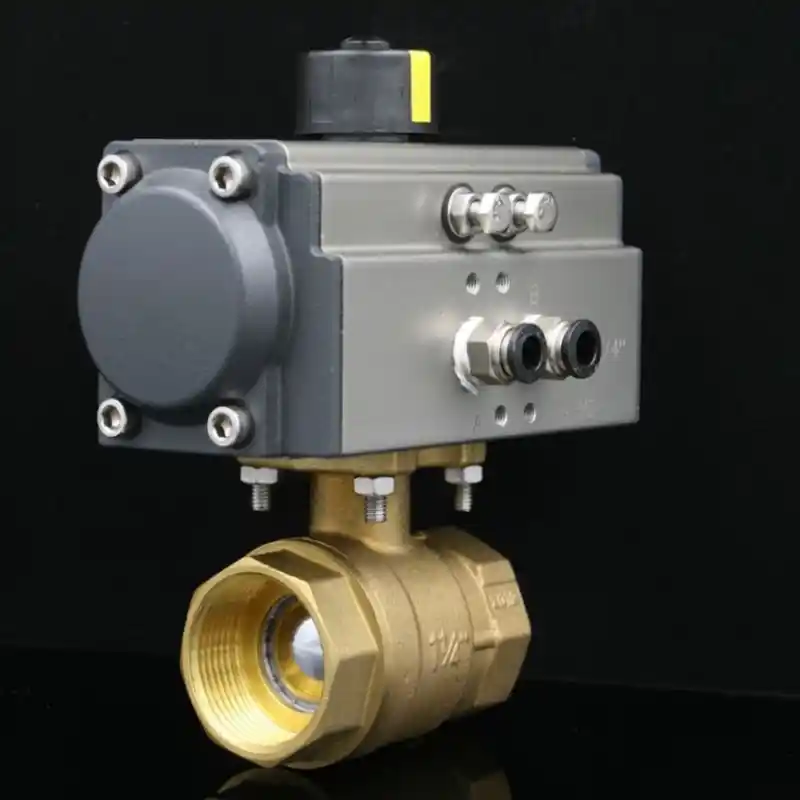
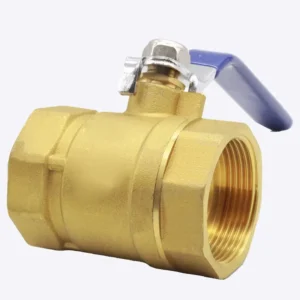
What Is the Brass Ball Valve Function? (brass ball valve function)
The core brass ball valve function is to shut off or release the medium through a short rotary movement. Common brass ball valve applications include general water supply, compressed air, and other compatible fluids. During procurement, check the body, ball, stem, seat, seals, port design, and connection standard. For corrosive chemicals, high-temperature media, oxygen, or hazardous gases, material compatibility must be confirmed separately.
How Does an Air Operated Brass Ball Valve Open and Close? (air operated brass ball valve)
An air operated brass ball valve commonly uses a rack-and-pinion pneumatic actuator. Compressed air pushes the piston, and the mechanism converts the linear force into rotary movement at the output shaft. The shaft then drives the ball through an approximately 90-degree rotation. During commissioning, confirm the actuator stroke, operating direction, and limit feedback to prevent the ball from remaining partly open or partly closed.
What Is the Difference Between a Double Acting Pneumatic Ball Valve and Spring Return? (double acting pneumatic ball valve)
A double acting pneumatic ball valve uses compressed air to complete both the opening and closing movements. A spring-return actuator uses air for one direction and a spring for the other, and it can be configured as fail-closed or fail-open. The choice should be based on the safe state required by the process when the air supply is interrupted. Actuator sizing should also be checked against valve torque and the minimum available air pressure.
What Should Be Checked in a Brass Ball Valve Material Specification? (brass ball valve material specification)
A brass ball valve material specification should not simply state “brass.” It should identify the body, ball, seat, and seal materials, as well as the size, port design, connection, thread standard, actuator mounting, operating air pressure, and failure position. The specific pressure, temperature, and material combination must be checked against the drawing and technical data for the selected model.
When Is a Brass Ball Valve for Air Line Service Suitable? (brass ball valve for air line)
A brass ball valve for air line service can be used for pipeline isolation when its pressure rating, seals, thread standard, and cleanliness meet the requirements of the compressed-air system. During installation, first check for air leakage and confirm the operating direction. Cycle the valve without process pressure, then verify the closed-position feedback. High-temperature, corrosive, high-cycle, or safety-interlocked services require a dedicated configuration.
A Practical Enterprise Application Case: Man Kian Hardware & Trading Sdn Bhd
✅Take Man Kian Hardware & Trading Sdn Bhd in Malaysia as an example. It is an industrial hardware and valve distribution company. Its public information presents pneumatic brass ball valves for general utilities, water lines, and air lines, including non-corrosive media in commercial and light-industrial settings. This case shows that ordinary procurement should first check the medium, connection standard, actuator interface, and opening and closing method before deciding whether brass is suitable.
✅When serving a local medium-sized food-processing company during a piping-system retrofit, the Man Kian team faced a practical challenge: the customer’s CIP cleaning line was controlled by manual ball valves. Each batch change required workers to go to the site and operate the valves one by one. This was inefficient, and mistakes in the operating sequence occasionally caused the cleaning liquid to cross into the wrong line. After assessing the site conditions, Man Kian’s technical team recommended the DN25 and DN40 double-acting pneumatic brass ball valve solution supplied by CHCV and connected it to the factory’s existing PLC control system. After the retrofit, operators could complete the automatic switching of cleaning liquids simply by clicking the touchscreen in the control room.
✅Valve response time was reduced from the 5–8 minutes required for manual operation to less than 3 seconds. More importantly, product waste caused by human operating errors was completely eliminated. The Man Kian project manager commented: “This pneumatic ball valve solution helped our customer significantly improve the automation level of the production line, while also giving us valuable project experience in industrial automation.”