
How to Understand the Working Principle of a Three-Way Ball Valve?
✅In complex piping systems, precise fluid diversion, mixing, or distribution is critical to process efficiency. This is where the Three-Way Ball Valve becomes an indispensable control element.
✅With just a 90-degree rotation of a single valve, you can achieve flexible switching among three different pipeline flow directions. So, how exactly does this valve work?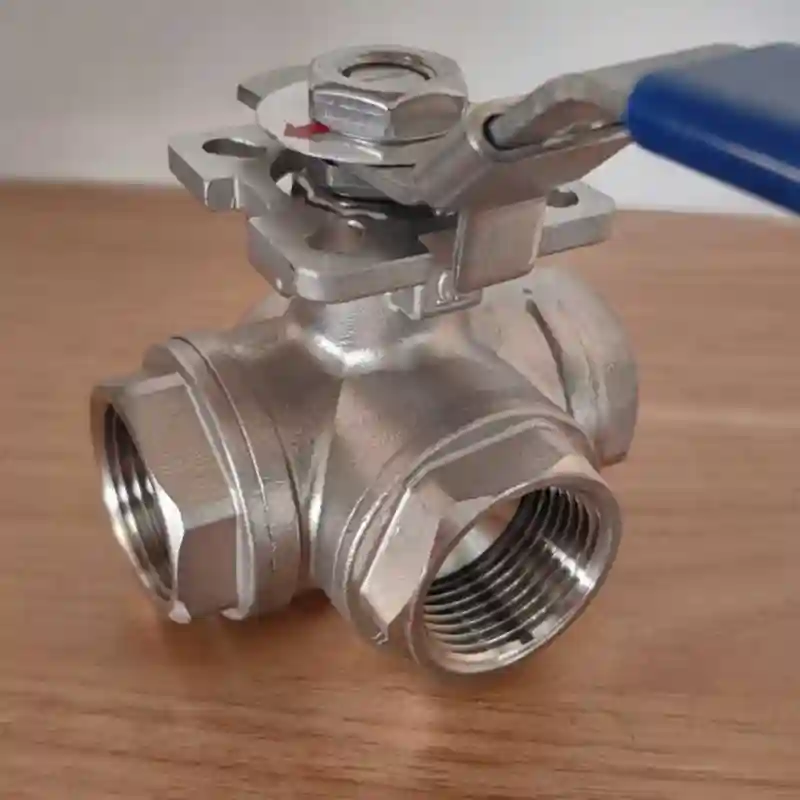
L-Port vs. T-Port: The Two Core Flow Path Designs
To truly master how a three way ball valve works, you must first understand its two main flow path configurations: L‑port and T‑port.
-
L-Port Three Way Ball Valve: The internal passage in the ball is shaped like an “L”. This design allows the valve to connect only two adjacent pipe ports, enabling flow switching or simple diversion. It is typically used in “selection” scenarios where the medium needs to be routed from one line to another, but it cannot connect all three pipelines simultaneously.
-
T-Port Three Way Ball Valve: The ball passage is shaped like a “T”. This is the more versatile design. By rotating the ball, a T‑port valve can not only switch flow paths like the L‑port, but also connect any two of the three pipes at the same time, or even fully open all three ports.
This makes it an ideal choice for mixing or diverting applications. Whether it is combining two streams (converging) or splitting one stream into two outlets (diverging), the T‑port valve can handle it.
Opening, Closing, and Switching Process of the Three‑Way Ball Valve
Unlike conventional globe valves, the three‑way ball valve operates extremely quickly. Its working process consists of two main stages:
-
Opening and Switching Process: When the actuator (manual handle or electric/pneumatic actuator) rotates the valve stem counterclockwise, the ball turns accordingly. At the beginning of rotation, the ball first lifts off the seat, eliminating friction on the sealing surfaces. The ball then rotates to the target position without friction. Once in place, the stem mechanically presses the ball tightly against the seat on the other side, establishing a new seal and simultaneously opening the corresponding flow path, completing the flow switch.
-
Closing Process: The operator turns the handle or actuator clockwise by 90 degrees, and the solid face of the ball turns toward the pipe port, cutting off the medium flow. As in the opening process, the ball is pressed firmly against the seat at the final stage of rotation, ensuring tight shut-off (zero‑leakage closure).
Outstanding Advantages of the Three‑Way Ball Valve
Compared to other valve types, the three‑way ball valve offers clear benefits:
-
Multi‑function in one valve: One valve can replace multiple shut‑off valves or fittings, greatly simplifying piping layout.
-
Quick operation: Only a quarter‑turn (90‑degree rotation) is needed for switching or on/off control, making it easy to automate.
-
Low flow resistance: The full‑bore design allows the medium to pass through with minimal resistance, causing no significant pressure loss.
-
Reliable sealing: The ball valve seat is typically made of high‑performance polymers such as PTFE, which are corrosion‑resistant and provide durable sealing performance, suitable for gases, liquids, and many other media.