
What Does LF Mean on Ball Valves? Lead-Free Marking, Brass Ball Valve Identification & Corrosion Analysis
When purchasing or installing ball valves, the letters “LF” are often cast on the valve body, handle or label. For potable water systems, LF does not stand for “Low Flow”. It means Lead Free, indicating that the lead content of the wetted parts of the ball valve meets the requirements of relevant regulations.
LF is only a starting point of marking. It does not guarantee that the valve is corrosion-resistant, nor does it mean all brass ball valves are suitable for potable water. Below is an analysis covering marking interpretation, material identification and corrosion causes.
1. What Does LF Usually Mean on a Ball Valve?
On brass or bronze ball valves, LF = Lead Free. This marking is commonly seen on potable water pipelines, water purification equipment, pump outlets, water meters and domestic water supply systems.
After the revision of the US Safe Drinking Water Act, the weighted average lead content of pipes, valves and fittings in contact with potable water shall not exceed 0.25%. Relevant certifications often include NSF/ANSI 61 and NSF/ANSI 372. NSF/ANSI 61 addresses health effects of potable water system components, while NSF/ANSI 372 focuses on lead content. Regions including California AB1953, Vermont and Maryland have similar requirements.
Therefore, when you see ball valve lead free, it generally means the valve has material controls for potable water applications.
Two exceptions should be noted. First, LF is sometimes misinterpreted as Low Flow. Low-flow valves are normally described by Cv value, flow coefficient or bore size, and will not use LF alone as the indicator. Second, if LF2 appears on steel valves, it usually refers to ASTM A350 LF2 low-temperature carbon steel material, not lead-free. LF2 is completely different from lead-free brass ball valves.
2. Where Can the LF Marking Appear?
LF may be cast on the valve body, printed on the handle, sticker, product box or specification sheet. It can also appear together with marks such as NSF/ANSI 372, cUPC and WaterMark.
Some manufacturers do not stamp LF directly, but use material codes instead. Common lead-free brass grades include C27450, C27451, C28500, CW510L, CW511L. Traditional free-cutting brass C36000 has high lead content and is not suitable for wetted parts contacting potable water.
If only “Brass” is marked without LF, NSF or material code, it cannot be directly confirmed to be usable for potable water.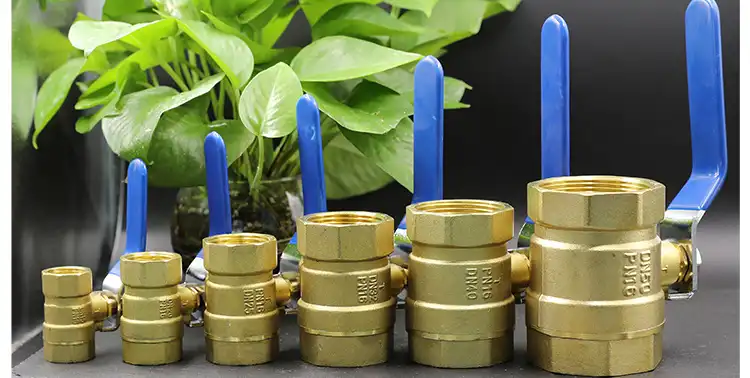
3. How to Identify a Brass Ball Valve for Water Service
Many people ask how do identify a brass ball valve for water. You can judge from the following aspects.
Check valve body markings first. Prioritize marks including LF, Lead Free, NSF/ANSI 372, NSF/ANSI 61 and cUPC. Then verify material codes to confirm whether it is lead-free brass or bronze suitable for potable water.
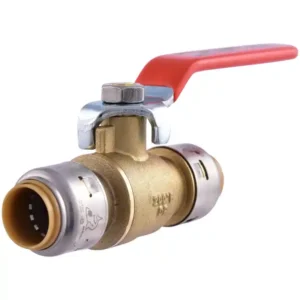
Check end connections. Common types for domestic water supply are NPT, BSP, compression, solder or push-fit ends. For potable water service, ball valve for potable water must satisfy material, sealing and pressure-temperature requirements simultaneously.
Check valve seats and seals. Materials such as PTFE, RTFE, EPDM and NBR fit different media. For potable water systems, sealing materials shall not leach harmful substances and must comply with local hygiene certifications.
Color is only an auxiliary reference. Brass is yellowish while bronze is reddish-brown or dark copper. When discussing brass ball valve vs bronze ball valve, color alone cannot be used for differentiation. Bronze is more widely used in seawater, marine and some industrial water systems; brass is common in domestic water supply, gas and general water circuits.
Check certificates and batch records. Qualified suppliers can provide material test certificates, potable water approvals and pressure test reports. CHCV marks LF, DZR and standard brass separately in deliveries to avoid misuse by customers.
4. Why Do Brass Ball Valves Corrode?
The answer to why are brass ball valves corroding is rarely a single factor; corrosion results from the combined effects of water quality, material, installation and operating conditions.
The most common type is dezincification corrosion. Brass is a copper-zinc alloy. When zinc is selectively leached out by water, a porous copper layer remains on the surface, showing a reddish color and reduced mechanical strength. Soft water, low pH, high chlorine, elevated temperature and stagnant water will accelerate dezincification.
Second is galvanic corrosion. When brass is connected to stainless steel, carbon steel or aluminum parts, a potential difference forms in electrolyte water. Copper alloys have higher potential, so steel components tend to corrode first. Installing insulating joints and isolating dissimilar metals can mitigate this issue.
Third is chlorine and chloramine. Tap water disinfectants oxidize brass surfaces. Pitting and dezincification are more likely to occur under high chlorine content, high temperature and low flow velocity.
Fourth is ammonia. Ammonia introduces risk of stress corrosion cracking for brass. Special attention is required in livestock houses, environments with certain cleaning agents, refrigeration systems and industrial water treatment systems.
Fifth is flux residue and overheating. Uncleaned chloride-containing flux after soldering or brazing causes localized corrosion. Excessive heat will also damage seals and material properties.
Sixth is erosion. If a ball valve stays partially open for throttling for a long time, high flow velocity will erode valve seats and the ball. This is not strictly corrosion, but it causes leakage, stiff handle operation and internal leakage.
5. Will LF Ball Valves Not Corrode?
No. LF only indicates controlled lead content; it does not guarantee dezincification resistance. To replace lead, lead-free brass may add bismuth, silicon, phosphorus and other elements. Different formulations have varying compatibility with water quality.
For brass ball valve water service, if the water is soft, high in chlorine or at elevated temperature, DZR brass that is both lead-free and dezincification resistant is recommended. Standard LF brass may not resist dezincification.
Therefore, three factors should be checked during material selection: LF status, DZR status, and compatibility with your water quality and temperature.
6. Installation & Maintenance Recommendations
For potable water ball valves, operate them fully open or fully closed; avoid long-term partial opening for throttling. If flow regulation is needed, use control valves or throttling valves instead.
Flush pipelines before installation to prevent welding slag and sand particles from entering the valve cavity. Remove sealing components or control heat input during welding to prevent PTFE seat deformation.
For buried or wall-mounted installation, reserve access openings. Although ball valves have a simple structure, stem packing and valve seats may still degrade over time.
For valves that remain idle for long periods, operate them open and closed every few months to prevent limescale and corrosion byproducts from jamming the ball.
7. Frequently Asked Questions
Is LF short for Low Flow? On potable water ball valves, LF mostly refers to Lead Free. Low Flow is normally described by flow coefficient or low-flow construction.
Can lead-free brass ball valves be used for gas? LF is specified mainly for potable water. Gas ball valves require gas certifications such as AGA, CSA and ANSI Z21.15; LF marking alone is not sufficient.
How to confirm a brass ball valve is suitable for potable water? Check LF, NSF/ANSI 61, NSF/ANSI 372 and cUPC marks on the valve body, together with material codes and supplier certificates.
Can LF ball valves suffer dezincification? Yes. LF is not equivalent to DZR. For poor water quality, select lead-free DZR brass, bronze or stainless steel based on service conditions.
Conclusion
LF marked on ball valves usually stands for Lead Free, signifying lead content control for potable water contact. To identify brass ball valves for water service, do not rely merely on the “Brass” marking or color. Verify LF, NSF approvals, material codes and sealing materials.
Corrosion of brass ball valves is commonly associated with dezincification, galvanic corrosion, chlorine, ammonia, flux residue and erosion. For potable water and corrosive water conditions, selecting ball valves that are lead-free, dezincification-resistant and matched to operating conditions is more reliable than checking only the LF marking.