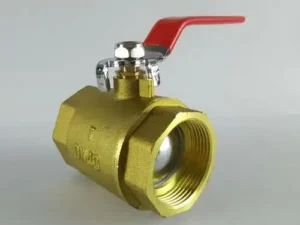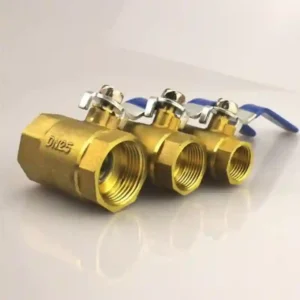

A 2 piece ball valve refers to a ball valve whose valve body consists of two main parts: a main body and an end cap. The end cap can be threaded onto the main valve body or fastened by bolts.
The ball, seats, stem and seals are clamped between these two valve body components. Compared with a one piece ball valve, the 2 piece design allows the end cap to be removed so the ball and seats can be taken out for replacement. In contrast to a 3 piece ball valve, it has fewer parts, a more compact structure, and generally lower procurement and installation costs.
Common end connections for 2 piece ball valves include internal thread, external thread, socket weld, butt weld, flange and tri-clamp. Available materials include brass, bronze, carbon steel, 304, 316, CF8M, etc.
Typical pressure ratings are 1000 WOG, 2000 WOG, PN16, Class 150, Class 300. Sealing materials are mostly PTFE, RPTFE, PEEK or metal-to-metal hard seal.
Selection depends on the medium, temperature, pressure and whether frequent cleaning is required. If the medium contains particles, tends to crystallize, or in-situ disassembly and cleaning are needed, a 2 piece ball valve may not be suitable.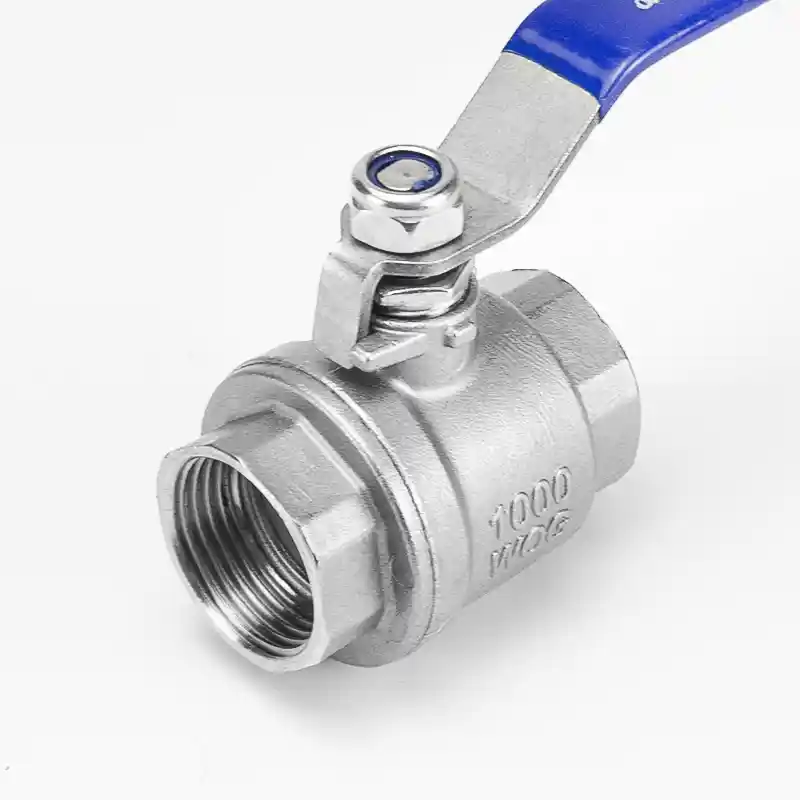
what is a 3 piece ball valve? Structural differences from the 2-piece type
Many people searching for what is a 3 piece ball valve want to know the differences between 3 piece and 2 piece ball valves. A 3 piece ball valve is composed of a central body, left end cap and right end cap, normally held together by four or more bolts.
After removing the bolts on both ends, the central body together with the ball and seats can be extracted, while the two end caps on the pipeline remain in place. This structure enables convenient in-line maintenance, cleaning and seal replacement.
what is a three piece ball valve refers to the same structure as the 3 piece ball valve mentioned above. It is widely used in brewing, food, pharmaceutical, chemical and water treatment systems. These applications require frequent cleaning, or allow end caps to be welded first before internal components are assembled, preventing welding heat from damaging PTFE seats and O-rings. The tradeoff is more components and bolts; assembly requires stricter control over bolt torque and tightening sequence, and its cost is higher than that of a 2 piece ball valve.
two piece vs three piece ball valve: How to choose
The selection between two piece vs three piece ball valve mainly depends on maintenance frequency and installation space.
2 piece ball valves are suitable for on/off isolation of common water, gas and oil pipelines. They feature a compact body with fewer joints at the end cap, ideal for equipment with limited space. For ordinary water supply, compressed air, HVAC or working conditions without frequent disassembly and cleaning, a 2 piece ball valve usually meets requirements.
3 piece ball valves are selected for systems requiring regular cleaning, in-line seat replacement, hygienic connections, welded ends or tri-clamp ends. Its removable central body enables thorough cleaning, and full pipeline disassembly is not required during overhaul.
3 piece ball valves save much time if the medium is prone to scaling, contains fermentation residues, or requires frequent seal replacement.
Note that ball valves are generally designed for fully open or fully closed service. Long-term throttling under partially open position is not recommended. At partial opening, high-velocity medium scours the edges of ball and seat, leading to rapid wear of sealing surfaces.
how to clean 3 piece ball valve: Cleaning and inspection
The procedure of how to clean 3 piece ball valve is straightforward, yet sequence and details matter.
Shut off upstream and downstream valves, depressurize and drain the pipeline. Confirm the medium temperature has dropped to a safe range.
Record the orientation of end caps, bolt positions and handle position. Keep bolts and nuts together during disassembly to avoid mixing parts.
Remove bolts on both ends and separate the central body. Take out the ball, seats and O-rings. The stem normally does not need removal unless stem packing is leaking.
Clean with warm water or neutral detergent using a soft brush. For food and brewing systems, use food-contact compatible cleaners. Do not scrape the ball surface with metal brushes, and avoid soaking PTFE seats in highly corrosive solvents.
Inspect the ball for scratches and pits; check seats for swelling, cracking or deformation, and O-rings for hardening. Replace the three piece ball valve repair kit or corresponding O-rings when necessary.
Reassemble after full drying. Tighten bolts diagonally in multiple passes instead of fully tightening in one go. After assembly, turn the handle to verify smooth operation, then perform low-pressure leak test.
Common mistakes include leakage at end caps caused by uneven bolt loading, assembly without full drying after cleaning, incompatible grease application, reversed seat installation, and forcing the handle to rotate a scaled ball.
how to install ball valve with drain: Installation of ball valve with drain port
When learning how to install ball valve with drain, confirm drain port position and flow direction first. Ball valves with drain ports are commonly installed at low points of water pipelines, water heaters, boilers, compressed air tanks, for freeze protection draining and maintenance isolation. The drain port should face downward or obliquely downward for convenient hose connection and draining. If mounted upward, it tends to accumulate dust, trapped water or ice.
For threaded connections, use proper sealing compounds for NPT or BSP threads. Wrap PTFE tape along the thread direction, and ensure tape fragments do not enter the pipeline. Select thread sealant compatible with the medium and allow adequate curing time.
For welded connections, 3 piece ball valves allow removal of central body and seals before welding only the end caps; reassemble internal parts after cooling. If the seals of a 2 piece ball valve cannot be removed, wrap the valve with wet cloth or apply heat dissipation during welding to prevent seat damage.
After installation, pressurize slowly and inspect stem packing, mating faces of end caps and drain plug. Actuate the handle several times to confirm full open and full close travel. For freeze protection draining, close the ball valve then open the drain port to empty water from downstream pipe segments. The drain plug must remain accessible for future maintenance; do not permanently seal it by welding.
three piece ball valve assembly: Assembly and torque control
The core requirements for three piece ball valve assembly are cleanliness, alignment and uniform loading. Before assembly, inspect ball, seats, O-rings, stem seals and bolts for damage. The ball shall rotate freely between seats without excessive play. End caps and central body must mate tightly with no trapped contaminants between contact faces.
Tighten bolts diagonally in two or three stages: first pass for light positioning, second pass for gradual torque build-up, final pass to verify against manufacturer torque table. Without a torque wrench, avoid over-tightening by experience, as PTFE seats and O-rings can be over-compressed, resulting in excessive operating torque or leakage. Complete manual operation test followed by pressure test after assembly.
Maintenance & Selection Guidelines
Maintenance focus for 2 piece ball valves: end cap seal, stem packing and ball surface. Maintenance focus for 3 piece ball valves: disassembly sequence, bolt torque and seat replacement.
Both types shall avoid long-term partial opening, medium freezing and incompatible sealing materials. For high temperature service, select PEEK or metal seats; for corrosive media, choose 316, CF8M, duplex steel and other suitable materials. Hard seals or special constructions should be considered for media carrying solid particles.
CHCV Valve supplies ball valve solutions including 2 piece, 3 piece, drain port type, electric actuated and pneumatic actuated models. During valve selection, clarify medium, temperature, pressure, end connection type and cleaning frequency to determine whether a 2 piece or 3 piece design is required, and whether a drain port is needed.