
Brass ball valve installation is usually treated as a simple threading job, but a reliable result depends on the complete connection: valve size, thread standard, pipe alignment, sealing method, operating space, and the test carried out after the valve is fitted. A brass ball valve can isolate a utility branch quickly, yet the valve should be selected and installed for the actual medium and service conditions.
This practical guide focuses on small and medium utility lines. It does not treat a general brass ball valve as a food-contact or sanitary valve. For a broader purchasing checklist, see our quality brass ball valve guide.
How Should Brass Ball Valve Sizes Be Checked Before Installation?
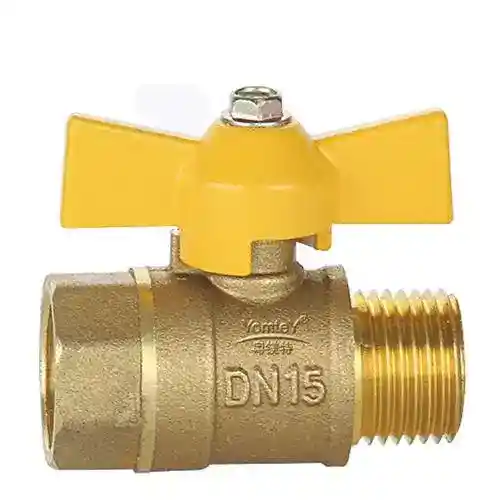
Start with the pipe outside diameter, nominal size, end connection, and the available face-to-face space. The valve size should match the connected piping and the intended flow path; it should not be chosen only because the handle or body looks similar to an existing valve. Check whether the line uses a male or female end, whether an adapter is required, and whether the valve can be removed later without cutting a fixed section of pipe.
For a replacement job, compare the old valve’s connection length, port size, handle clearance, and flow opening with the new drawing. A nominal size alone does not prove that two valves are interchangeable. Also confirm the body, ball, stem, seat, and seal materials against the medium and temperature specified for the line.
Which Thread Details Matter in a Brass Ball Valve Installation?
Thread standard is one of the first checks. NPT and BSP threads are not interchangeable simply because their nominal sizes appear similar. Confirm the thread designation, taper, gender, and engagement length before ordering. A brass ball valve to pvc pipe connection normally needs a compatible transition fitting or adapter; the brass valve should not be forced directly into a plastic thread that was not designed for it.
The same principle applies to a brass ball valve connected to galvanized pipe, copper tube, or another metal system. Use the specified adapter and a sealant suitable for the thread and service. Do not use excessive tape or compound to compensate for the wrong thread. A connection that starts stiff or cross-threads can damage both the valve and the mating fitting.
What Does Ball Valve Installation Flow Direction Mean?
Many two-way ball valves can operate in either flow direction, but the project drawing, body markings, drain arrangement, and any special seat or check feature still need to be reviewed. If the selected model has a marked flow arrow or a preferred orientation, follow that instruction. The handle must also have enough room to move through its full open and closed positions without striking a wall, cable tray, machine guard, or insulation.
Before tightening, place the valve so that the operating position and the downstream maintenance route are clear. A valve that is technically connected but installed with the handle against a structure is not a practical isolation point.
What Are the Main Ball Valve Installation Position Checks?
Keep the pipe run aligned and free from forced tension. The valve should be supported by the piping arrangement or an appropriate support, not by the lever. When tightening a threaded connection, hold the valve body or the fitting at the correct wrench point and avoid transferring assembly torque through the ball, stem, or handle. Do not use the lever as a temporary wrench extension.
Before installation, inspect both the valve and the mating pipe for dirt, burrs, damaged threads, or foreign material. Cycle the valve gently by hand if the manufacturer’s instructions permit it. For soldered or heat-affected connections, follow the valve maker’s instructions for valve position and heat protection; a threaded valve and a solder-end valve are not installed by the same procedure.
How Do Brass Ball Valve Applications Change the Installation Checks?
Brass ball valve applications commonly include general water, compressed air, irrigation, heating support, and other compatible utility services. Each application changes the checks that matter most. A washdown-water branch needs attention to isolation, drainage, and access. A compressed-air branch needs attention to pressure rating, fitting standard, hose or tube compatibility, and safe depressurization before maintenance.
For chemicals, high temperature, oxygen service, or a line that contacts a product, do not assume that a standard brass valve is suitable. Confirm the material specification, seat and seal combination, cleanliness requirements, and connection standard for that actual service.
What Are Good Brass Ball Valve Installation Tips for Commissioning?
After the valve is connected, restore the line gradually and inspect each joint. Check for leakage at the threaded or soldered connection, the stem area, and the valve body. Operate the handle through the intended positions without forcing it. Confirm that “open” gives the expected passage and that “closed” isolates the branch. The final pressure or leak test should follow the project specification and the limits stated for the selected valve.
Record the valve size, connection standard, material and seal information, installation date, and test result. That small record makes later replacement or troubleshooting much easier, especially when several similar brass ball valves are installed in one utility room.
📌 Application Case: Selangor Small-Batch Retort Line Utility Tie-In
Creators Food is a Selangor-based Malaysian food manufacturer that describes its business as starting in 2018 with one production line and serving brands that need smaller production runs. For a fictional project scenario, its small-batch retort line added a utility tie-in during a layout upgrade named “Selangor Small-Batch Retort Line Utility Tie-In.”
The project used a CHCV brass ball valve solution at two non-product-contact locations: a washdown-water branch serving the equipment cleaning area, and a compressed-air service branch used for a small packaging station. The installation team first checked the valve size, thread type, access for the lever, and the pipe support before connecting the branches. The valves were kept outside the product path; if a line later carries food, beverage, special cleaning chemicals, or higher-temperature media, the material and connection requirements must be reviewed again.
What Should Be Confirmed Before Ordering?
Ask for the exact valve model, body and internal material, nominal size, NPT or BSP connection, seat and seal combination, working conditions, and applicable inspection documents. Brass ball valve installation is successful only when the selected valve, the mating pipe, and the commissioning procedure are treated as one system.