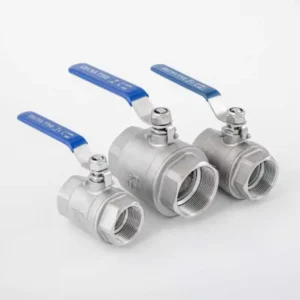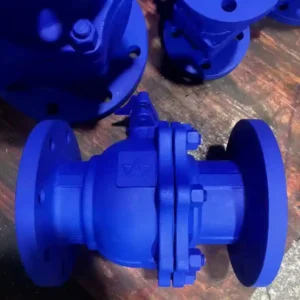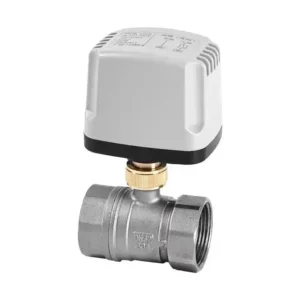

The “smart” part of a wifi motorized ball valve system usually comes from a wireless gateway, controller, or accessory module—not from the valve body itself. During procurement, check the electric actuator, power supply, network connection, phone or platform permissions, and local manual operation as separate items. A remote open/close command does not prove that the valve has reached position.
Define the safe state for communication loss, power loss, and signal delay first. For wash water, irrigation, or equipment utility branches, retain a visible isolation point and an accessible maintenance route.
For model and connection details, see CHCV valve resources.
how to control a motorized ball valve: How does a remote command return to the field?
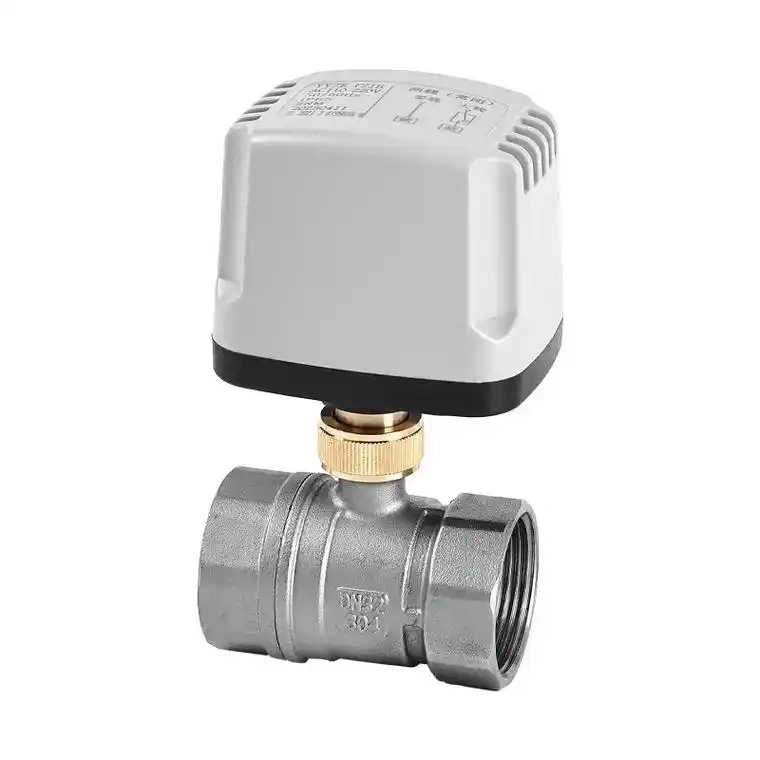
The how to control a motorized ball valve path should cover the remote command, a local button, and what happens when the network is unavailable. Maintenance personnel need to identify the actual valve position, while the control platform must distinguish command status from feedback status. A system without feedback can prove only that a command was sent; it cannot prove that the valve completed the movement.
motorized ball valve with feedback: Build a position-feedback loop
A motorized ball valve with feedback suits a branch where open position, closed position, or a fault state must be confirmed. Confirm whether the feedback is a dry contact, analog signal, or communication data, and confirm that the controller input matches. After feedback is connected, verify it with real open and close movements rather than relying on a platform icon.
motorized ball valve with wifi timer: Separate the valve, gateway, and schedule
The motorized ball valve with wifi timer selection should be split into three layers: the valve and actuator, the wireless control module, and the timer or scene logic. Confirm the module power supply and protocol, and confirm whether a separate gateway is required. “WiFi supported” should not be treated as proof that every control function is built into the valve.
arduino control motorized ball valve: Define the prototype boundary
Arduino control motorized ball valve projects can be useful for prototypes or low-risk tests. A formal installation still needs power protection, a relay or driver module, limit feedback, enclosure protection, and a power-loss strategy. A control board can make a valve move without giving the complete system the maintainability required in an industrial field.
electric ball valve with feedback: Who takes over when the network is lost?
The electric ball valve with feedback network-failure response belongs in the commissioning record: does the valve hold its position, move to a defined state, or transfer control to a local controller? These choices have different safety meanings. Do not infer the valve state from a WiFi device’s default setting.
🌐 Five checks in the remote-control chain
- Power: Verify the actuator and gateway supplies separately.
- Connection: Define the WiFi link, gateway, and platform permissions.
- Feedback: Display command status separately from actual valve position.
- Loss of connection: Document the state during network loss, power loss, and recovery.
- Maintenance: Keep local operation, isolation, and reset steps executable.
📌 Case Setting
Rowy Hardware Sdn Bhd is a Malaysian warehouse distributor of pipe fittings and hardware, supplying industrial valves, piping accessories, and engineering hardware. Daily warehouse cleaning required maintenance personnel to walk repeatedly to the wash-water valve to open and close it. This took time, and the water supply was sometimes delayed or left open when staff were occupied with other work. Rowy Hardware wanted to test remote switching on a warehouse wash-water branch while keeping the branch clearly isolatable, controllable during a network loss, and locally operable during maintenance.
The project team selected one wash-water branch as a pilot and installed a CHCV electric ball valve with feedback, together with a gateway and remote control platform. The core test was not simply whether someone could tap an open or close button. The team checked four items separately: stable power, reliable gateway communication, agreement between the platform status and the actual valve position, and whether the valve completed the movement and returned a status signal within the required time. Only after all four checks passed would the team consider extending the remote arrangement to other branches.
The timer function was used only as an auxiliary feature in this test. It reduced repetitive switching at fixed times but was not treated as the primary control method. Maintenance personnel retained mechanical isolation and local manual steps and could shut off the water through the local handle or isolation valve regardless of the network or platform state. The project record stressed that a connected network does not prove that the valve moved, and that a platform “open” display does not prove that the pipe is flowing. Remote status had to be checked against the physical valve position branch by branch, with local inspection and mechanical isolation kept in the existing maintenance procedure.
Frequently Asked Questions
Will a motorized ball valve close automatically when WiFi is disconnected?
There is no universal answer. The valve may hold its position or follow a controller’s preset logic. Confirm the behavior from the specific actuator and control-module documentation.
Can a WiFi electric ball valve without feedback be used for critical isolation?
Do not confirm critical isolation from a remote command alone. If position confirmation is required, choose a suitable feedback configuration and complete a field test.