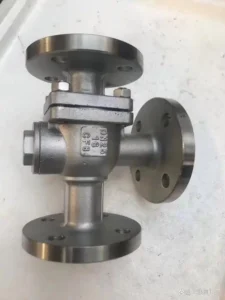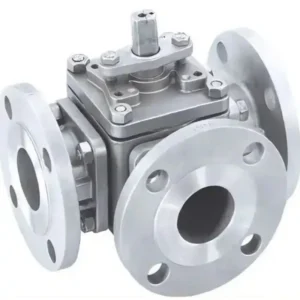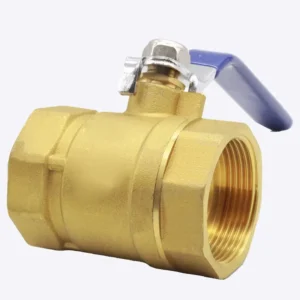

3 way diverter ball valve is a core valve for medium diversion and flow distribution in piping systems. Stainless steel three way ball valve is the mainstream version on the market. The valve body and ball are mostly made of 304/316 stainless steel; carbon steel, PP and CPVC materials are also available for corrosive service conditions.
The standard pressure range covers PN16‑PN40, and custom high‑pressure versions can reach PN100. Temperature rating depends on sealing materials: PTFE soft seal ranges from ‑20~180℃, while metal hard seal can be applied for higher‑temperature working conditions.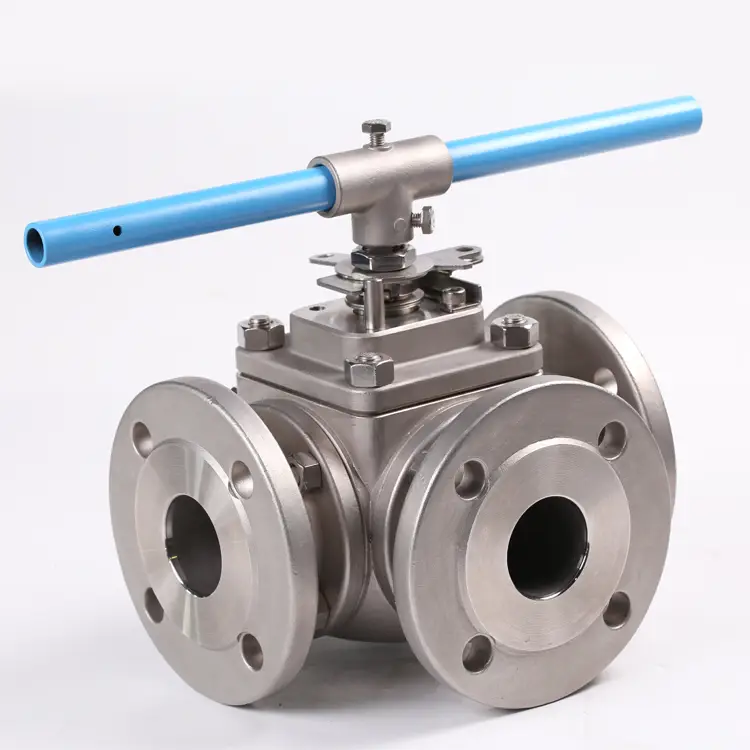
Actuation types include manual handle, pneumatic three‑way ball valve with pneumatic actuator, and electric motor drive.
Manual operation suits local on‑site operation; pneumatic and electric actuators can connect to automation systems to realize remote diversion control, meeting the requirements of continuous industrial production.
Types of 3‑way ball valve: differences between L‑port and T‑port Flow path design of all 3‑way ball valves falls into two categories, which are the primary technical parameters to confirm during procurement:
L‑port three way ball valve: The internal ball passage is L‑shaped, and it can only connect two adjacent ports. Its typical function is flow diversion — switching one medium stream to another outlet. It is commonly used for pump bank switching, filter bypass or alternating feeding between dual tanks. When the handle rotates 90°, the original flow path closes and a new path opens, with the third port kept closed all the time.
T‑port three way ball valve: The ball passage is T‑shaped. It can connect any two of the three ports, or even interconnect all three ports simultaneously. It is used for medium mixing or flow splitting — for example, mixing hot and cold water streams into one temperature‑controlled water supply, or distributing one fluid stream to two downstream equipment units.
Procurement tip: Select L‑port if the process only requires “either‑or” switching; T‑port is mandatory when simultaneous distribution or mixing adjustment is needed.
Typical application scenarios for 3 way diverter ball valve 3‑way ball valve can replace two 2‑way ball valves, reducing pipe joints and potential leak points, and is widely adopted in process pipelines across multiple industries.
- HVAC circulating water systems: diversion and switching of cooling media between standby heat exchangers;
- Chemical and water treatment industries: switching and distribution of chemical agent pipelines, bypass switching for filter systems operating in one‑active‑one‑standby mode;
- Sanitary pipelines for food and pharmaceutical industries: material flow distribution; sanitary‑grade stainless steel variants are suitable for liquid material transfer;
- General equipment accessories: tank inlet and outlet distribution, medium diversion for hydraulic and lubricating oil pipelines.
Confirm flow path type, material, pressure‑temperature rating and actuation type in the early project phase, so as to prevent 3 way diverter ball valve from failing process requirements after installation and cut rework costs.