
How to Evaluate the Air Consumption per Cycle for Pneumatic Actuated Ball Valves
In many automation projects, when designing instrument air systems or selecting air compressors, engineers often refer to the typical air consumption pneumatic actuator ball valve cycle – that is, the amount of compressed air consumed by a pneumatic ball valve to complete one open‑close cycle. This parameter is the basis for sizing the compressed air system capacity and is frequently cited in engineering documents and data sheets.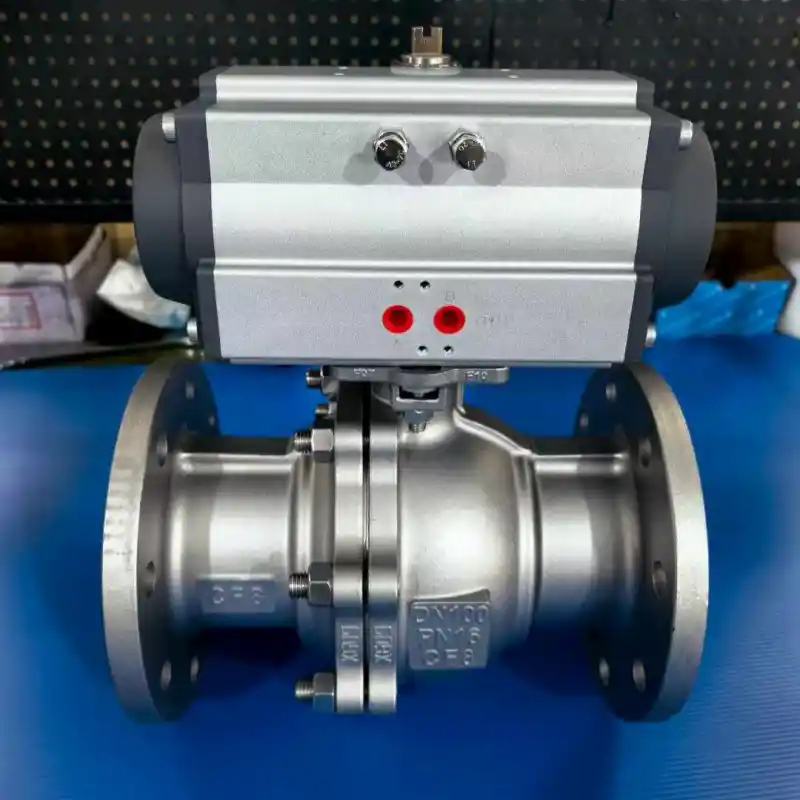
Effect of the 3‑piece pneumatic actuator ball valve structure on air consumption
The three‑piece ball valve body itself does not consume compressed air; all consumption comes from the associated quarter‑turn pneumatic actuator. For the same valve bore, if a larger‑torque actuator is fitted, its internal chamber volume increases, and the air consumption per single stroke rises accordingly. There is a clear difference in consumption logic between double‑acting and spring‑return single‑acting actuators:
-
Double‑acting: Compressed air is required in both the opening and closing directions. A full open‑close cycle consumes air in both strokes.
-
Spring‑return single‑acting: Air is supplied only for the powered stroke (e.g., opening); the return stroke is achieved by spring force and consumes no air.
How to read air consumption data from actuator sizing calculation tables
Manufacturer catalogues usually provide two definitions, which is a common source of confusion on site:
-
Single stroke – air consumption for one directional movement (open or close only);
-
Full cycle – air consumption for a complete open‑close‑open or close‑open‑close reciprocating cycle.
Actual consumption is strongly correlated with the test conditions. The industry standard test pressure is typically 0.5–0.6 MPa. If the actual on‑site supply pressure is higher than the catalogue test pressure, the actual consumption will exceed the nominal value, and a correction must be applied when sizing the compressor.
Energy cost considerations for air consumption pneumatic actuator ball valve
In high‑frequency on‑off service, the accumulated air consumption directly translates into electricity costs for the air compressor. Project evaluations should not look only at the purchase price of the valve; the annual number of valve cycles and the consumption per cycle must be included in the total life‑cycle cost calculation. For rapid cycling applications, an oversized actuator leads to sustained unnecessary air consumption overhead.
Cross‑comparison of energy consumption: air consumption pneumatic actuator ball valve vs. electric power consumption
When comparing alternative drive solutions, engineers often contrast the air consumption of a pneumatic ball valve with the power consumption of an electric ball valve. It is important to note that the energy baselines differ: pneumatic valves consume compressed air (which ultimately comes from the air compressor’s continuous electricity draw), while electric valves consume electricity only during the actuation moment and have very low standby power. For low‑frequency operation, electric drives have an advantage in energy efficiency; however, in explosion‑proof and high‑speed, high‑frequency switching scenarios, pneumatic solutions are still widely adopted.
Practical approach
To obtain the cycle air consumption for a pneumatic ball valve, first consult the actuator catalogue. Distinguish clearly between single‑stroke and full‑cycle definitions, and verify the actual on‑site supply pressure against the catalogue test condition. Then, combine the per‑valve consumption, total valve count, and actuations per hour, add a safety margin, and you can complete the basic sizing of the air compressor and receiver tank.