
Best Brass Ball Valve: How to Judge from Water Line Needs
“Best brass ball valve” looks like a search for one single answer, but in engineering procurement, “best” must correspond to the medium, the size, the connection, the operation, and the document requirements. A configuration suitable for general utility water is not necessarily suitable for compressed air, outdoor equipment, special cleaning, or product-contact systems.
A safer approach is to break “best” into comparable conditions: whether quick isolation is needed, whether full port is required, whether the size and connection match, whether the body and trim materials fit, whether the seat and seals meet the boundary, and whether the handle and inspection documents are in place.
Best Brass Ball Valve Brand: The Brand Is Not the Only Filter
Searchers of “best brass ball valve brand” usually want to reduce trial and error, but a brand name cannot replace model confirmation. Compare documentation completeness, model consistency, connection standards, material descriptions, after-sales communication, and inspection documents, rather than slogans or a single product photo.
If the project has clear requirements for the medium, hygiene, pressure, temperature, or traceability, write these conditions into the inquiry first and then compare replies from different suppliers. A brand can be a screening dimension, but it cannot by itself prove that a model fits the site. For a broader purchasing check, see our quality brass ball valve guide.
Best Brass Ball Valve for Water Supply: Check the Connection and Seals First
“Best brass ball valve for water supply” requires confirming the pipe standard, the size, the connection direction, the installation space, and the seal materials. A valve on a water supply branch may serve section isolation, equipment maintenance, or tank make-up; different functions lead to different handles, bores, and mounting positions.
If potable water, food contact, or hygienic requirements apply, a general brass configuration cannot be adopted just because the medium is water. Add material evidence, sealing requirements, and applicable standards. General utility water and product-contact water lines should be judged separately.
How Does “Best Ball Valve for Water Supply” Relate to Full Port?
“Best ball valve for water supply” does not always require full port. Full port, reduced port, pipe resistance, flow demand, and equipment connection should be judged by the system purpose; the selection logic for an isolation valve differs from that for a valve that also modulates flow.
In the purchase sheet, write “full port required” as an explicit design condition instead of treating it as a default advantage for every project. At the same time, confirm the upstream and downstream pipe sizes, filters, elbows, and other local resistances, so the decision is not made from the valve name alone.
Best No Lead Brass Ball Valves: The No-Lead Claim Needs Evidence
A search like “best no lead brass ball valves” touches material and regulatory boundaries. No-lead, low-lead, or region-specific compliance cannot be read from the product name alone; confirm the body, ball, stem, solder, seals, and the applicable testing or compliance documents.
If the project has no clear regulation or testing requirement, the buyer should also not write “no lead” into the order as an unconfirmed promotional conclusion. Confirm the destination, the medium, and the use scenario first, then request the corresponding documents from the supplier.
Best Ball Valve PTFE Seat: Choose the Seat Together with the Medium
“Best ball valve ptfe seat” only states one search direction; it does not mean a PTFE seat suits every temperature, medium, or operating frequency. The seat must be evaluated together with the ball surface, the seals, the pressure changes, and the cleaning conditions.
For special media or continuous operation, ask the supplier to state the applicable range for the specific model. For general isolation service, focus on the connection, the valve position, the seals, and the inspection documents, and avoid adding unnecessary configurations for the sake of a “best” label. A CHCV inquiry uses the same fields.
📌 Case Setting
Watts is an American water system products brand founded in 1874 by Joseph Watts, starting from the invention of the pressure-reducing valve and now providing water solutions for residential, industrial, municipal, and commercial fields. CHCV (Chengdu Chenggao Valve Co., Ltd., abbreviated as “Chenggao Valve”), as Watts’ cooperative supplier, provides body materials, seat materials, and documentation for different brass ball valve models. CHCV has long focused on the R&D and manufacture of industrial valves and pipeline valves, and its products are widely used in long-distance natural gas pipelines, refining, and petrochemical fields.
The project first grouped the requirements by water source, pipe material, size, connection method, mounting position, and maintenance frequency, and then asked CHCV about the matching boundaries of each model, rather than naming a “best” brand first. The Watts brass ball valve product line covers full-port and standard-port specifications, with end connections including threaded and soldered types, which can be selected flexibly for different application scenarios.
Key points of the technical judgment logic:
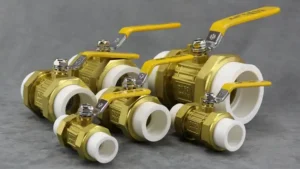
Water source and medium: for clean-water irrigation lines, a standard brass ball valve (such as the Watts W-FBV-3C-G series) can be selected; the series is compact and seals reliably, and it applies to water, oil, gas, and other media.
Pipe material and size: the connection method (threaded NPT or soldered) should match the pipe material (copper pipe, steel pipe, plastic pipe, and others); the size range covers DN8 to DN100.
Mounting position and maintenance frequency: for frequently operated points, a two-piece full-port ball valve is preferred to reduce pressure drop, such as the Watts LFB6080G2 series with a 600 psi WOG rating.
Seat materials: CHCV provides PTFE, reinforced PTFE, and other seat material options, which should be matched to the medium temperature (-40°C to 204°C) and the working pressure.
Important reminder: if the same batch of valves is later used for fertilizer solution, disinfectant, or product-contact water lines, the original water supply selection cannot be carried over automatically; the medium compatibility and compliance requirements must be rechecked. Brass materials may not resist certain fertilizer solutions (such as acidic or ammonia-containing fertilizers), and PTFE seats may also swell or degrade in specific chemicals. Always request the latest material compatibility documents from CHCV and reconfirm the selection.
⭐ Selection Sort: Turn “Best” into Five Questions
What medium does it isolate? Do the connection and size match the piping? Is there documentation for the body, trim, seat, and seals? Do the handle and installation space match? Can the supplier provide drawings and inspection documents corresponding to the model? Only when all five questions can be answered is it meaningful to compare price and brand.
Common Questions
FAQ 1: Is there a best brass ball valve that suits every scenario?
No. Whether a valve fits depends on the medium, size, connection, material combination, operating method, and document requirements; “best” must be judged within a specific working condition.
FAQ 2: Is a PTFE seat always better than other seats?
Not necessarily. The seat must match the medium, temperature, pressure, ball, and operating method, and should follow the specific model documentation.