
When industrial processes impose stringent demands on fluid control, the reliability of a pneumatic operated ball valve often determines the operational safety of the entire system.
As a purchaser or engineer, when facing numerous pneumatic operated ball valve manufacturers, how can you see through surface-level pricing and evaluate the intrinsic quality of the valve?
This article will deconstruct the evaluation criteria for high-quality pneumatic ball valves from two dimensions: material science and actuation matching.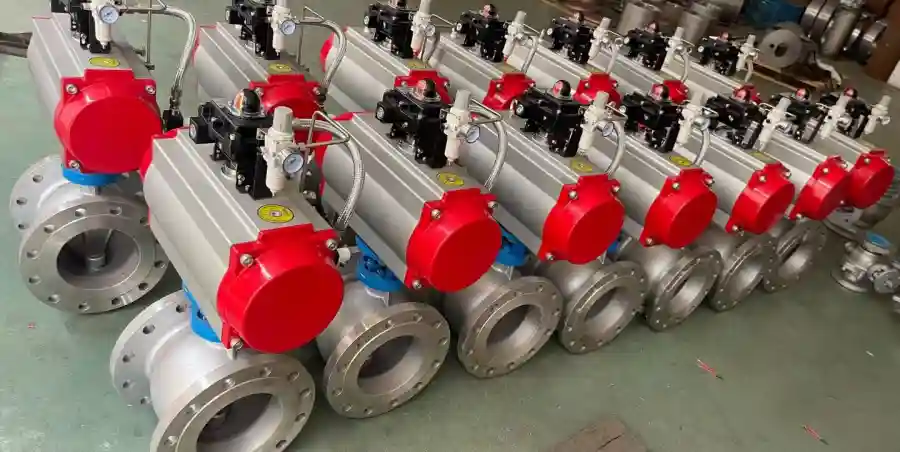
1. Valve Body Material: The Process Gap Between Forged and Cast
Many purchasers focus on the valve body material (e.g., 316 stainless steel or carbon steel) but tend to overlook a critical detail – the forming process of the ball. As the core component that directly contacts the media and undertakes sealing, the ball’s density is of paramount importance.
-
Solid Forged Ball: Through high-pressure forging, the internal grain structure of the metal becomes denser, eliminating internal defects such as porosity and pinholes. Under high-frequency cycling or high-differential-pressure conditions, a forged ball maintains geometric accuracy, ensuring proper sealing pair contact.
-
Cast Ball: Although lower in cost, castings may contain microscopic shrinkage cavities or sand holes. These tiny voids can become starting points for fatigue cracks under pressure fluctuations, leading to ball deformation or sealing surface leakage.
An excellent pneumatic operated ball valve supplier will explicitly specify “Forged Ball” or “Solid Forged Ball” in the technical parameters. If the supplier cannot confirm that the ball is solid forged, the long-term stability of the valve becomes questionable. This is also the primary detail for examining the production capability of pneumatic operated ball valve suppliers.
2. Safety Margin of Operating Torque
A pneumatic ball valve relies on a pneumatic actuator to rotate the valve stem. If the actuator output torque is insufficient, the valve may fail to close completely or may stick during opening. The core of quality control lies in the precise matching between actuator torque and valve torque.
Industry practice dictates that the actuator output torque should be at least 1.2 to 1.5 times the valve’s maximum breakaway torque.
-
1.2x safety margin: Suitable for stable operating conditions, clean media, and low switching frequency.
-
1.5x safety margin: When the media contains particulates, temperatures vary widely, or the valve remains inactive for long periods (e.g., emergency shutdown valves), a higher safety margin helps overcome static friction between the seat and ball, as well as resistance from possible deposits.
Professional pneumatic operated ball valve manufacturers will provide measured breakaway torque curves under different pressures, rather than relying solely on empirical estimation. If a supplier cannot provide a torque calculation sheet or selection table, it indicates a lack of necessary technical verification capabilities.
3. Accessory Integration and Response Speed
Beyond the body and actuator, the reliability of accessories is equally an extension of overall quality. The response speed of solenoid valves, the precision of limit switches, and the pressure regulation stability of filter-regulators all affect the control quality of the entire valve. When evaluating pneumatic operated ball valve suppliers, you should consider whether they offer a complete accessory integration solution and optimized pneumatic routing recommendations – this directly impacts on-site installation convenience and long-term system maintainability.
Choosing a reliable pneumatic operated ball valve manufacturer cannot be based solely on price or surface coating. Digging deeper – asking “Is the ball forged or cast?” and “Does the actuator torque have a 1.2–1.5x safety factor?” – is an effective way to identify a supplier’s expertise and sense of responsibility.
A truly reliable pneumatic operated ball valve manufacturer will have the confidence to show clients the details of their manufacturing processes and the calculation logic behind their torque matching.