
In industrial fluid control systems, ball valve selection directly impacts production‑line efficiency and maintenance costs. When piping designs require frequent media switching or regular overhaul, the 3‑piece ball valve stands out as the preferred choice for professional engineers thanks to its unique mechanical construction.
Unlike one‑piece or 2‑piece designs, the core value of the 3‑piece ball valve lies in its service‑friendly dismountable structure and performance under extreme operating conditions.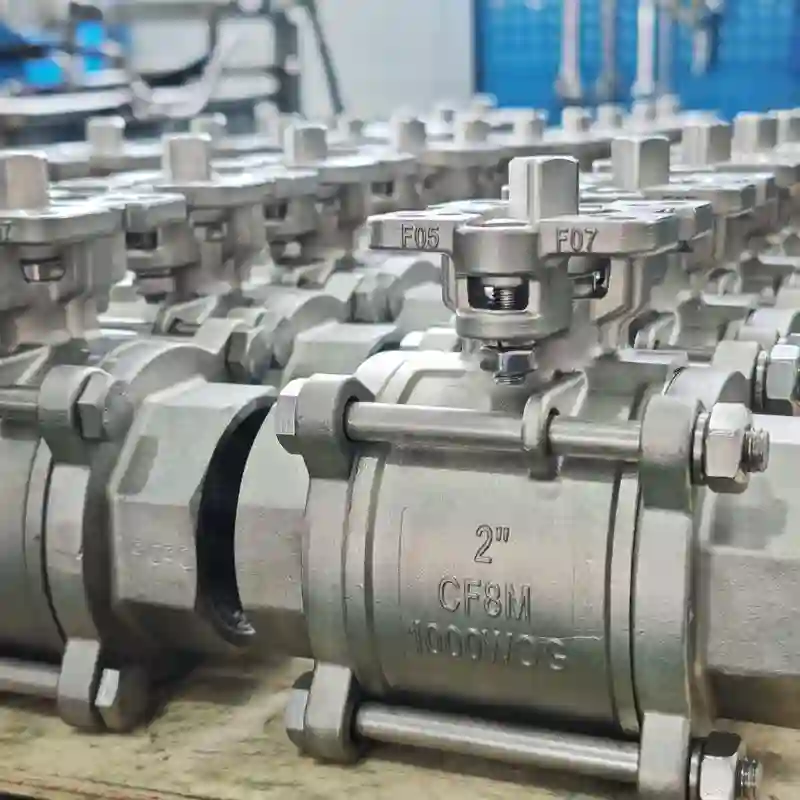
What is a 2 piece and 3 piece ball valve?
To understand the strengths of the 3‑piece design, it is essential to distinguish the structural differences between 2‑piece ball valve and 3‑piece ball valve.
2‑piece ball valve: Consists of two main components (normally valve body and bonnet) fastened together via threads or bolts, with the ball clamped in‑between. This design features a compact footprint, light weight and relatively low cost. It is suitable for normal‑temperature, low‑pressure services where frequent disassembly and cleaning are not required.
Nevertheless, once seats or seals wear out, a 2‑piece ball valve usually has to be fully removed from the pipeline. The removal process may damage threads, resulting in high‑difficulty repairs.
3‑piece ball valve: Composed of a central body (housing ball and seats) plus two end connections, assembled with through‑bolts. Its most prominent feature is that full removal of the valve from the pipeline is unnecessary for maintenance. Simply loosen the bolts on the central body, and the central cartridge can be extracted for seal replacement or internal cleaning. This on‑line maintenance capability represents the fundamental difference between the two designs.
What is a 3 piece ball valve?
A 3‑piece ball valve is a split‑pattern block valve. Its internal ball is typically a Floating ball, which relies on seat pressure at both ends to push the ball toward the outlet side and achieve sealing. Benefiting from its removable central cartridge, this valve delivers reliable performance under harsh conditions such as high‑temperature, high‑pressure service or media carrying particulate solids.
When the Seat deforms and ages after long‑term operation, on‑site sealing performance can be quickly restored using a 3 piece ball valve repair kit. This feature greatly cuts unplanned downtime for steam distribution, high‑temperature hot‑oil systems, and food/pharmaceutical piping that requires periodic cleaning.
3 Piece Ball Valve Disassembly and Maintenance
The 3 piece ball valve disassembly procedure is highly standardized. Operators remove bolts on the central cartridge, then axially pull out the complete module containing the Ball and Seat. Compared with welded or monolithic valves, this configuration grants direct access to core internal components without disturbing welded or threaded end connections.
For high‑sanitation grades or media prone to crystallization, this structure is widely adopted in 3 piece ball valve homebrew and small‑scale industrial equipment. It delivers Full bore geometry with no dead pockets, and no threaded crevices to trap contaminants. After disassembly, ample working space is available for removing coke deposits or polishing ball surfaces.
Advantage of Three Piece Ball Valve
The Advantage of three piece ball valve is most evident in maintenance expenditure. Although the initial procurement cost of a 3‑piece ball valve is slightly higher than that of a 2‑piece unit, it offers a lower Life Cycle Cost. When internal leakage occurs, only the 3 piece ball valve replacement o ring or seats need replacing, rather than scrapping the entire valve body.
Additionally, for high‑temperature applications, the 3‑piece arrangement allows high‑grade specialty alloys (e.g. stainless steel 316 or duplex steel) to be used exclusively for the central cartridge, while standard carbon steel is deployed for end connections. Corrosion resistance is preserved while optimizing material expenditure.
Its robust bolted construction also yields higher pressure ratings (Class 300‑600), capable of withstanding water hammer and piping stress.
3 Piece Ball Valve Seal Kit and Application
Valves fitted with a 3 piece ball valve seal kit offer great flexibility for field maintenance. A seal kit generally contains PTFE or reinforced seats, V‑packing, and stem O‑rings.
When temperature fluctuations in process media alter seal preload, operators can easily eliminate minor stem leakage by adjusting bolt torque on the central body — an advantage difficult to achieve with alternative designs.
For certain processes where Deadleg in piping is prohibited, modified full‑weld‑variant 3‑piece ball valves (bolted construction with custom zero‑cavity geometry) can prevent media sedimentation.
Furthermore, low operating torque makes it well‑suited for actuated ball valve setups; reduced seal friction significantly extends actuator service life.
Summary
Specifying a 3‑piece ball valve essentially means adopting a predictable, controllable maintenance strategy. For industrial users prioritizing continuous production and reduced long‑term operating expenditure, the 3‑piece design delivers convenient repairability, interchangeable spare parts, and tolerance for extreme temperatures. For pipeline sizes below 6‑inch, it provides superior engineering economy compared to 2‑piece and monolithic ball valves.