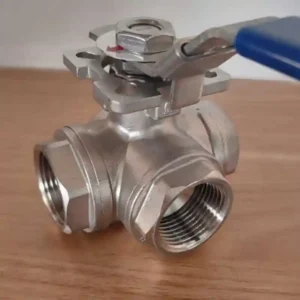

When sourcing three-way ball valves, buyers often search for manufacturers first before asking about applications.
If you select a three-way ball valve with the wrong port configuration, pressure class or actuator, installation and operation will become troublesome later.
Therefore, you should clarify product specifications, testing requirements, documentation and delivery terms upfront. This text first compares different types of manufacturers, then explains the purpose of three-way valves, installation locations, and scenarios requiring valve opening.
Global Landscape of Three-Way Ball Valve Manufacturers: Comparison by Region and Capability
Chinese Manufacturers: Strong OEM Capability & Cost Control
China boasts a concentrated valve supply chain with a wide selection of three-way ball valves. Common constructions include 1PC, 2PC, 3PC, with end connections ranging from threaded, flanged, welded to tri-clamp. Available materials cover brass, stainless steel 304/316, carbon steel, PVC, CPVC and UPVC.
Chinese factories usually respond faster if your project requires custom port designs, laser marking, locking devices, extended stems, or bulk orders of manual, pneumatic and electric three-way ball valves. Most users searching for 3 way ball valve manufacturer in china are looking for this range of supply capabilities.
Nevertheless, there are large gaps among Chinese manufacturers. You need to verify their stable casting/forging sources, machining equipment, pressure test benches, material certificates and export packaging experience. A low unit price does not equal a lower total cost of ownership.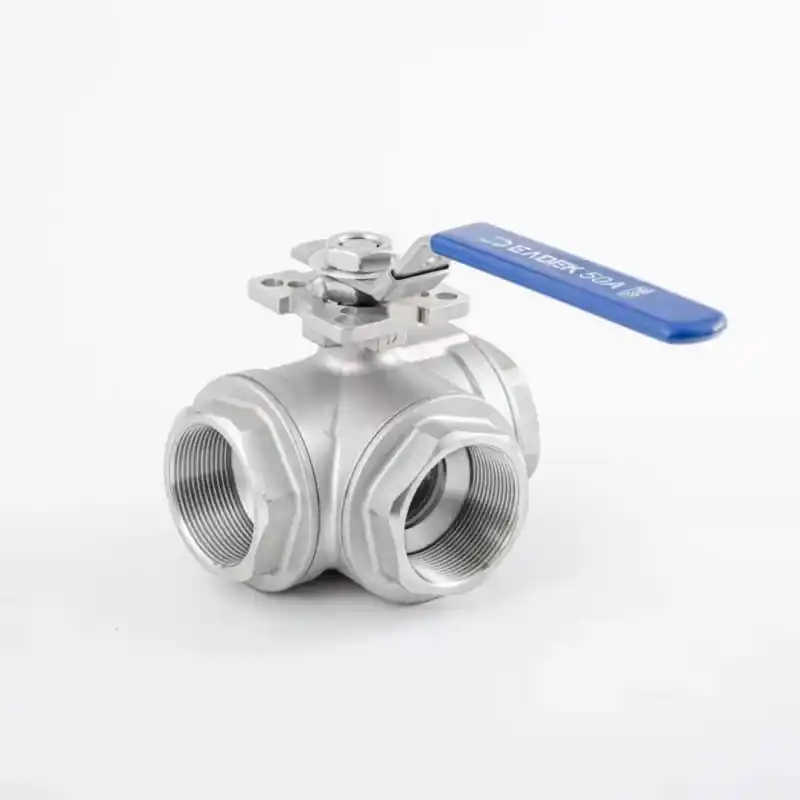
European Manufacturers: Solid Expertise in Brass, HVAC and Gas Applications
Manufacturers from Italy, Germany and other European countries have rich experience in brass ball valves, gas ball valves and HVAC valves. They frequently serve building automation, closed water systems, heating and civil gas projects.
Their strengths lie in standardized documentation, strong brand recognition and complete certifications for certain applications. Drawbacks include higher pricing, longer lead times, and customisation flexibility that may not exceed Chinese factories. If your project specifies European brands, lock in lead times in advance.
US Manufacturers: Oil & Gas, High Pressure and Fire Safety Certification Focus
US manufacturers excel in oil & gas, high pressure, fire protection applications, and standards such as API 6D, API 6A, API 607/6FA. They commonly supply trunnion mounted ball valve, metal seated ball valve and flanged ball valve.
If your project requires a high pressure 3 way ball valve supplier with full API documentation, fire testing and NACE compliance, US or selected European manufacturers will be shortlisted. However, you need to allow extra budget and lead time.
Indian and Asia-Pacific Manufacturers: Local Projects & Mid-Tier Market
Indian manufacturers hold price advantages for local EPC projects and mid-range industrial valves. Some manufacturers in Japan, South Korea and Singapore have accumulated expertise in precision automation, sanitary and marine applications.
When selecting manufacturers from this category, confirm matching standard systems. Mixed standards such as DIN, JIS, BS and ANSI may result in mismatched flange bolt holes, threads and face-to-face dimensions.
8 Hard Criteria to Screen Three-Way Ball Valve Manufacturers
- Port configuration: L port, T port or double L port. L port is widely used for switching and diversion; T port is used for confluence, diversion and bypass. When looking for a 3 way ball valve l port factory in china, request port schematic drawings.
- Pressure class: 1000 WOG, 2000 WOG, 3000 psi, 6000 psi, ANSI 150/300/600/900/1500/2500. Never judge only by nominal size.
- Temperature and sealing: PTFE, RTFE, PEEK, metal seat. Verify separately for steam, cryogenic and thermal oil services.
- End connection: NPT, BSP, BSPT, flanged, socket weld, butt weld, Tri-Clamp, PVC socket. A mismatch in thread standards will prevent assembly.
- Actuator interface: ISO 5211 mounting flange, output shaft size, limit switches and feedback signals. When sourcing a pneumatic three way ball valve supplier, also confirm air supply pressure, action type and fail-safe position.
- Testing and documentation: Shell test, seat test, API 598, EN 12266, material certificates, EN 10204 3.1, anti-static and fire-safe design.
- Customisation capability: Extended valve stem, locking handle, mounting bracket, OEM nameplate, special cleaning and degreasing.
- Lead time and after-sales service: Stock availability for standard models, lead time for non-standard items, spare parts package, actuator matching and installation instructions.
why use 3 way valve: Why Three-Way Ball Valves Are Used in Systems
The value of a three-way ball valve is more than simply “an extra port”. It consolidates the function of two 2-way valves plus a tee fitting into a single valve body.
This reduces connections and leakage points, saves installation space and simplifies operation. Operators can change media flow direction simply by turning the handle or sending a signal to the actuator.
Typical applications:
- Switching between main pump and standby pump
- Heat exchanger commissioning and bypass
- Cold and heat source switching
- Flow confluence and diversion
- Cleaning circuits
- Bypass for compressed air dryers
- Hydraulic circuit reversing
- Irrigation zone control
- Sanitary pipeline switching
For closed-loop water systems, users searching for best three way ball valves for closed loop water systems shall focus on flow resistance, seal service life, actuator feedback and bypass logic. Three-way valves are commonly installed near boilers, chillers, cooling towers and plate heat exchangers to maintain flow rate or switch circuits.
To understand operation, learn how a three way ball valve works. The ball has an L-shaped or T-shaped flow passage. L port usually performs 90° switching; T port can enable communication among all three ports or pairwise connection. Different port schematics define the valve’s flow path at each position.
where to put the 3 way valve: Reasonable Installation Positions
Three-way ball valves shall be installed at nodes requiring flow direction change or flow distribution, rather than randomly fitted on straight pipe sections.
Common installation locations:
- Pump outlet bypass: Prevent pump dead-head when the outlet valve is closed.
- Heat exchanger inlet: For commissioning, bypass or cleaning.
- Between boilers and chillers: For cold and heat source switching.
- Cooling tower supply and return lines: For bypass and flow regulation.
- Water treatment systems: For filter, softener and backwash switching.
- Main irrigation pipeline: For zoned water supply.
- Compressed air systems: For dryer bypass.
- Hydraulic power unit: For reversing or unloading.
- Sanitary pipelines: For switching between cleaning fluid and product media.
Four key installation notes:
- Align flow arrows with port schematics. L port and T port have different opening geometries; incorrect installation will alter operation logic.
- Mount handles or actuators for easy operation and maintenance. Leave disassembly clearance for electric and pneumatic actuators.
- Valve stem orientation: preferably upward or horizontal. A downward stem easily accumulates water and dust and complicates maintenance.
- Support piping for high-pressure and large-bore valves. Torque and vibration are generated during actuator stroke; the valve body alone cannot bear these loads.
why do we need to open the 3 way valve: Reasons to Open the Three-Way Valve
Opening a three-way ball valve is generally to establish a new flow path, such as bringing a standby pump online, enabling heat exchanger bypass, introducing cleaning fluid into the circuit, or returning excess flow back to the tank.
However, “opening” does not mean arbitrarily turning the handle. Always confirm system status and port logic first.
Examples: Opening the pump outlet bypass valve maintains minimum pump flow. Opening the heat exchanger bypass allows maintenance or cleaning without shutting down the whole system. Opening the cold/heat source switching valve transfers load from one unit to another.
Operation sequence matters: Open bypass first then close the main line; equalise pressure before switching. Operate high-pressure gas and steam systems slowly to avoid water hammer and shock.
For electric or pneumatic three-way ball valves, check limit switches and feedback signals. Actuator reaching the set position does not guarantee correct pipeline flow logic. An L-port valve at the 90° position may only connect two ports, while a T-port valve at the mid-position may connect all three ports. Verify port schematics before operation instead of relying solely on handle position.
Three-way ball valves are not the first choice for precise flow regulation. They are designed mainly for on/off and switching duties. For modulating control, consider V-port ball valves or dedicated control valves.
CHCV Valves’ Position in Three-Way Ball Valve Supply
CHCV Valves serves global procurement and engineering users, providing three-way ball valve selection consultation, drawing confirmation, material and pressure class matching, actuator assembly and OEM supply.
Product coverage includes L-port / T-port three-way ball valves, stainless steel and brass bodies, threaded and flanged ends, manual/pneumatic/electric actuators, high-pressure models, and applications in closed-loop water systems, HVAC, water treatment and industrial piping.
For buyers, compiling a one-page selection sheet listing media, temperature, pressure, nominal size, end connection, port diagram, actuator signal and certification requirements helps obtain accurate quotations far better than simply asking “how much”.
FAQ
why use 3 way valve? A single three-way valve can perform diversion, confluence or switching, reducing installation space and leakage points compared with two 2-way valves plus a tee fitting.
where to put the 3 way valve? Install at nodes requiring flow direction change, such as pump outlet bypass, heat exchanger inlet, cold & heat source switching, water treatment backwash and irrigation zoning.
why do we need to open the 3 way valve? Opening establishes bypass, switches standby equipment, cleans circuits, vents air, prevents freezing or maintains minimum pump flow. Closing is for isolation and maintenance.
How to select L port vs T port? L port fits 90° switching and diversion; T port fits confluence, diversion and bypass. Final selection depends on port schematics and system logic.
Conclusion
Leading Chinese three-way ball valve manufacturers offer flexible OEM solutions, cost advantages and delivery terms. European manufacturers have deep expertise in brass, HVAC and gas applications. US manufacturers are strong in oil & gas, high pressure and fire safety certifications.
During procurement, clarify your application first before comparing manufacturers. Confirm L/T port type, pressure class, end connection, sealing material, actuator and testing documentation.
Only with this selection process can your three-way ball valve perform switching, bypass and isolation as expected after installation in the system.