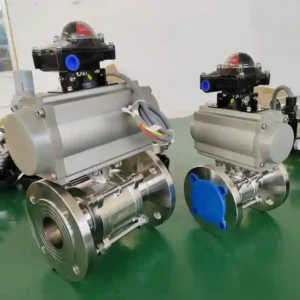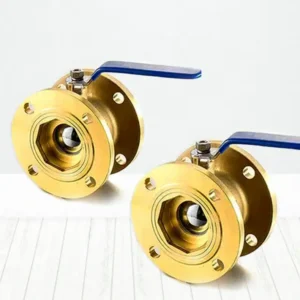

Many purchasers and installers pay attention to handle colour when selecting ball valves. Black handles are a very common configuration on the market.
Many users wonder whether a black handle represents a specific medium, as well as practical handle-related questions: how the handle works, whether it can be reverse-mounted, and whether gas ball valves must be fitted with a handle.
I. What does a black handle on a ball valve mean
Handle colour is an auxiliary identification mark. There is no mandatory national or ISO standard worldwide that ties black handles to a certain medium.
The widely used 2-piece threaded ball valve is factory-supplied mostly with black nylon or phenolic handles. Here, black is merely the default colour of the handle shell and does not directly correspond to the medium type.
Some industry conventions can be used for reference:
- Black handles are commonly used for oil products, general process fluids and ordinary water systems;
- Yellow handles are mostly for gas media, blue for cold water, and red for hot water / fire protection pipelines.
⚠️ Important reminder: Do NOT judge medium compatibility solely by handle colour. For the same ball valve with a black handle, the body material and sealing materials are the core factors determining medium compatibility. For complex working conditions, refer first to the valve nameplate and product data sheet instead of handle colour. Many 1000 wog ball valve high-pressure general-purpose ball valves come with black handles from factory, whether used for water or oil service.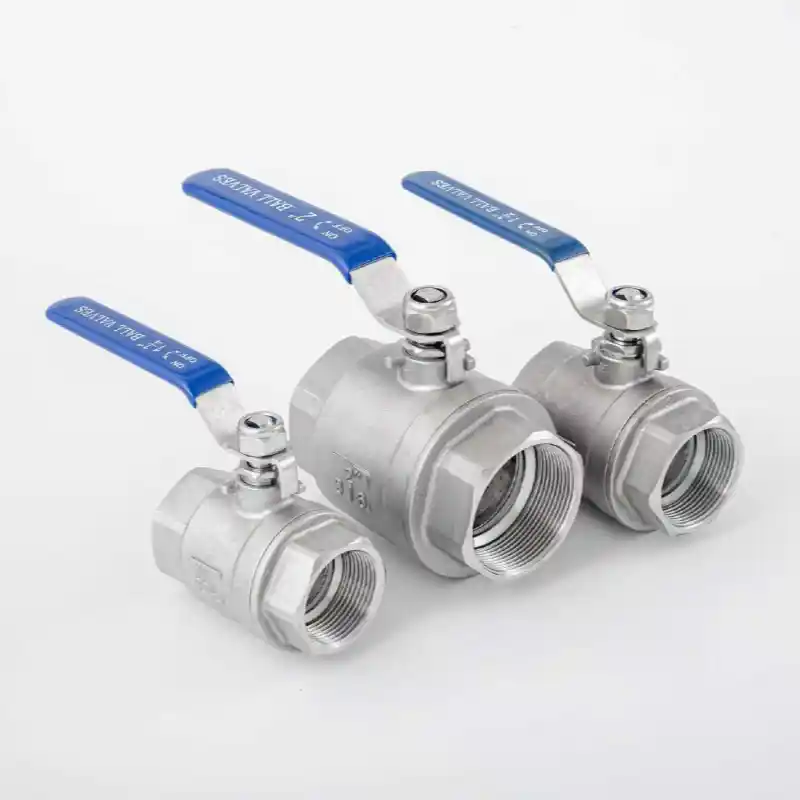
II. how do valve handles work: Operating principle of ball valve handles
Ball valves are quarter-turn valves. The handle directly drives the stem and rotates the internal ball; only a 90° turn is required for full open or full close.
Handle position provides a clear visual indication:
- Handle parallel to the pipeline axis → valve open;
- Handle perpendicular to the pipeline axis → valve closed.
A full port ball valve with a standard handle delivers moderate operating torque for easy manual operation. The handle has built-in stop limit structures that lock at the open and closed positions to prevent accidental rotation.
The handle only transmits torque and indicates valve status. Handle colour and shell material will not change the internal sealing or flow capacity of the valve.
III. how to reverse handle on ball valve: Can ball valve handles be reversed?
After installation, many users find the handle orientation awkward, blocked by pipes or walls, and ask whether the handle can be reversed.
For most standard manual ball valves, the handle can be repositioned: depressurise the line, remove the handle retaining screw, take off the handle, rotate it to the desired angle and reinstall to change handle direction.
There are two critical limitations:
- After handle reversal, the position logic (“parallel = open, perpendicular = closed”) remains unchanged; the ball structure itself is not altered.
- Lockable ball valve with limiting lugs and lock holes cannot have the handle reversed arbitrarily. Forced reinstallation will damage the limiting structure, removing switch positioning and making valve status unidentifiable. After disassembly and reassembly of a lockable ball valve handle, verify that the lock can still engage correctly at both open and closed positions.
Do not disassemble the handle on a pressurised pipeline. Always release internal line pressure before operation.
IV. do gas valves need a handle for shut off: Must gas ball valves have a handle?
For gas ball valves, the original complete handle is strongly recommended, but valve type must be distinguished.
- Ordinary manual gas ball valve: A handle is required for manual opening and closing. Without a handle, the stem cannot be rotated by hand. Wrenches or pliers are not permitted as permanent substitutes; they may slip and wear the stem flat, leading to valve failure and leakage. Many gas-specific ball valves use yellow handles, but gas ball valves with black handles also exist. Handle colour is not equivalent to gas certification. Gas suitability is verified via valve certification reports, not handle colour.
- Spring-loaded self-closing gas valve: This is a special design that closes automatically by spring mechanism. It is not a conventional manual ball valve and is excluded from this discussion.
When purchasing gas ball valves, confirm the handle is complete, and check thread specification, pressure rating and medium certification. Do not make judgements based only on handle appearance.
V. Summary for ball valve handle selection during procurement
- Handle colour serves only as on-site auxiliary identification and cannot be the sole criterion for medium selection; black handles are widely used for general service.
- Prioritise core valve parameters: body material, pressure rating such as 1000 wog ball valve, flow structure full port ball valve, before considering handle style.
- If installation space is limited on site, confirm in advance whether the ball valve supports handle reorientation. For lockable ball valve, recheck limit and lock function after handle disassembly and reassembly.
- For gas service, ensure the original handle is intact and verify product medium certification. Do not rely on handle colour to confirm gas compatibility.
Common QA
Q: Can a ball valve with a black handle never be used for gas? A: No. Some gas ball valves adopt black handles. Gas suitability depends on the certification of valve body and sealing rings. Handle shell colour does not decide medium compatibility.
Q: The handle is broken. Can the ball valve still be used? A: Continued use is not recommended. The stem flat can easily be damaged by tools, bringing risks of switch failure later. Replace with a matching original handle kit.
Q: Can all ball valve handles be reverse-mounted? A: Most ordinary 2-piece threaded ball valve without locking structures support this operation; ball valves with integrated limit and lock handles cannot be reversed arbitrarily.